
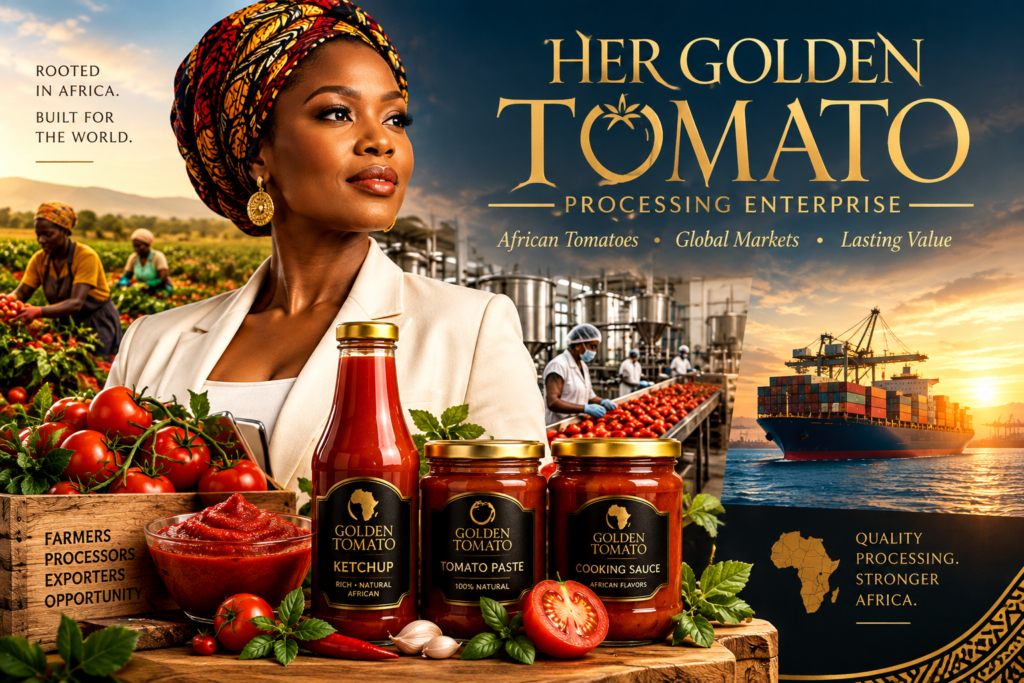
HER GOLDEN TOMATO EMPIRE
Turning Africa’s tomato gap into a shelf-stable food business, from the African tomato field to the supermarket shelf
There is something almost absurd about the tomato business in Africa.
The continent grows tomatoes. Lots of them.
Yet supermarkets, restaurants, wholesalers and food manufacturers across African markets continue to import tomato paste, preserved tomatoes, ketchup and tomato sauces from China, Italy, Egypt, Kenya, Turkey and elsewhere.
That is where the opportunity begins.
Not necessarily with building a giant tomato factory.
And certainly not with competing head-to-head with the world’s biggest tomato processors on day one.
The more interesting opportunity is to take one of Africa’s most familiar crops and move it one or two steps further up the value chain — from fresh tomato to a branded, shelf-stable product that can travel.
That product might be tomato paste.
It might be ketchup.
It might eventually become a whole family of African tomato products: cooking sauce, pizza sauce, chilli tomato sauce, pasta sauce, tomato relish and institutional foodservice packs.
The trade numbers suggest there is room.
THE OPPORTUNITY
Africa’s tomato opportunity is not simply about growing more tomatoes.
It is about preserving them, concentrating them, packaging them and moving them into markets where consumers already spend money on imported products.
The international trade data tells the story.
For trade purposes, HS 200290 covers tomatoes preserved other than by vinegar and includes many processed tomato preparations, while HS 210320 covers tomato ketchup and other tomato sauces. These categories are therefore useful indicators of the commercial market, although they should not be treated as a perfect measure of tomato paste alone.
And some of the numbers are striking.
In 2024, Ghana reported approximately US$44.95 million of imports under HS 200290, with China accounting for approximately US$43.48 million. (World Integrated Trade Solution)
That means Ghana alone was bringing in tens of millions of dollars’ worth of preserved tomato products while an African tomato-processing opportunity was sitting much closer to home.
China’s export data makes the dependence even more visible: China reported approximately US$69.82 million and 83.27 million kilograms of HS 200290 products exported to Ghana in 2024. (World Integrated Trade Solution)
The precise values reported by exporting and importing countries do not always match because customs datasets can differ in valuation, timing and reporting methodology. For that reason, the importing country’s reported figure is the more useful number when examining the size of its domestic import bill.
The African import gap
| Market | 2024 preserved tomato imports, HS 200290 | What stands out |
|---|---|---|
| Ghana | US$44.95M | China supplied about US$43.48M |
| Kenya | US$3.71M | Egypt supplied US$3.12M |
| Uganda | US$5.45M | Almost 4 million kg imported |
| Niger | US$6.54M | Ghana supplied US$4.64M |
| Tanzania | US$0.52M | About 1.56 million kg imported |
Sources: World Bank WITS/UN Comtrade, 2024. (World Integrated Trade Solution)
Ghana is particularly interesting because the market demonstrates the scale of the gap rather dramatically. A country does not need to eliminate a US$45 million import bill to create a successful domestic business. Capturing even a small fraction of an established market can be meaningful.
But there is another lesson hiding in the numbers.
Africa is already capable of exporting tomato products to Africa.
In 2024, Ghana exported preserved tomato products to Niger worth approximately US$4.64 million, representing more than 5 million kilograms. Ghana also exported smaller quantities to Togo, Burkina Faso, Côte d’Ivoire, Canada, the United States and other markets. (World Integrated Trade Solution)
Ghana therefore provides something more valuable than a theoretical example.
It provides evidence that an African tomato-processing company can manufacture for its own market and cross a border with the finished product.
Then there is East Africa.
Tanzania’s 2024 ketchup and tomato-sauce trade is particularly revealing.
Tanzania imported approximately US$1.28 million, or 2.71 million kilograms, of ketchup and other tomato sauces. Kenya was the largest supplier at approximately US$518,000. (World Integrated Trade Solution)
At the same time, Tanzania reported approximately US$4.79 million of exports of ketchup and tomato sauces — more than three times the value of its reported imports. Rwanda accounted for approximately US$4.69 million of those exports. (World Integrated Trade Solution)
This is important.
The East African opportunity is not merely Can we manufacture ketchup?
It is:
Can an African producer manufacture a product that travels successfully across African borders?
The answer, based on existing trade, is yes.
Kenya is another useful example. It exported approximately US$1.46 million of ketchup and tomato sauces in 2024, with Tanzania and Uganda accounting for the largest destinations. (World Integrated Trade Solution)
Uganda exported approximately US$1.21 million, overwhelmingly to the Democratic Republic of Congo. (World Integrated Trade Solution)
This begins to reveal a regional network rather than isolated national markets.
THE SOLUTION
The smartest entry point is not necessarily a giant paste-processing plant.
There are actually three different tomato businesses hiding inside the idea.
The first is the low-entry model: the brand.
A woman does not have to own the tomato factory.
She can develop the brand, recipe, packaging, market and distribution strategy while working with an established food processor or co-packer.
This changes the economics completely.
Instead of purchasing industrial evaporators, vacuum systems, concentrating equipment, sterilisation systems, filling lines and industrial packaging machinery, the entrepreneur purchases production capacity from someone who already has it.
Her company owns the customer relationship and brand.
That makes a premium African ketchup, cooking sauce or chilli-tomato sauce considerably more accessible as a first business.
The second is the processor.
Once volumes justify it, the business can move into its own processing facility.
Fresh tomatoes are washed, sorted and processed into a concentrated or formulated product. The business then packages that product for supermarkets, wholesalers, restaurants, hotels, schools and food manufacturers.
This is where tomato paste becomes interesting — but also where the capital requirement rises.
Tomato paste is fundamentally a concentration business.
A commercial processor needs to manage tomato quality, solids/Brix, water removal, heat treatment, food safety and packaging. The economics therefore depend heavily on obtaining sufficient quantities of suitable tomatoes at the right price and moving them into processing quickly.
This is not the same business as making a small batch of ketchup in a commercial kitchen.
The third is the ingredient business.
This may actually become one of the most interesting long-term opportunities.
Instead of selling only jars and bottles to consumers, an African processor could sell tomato paste or concentrated tomato ingredients in larger formats to restaurants, hotels, caterers, food manufacturers and other sauce producers.
The customer may never care what the consumer-facing brand looks like.
They care that the tomato ingredient is consistent, safe, concentrated and available.
That creates a B2B market alongside the retail market.
WHY KETCHUP MAY BE THE LOWER-ENTRY DOOR
Ketchup has a major advantage for a smaller entrepreneur: you are selling a finished consumer product rather than trying to compete with industrial tomato-paste producers on processing scale.
The formula can incorporate tomato concentrate alongside vinegar, sugar, salt and spices, subject to the food regulations and product standard applicable in the target market.
That creates room for differentiation.
The African opportunity does not have to be another bottle of generic red ketchup.
It could be a distinctly African pantry product.
Think roasted tomato and chilli.
Smoky tomato.
Tomato and tamarind.
Tomato and pili pili.
Tomato and ginger.
Tomato sauce designed specifically for grilled meat, chips, eggs, rice, plantain or African street food.
The point is not novelty for its own sake.
The point is to create a product that gives consumers a reason to choose an African brand rather than simply substituting one imported ketchup for another.
And the trade data shows that consumers are already buying the category.
Kenya’s 2024 ketchup imports were approximately US$2.16 million, equivalent to about 1.87 million kilograms. (World Integrated Trade Solution)
Uganda imported approximately US$2.97 million and 2.55 million kilograms. China supplied approximately US$1.42 million, while Kenya supplied another US$562,000. (World Integrated Trade Solution)
Tanzania imported approximately US$1.28 million and 2.71 million kilograms. (World Integrated Trade Solution)
And Jamaica — an especially interesting diaspora-market example — imported approximately US$2.02 million and 1.17 million kilograms of ketchup and tomato sauces in 2024. (World Integrated Trade Solution)
That opens a fascinating future route:
African production → African regional markets → Caribbean and diaspora markets.
THE POTENTIAL
The real opportunity is not the tomato.
It is the value added to the tomato.
A fresh tomato is highly perishable.
A properly processed and packaged tomato product can sit on a supermarket shelf for months rather than days, allowing the producer to sell outside the immediate harvest period and outside the immediate farming region.
That changes everything.
Fresh tomato → processing → shelf-stable value
| Product | Perishability | Processing complexity | Transportability | Brand potential |
|---|---|---|---|---|
| Fresh tomatoes | High | Low | Low–medium | Medium |
| Tomato pulp | High | Medium | Medium | Low |
| Tomato paste | Low | High | High | High |
| Ketchup | Low | Medium | High | Very high |
| Cooking sauce | Low | Medium | High | Very high |
| Foodservice tomato sauce | Low | Medium | High | High |
The strongest business may ultimately be a portfolio, rather than a single product.
A consumer might buy a 500g cooking sauce.
A restaurant might buy a 5kg foodservice pack.
A manufacturer might buy a bulk tomato concentrate.
A supermarket might commission a private-label version.
One processing relationship can therefore support several revenue channels.
There is also a supply-side opportunity.
Tomatoes create a difficult agricultural problem because harvests are seasonal while consumers want tomato products throughout the year.
That makes processing an agricultural stabiliser.
Instead of asking farmers to somehow make fresh tomatoes survive a long supply chain, the processor can purchase suitable tomatoes during periods of availability and convert them into a product designed for storage and distribution.
But this only works if the factory is designed around the farming reality.
A common mistake would be to build the factory first and search for tomatoes later.
The better model is to establish farmer relationships, identify production zones, understand the harvest calendar, agree quality specifications and then design processing capacity around realistic supply.
THE TOMATO PASTE QUESTION
Tomato paste is attractive because it is already a major traded ingredient.
But it is also where entrepreneurs can underestimate the capital requirements.
Industrial paste production requires considerably more than a pot, blender and filling machine.
The economics are affected by:
tomato solids, yield, water removal, energy, processing speed, cold-chain or transport requirements for fresh tomatoes, packaging, quality control and factory utilisation.
The biggest industrial processors also benefit from scale.
That is why a small entrepreneur should not automatically conclude:
“I need to build a tomato-paste factory.”
The more useful question is:
Where is the smallest point in the value chain where I can capture margin?
That might initially be a branded ketchup.
It might be a cooking sauce.
It might be a private-label product.
It might be a foodservice tomato sauce.
And eventually it could become paste.
THE IMPORT GAP IS NOT THE WHOLE STORY
There is another factor worth noticing.
Africa’s tomato trade is not simply a story of foreign products entering African countries.
African countries are already trading tomato products with each other.
Tanzania exported approximately US$4.79 million of ketchup and tomato sauces in 2024, principally to Rwanda. Kenya exported US$1.46 million, mainly to Tanzania and Uganda. Uganda exported US$1.21 million, principally to the DRC. (World Integrated Trade Solution)
That suggests a possible regional strategy:
Do not build the business around one country. Build it around a regional corridor.
For an East African producer, that could mean Tanzania as the production base with distribution into neighbouring markets.
For a West African producer, Ghana’s established exports to Niger, Togo, Burkina Faso and Côte d’Ivoire demonstrate another potential corridor. (World Integrated Trade Solution)
The African Continental Free Trade Area makes the broader concept even more interesting, although actual market access still depends on rules of origin, tariffs, standards, labelling, registration and the regulatory requirements of each destination.
THE LOW-ENTRY BUSINESS MODEL
This is where I think the opportunity becomes particularly interesting for women who do not have millions of dollars sitting in the bank.
Model A — The Golden Ketchup Brand
Work with an existing licensed processor.
Develop the recipe and packaging.
Order relatively small commercial production runs.
Build the brand through supermarkets, restaurants, hotels, online sales and foodservice.
The entrepreneur concentrates capital on product development, packaging, regulatory compliance, marketing and distribution rather than industrial equipment.
Model B — Private Label Tomato Company
Rather than immediately building a consumer brand, produce tomato sauces under supermarket, hotel or restaurant brands.
This can create volume without requiring the entrepreneur to spend heavily on consumer advertising.
Model C — Foodservice Tomato Company
Produce larger packs for restaurants, caterers, schools, hotels, fast-food operators and institutional kitchens.
The packaging may be less glamorous.
The repeat orders can be more important.
Model D — Regional Tomato Processor
This is the bigger play.
Once demand is established, the company invests in processing equipment and builds direct relationships with farmers.
At this stage, paste becomes much more attractive because the company is no longer simply buying tomato concentrate from somebody else and putting it into a bottle.
It is becoming part of the underlying supply chain.
THE INVESTMENT
The figures below are illustrative planning ranges, not quotations for equipment or guarantees of returns. Actual costs vary enormously by country, capacity, food-safety requirements, packaging format, utilities and whether production is owned or outsourced.
| Entry model | Illustrative starting capital | What the money is really buying |
|---|---|---|
| Test-market sauce brand using a co-packer | US$5,000–15,000 | Recipe development, samples, packaging, first production, registration, launch |
| Small commercial/private-label brand | US$15,000–50,000 | Larger production runs, packaging inventory, sales and distribution |
| Small dedicated sauce facility | US$50,000–150,000+ | Processing, filling, storage, quality control and premises |
| Small-scale tomato processing operation | US$150,000–500,000+ | Processing equipment, utilities, packaging and working capital |
| Industrial paste plant | US$1M+ | Industrial processing, concentration, filling, utilities and substantial working capital |
The first two levels are where the low-entry opportunity lives.
They allow an entrepreneur to prove that customers will buy the product before making a major equipment investment.
That is particularly important because food businesses can fail for reasons that have nothing to do with whether the recipe tastes good.
A beautiful sauce can still fail because the bottle is too expensive.
The packaging can leak.
The shelf life may be inadequate.
The distributor may demand 60-day payment terms.
A supermarket may charge listing or promotional fees.
The product may be too expensive compared with an established competitor.
Or the entrepreneur may discover that restaurants want a 5kg pack rather than a 250ml glass bottle.
Those are business-model problems, not tomato problems.
THE NUMBERS THAT MATTER
Before buying machinery, a tomato entrepreneur should know five numbers:
Cost per kilogram of tomatoes.
Usable yield after processing.
Cost of packaging per finished unit.
Fully loaded cost per bottle, sachet, jar or carton.
Real selling price after distributor and retailer margins.
Those numbers determine whether the business exists.
A product that costs US$0.80 to manufacture cannot become a US$0.90 supermarket product simply because the entrepreneur wants to compete with imported ketchup.
The business must be designed backwards from the market.
PACKAGING MAY BE THE HIDDEN OPPORTUNITY
There is a particularly interesting African problem here.
Glass bottles look premium but are heavy.
Heavy packaging increases transport costs.
It also increases breakage risk.
Flexible pouches, sachets and foodservice packs can potentially reduce packaging and logistics costs, depending on the product and processing system.
A small African sauce company therefore has an opportunity to design the product for African distribution from the beginning.
The question is not:
“What does ketchup traditionally look like?”
It is:
“What is the most economical, attractive and reliable way to move this product from a factory to a woman buying it in another African country?”
That is a very different question.
THE FARMER IS PART OF THE BUSINESS
A serious tomato-processing enterprise eventually needs an agricultural procurement strategy.
The processor needs tomatoes that are suitable for processing, not merely tomatoes that look attractive in a market stall.
Varieties, maturity, solids content, disease pressure, harvest timing and transport distance all influence processing economics.
And the shorter the journey between farm and processor, the easier it becomes to manage quality and losses.
This creates another opportunity for women.
A tomato-processing company can develop contract farming relationships with smallholder growers rather than attempting to own enormous amounts of farmland.
The company becomes the guaranteed buyer.
The farmer becomes the supplier.
The processor receives more predictable raw material.
That is the beginning of an agricultural value chain rather than simply a food brand.
THE GOLDEN TOMATO EMPIRE COULD BE BIGGER THAN KETCHUP
Once the processing capability exists, the tomato itself can become the foundation of a much broader pantry business.
A single tomato platform could eventually produce:
Tomato paste.
Ketchup.
Cooking sauce.
Pizza sauce.
Pasta sauce.
Chilli tomato sauce.
Tomato relish.
Stew base.
Foodservice sauce.
Bulk tomato concentrate.
That is where the economics become more interesting.
The factory does not have to depend on one supermarket SKU.
It becomes a tomato ingredient and finished-food platform.
THE NEXT MOVE
The first move should not be buying equipment.
It should be finding the gap.
Select three markets — for example Tanzania, Uganda and Kenya in East Africa, or Ghana, Niger and Côte d’Ivoire in West Africa — and map their current imports of HS 200290 and HS 210320.
Then identify the brands behind those imports.
Find out their pack sizes and approximate retail prices.
Talk to supermarket buyers.
Talk to restaurants and hotels.
Ask food manufacturers what they currently import.
Then identify licensed co-packers capable of producing the product to the required food-safety standard.
Run a small commercial batch.
Put it in front of real customers.
Measure repeat orders.
Only after those numbers begin to work should the entrepreneur consider buying processing equipment.
The eventual business may become a factory.
But the factory should be the consequence of proven demand — not the beginning of the dream.
THE HER GOLDEN ERA TAKE
Africa does not need another business plan that begins with “Africa has abundant tomatoes.”
The interesting question is what happens after the tomato is harvested.
In 2024, Ghana imported roughly US$45 million of preserved tomato products. Kenya imported US$3.7 million. Uganda imported US$5.4 million. Tanzania imported more than 1.5 million kilograms. Meanwhile, Tanzania, Kenya, Uganda and Ghana were already demonstrating that African-made tomato products can cross borders and find buyers elsewhere on the continent. (World Integrated Trade Solution)
That is the gap worth watching.
Not simply tomato farming.
Not simply ketchup.
But the African woman’s opportunity to take an ordinary agricultural crop, preserve it, package it, brand it and move it across borders as a finished product.
The first Golden Tomato business might begin with a few thousand dollars and a co-packer.
The larger opportunity could eventually be a regional food-processing company.
**The tomato is already growing.
The value is waiting further down the chain.**
Trade note: HS 200290 is broader than tomato paste alone, while HS 210320 includes ketchup and other tomato sauces. The trade figures above should therefore be treated as indicators of the processed-tomato opportunity rather than measurements of a single product category. Trade values are reported customs data and may differ between importer and exporter records.
One chart I would definitely keep on the article
The Ghana / Niger / Uganda / Kenya / Tanzania import comparison is powerful because it immediately shows readers that this isn’t a made-up “African opportunity.” There is already money leaving these markets for preserved tomato products. (World Integrated Trade Solution)
And I particularly like the Tanzania ketchup contradiction for your Her Golden Era audience: Tanzania reported both US$1.28M of ketchup/sauce imports and US$4.79M of exports in 2024, with Rwanda taking the overwhelming majority of Tanzanian exports. (World Integrated Trade Solution)
That gives us a beautiful editorial line for the site:
Africa isn’t waiting for someone to teach it how to make tomato products. It is already doing it. The opportunity is to make more of the value stay here.
| market | imports |
|---|---|
| Ghana | 44.95 |
| Niger | 6.54 |
| Uganda | 5.45 |
| Kenya | 3.71 |
| Tanzania | 0.52 |