

FOUR WARS, ONE HUNGER SEASON
From my research in Tanzania, what I keep finding is the same thing: the crops are there, the women are there, and a large share of the harvest is lost before it reaches a plate.
But I came to this question of food preservation long before I set foot in Africa.
I came to it as a child, standing in an American school cafeteria, staring at a white cans of food designed out of a supply chain system meant to feed the US army.
I share with you my experience of four wars from the vantage point of food. Each taught me something different, and together they point to a season I believe is coming for Africa and what we can do about it:
Part 1: The War That Built the System. How World War II turned canning, packing and distribution into a way of life, and what that meant for a girl from Jamaica in an American school cafeteria in the 1980s.
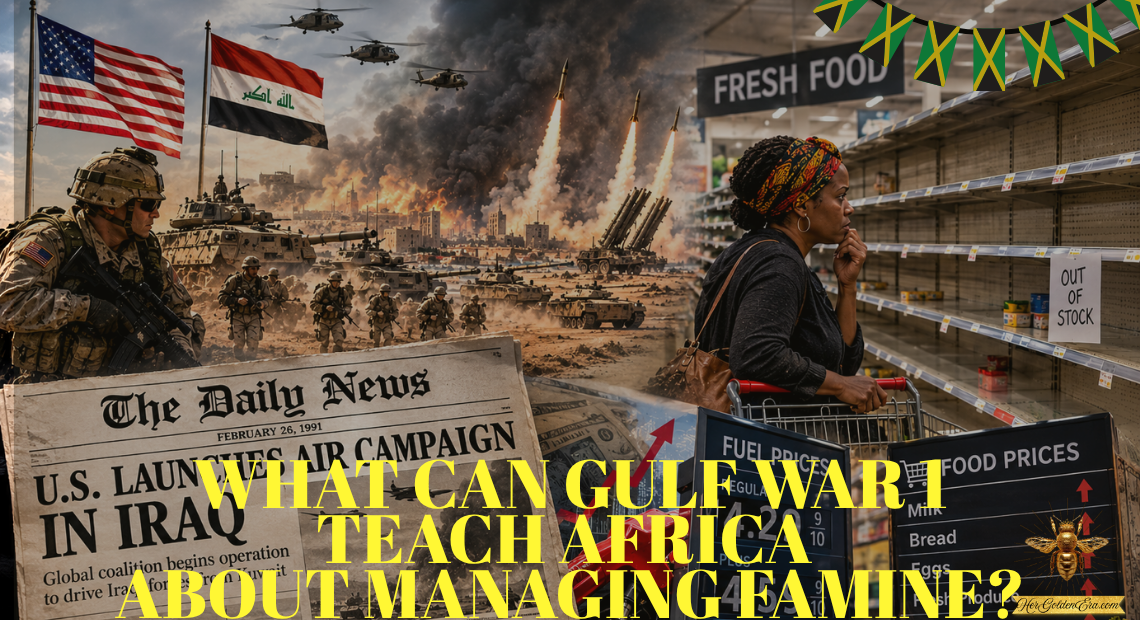
Part 2: The War That Emptied Our Shelves. What Gulf War 1 taught me when canned foods basically vanished from Jamaica, the dollar climbed, and prices followed, taking Jamaican inflation into a place of irriversible economic damage.
Part 3: The War That Fed Itself. How Gulf War 2 preparedness showed two ways to keep food moving: a ration system in Iraq and the commercial abundance of America powered by a subsidized, contracted and enabled food processing system.
Part 4: The War That Priced Out the Farm Why the war in Iran shows that the next shock arrives through fertilizer, and what women, dried fruit and cooperatives can do about it.
Please read together, they make one concise argument: hunger is predictable, preparation is a choice, and the women who already work the fields can be the ones who make that choice real.
GULF WAR 1 & JAMAICA’S FOOD SHOCKS
When I returned to Jamaica for high school in 1989.
I did not realize that my education on the impact of war and food in the context of food security, would be further illuminated.
Though Jamaica did not rely heavily on processed foods, my country felt the impact of Operation Desert Storm in surprising ways.
As mentioned in Article 1, Jamaicas foodways are very similar to Africa.
Family farms in the countryside provide the bulk of our carbohydrates and fresh fruits and supplemented with fresh chicken, eggs, meats, and occassionally some canned and cured foods.
Jamaicans, like people in many other small and developing nations at the time, experienced food shortages and extremely high cost of living during the first Gulf War.
However, due to Jamaica’s economic positioning at the time, I am not sure if there is another country outside of the conflict save for perhaps Haiti, that felt the impact of the 1s Gulf War-as severely as Jamaica.
Jamaica experienced double digit inflaion overnight and barely had bulk reserve commodities to absorb the shock.
Normal foods which we didnt expect to be impacted-blindsided us, revealing how vulnerable we truly were.
For Example, soybeans for animal feed was hard to come by, which led to shortages of eggs, chicken and meat, since chickens depend on that feed, and of other basic staples.
Flour, which was heavily imported in Jamaica, also suffered which created an increase of almos 100% in the price of bread and baked goods.
And my favorite canned foods, Grace Bully Beef and Brunswick sardines, disappeared overnight into thin air, as I suspect Argentina and Canada redirected food from international exports to their armies deployed in Iraq.
Chicken, Rice and Half of our National dish- Salted Codfish, was imported from Canada or elsewhere– did not fair better.
Many households relied on remittances from family overseas or barrels filled with food from loved ones from abroad to susain their households.-giving rise to the term “Barrel Economy”
Rising fuel costs meant an increase in the cost of everything, including transportation and bus fare.
Going to the supermarke felt surreal- I felt as if I was living in a real life scenario of the Great Depression we learned about in American schools
While many Jamaicans were up in arms with the Government about the cost of living, I had a secret knowing:
the matter could not be helped by the Government.
I had something to compare this crisis to, I had my pet research on WWII and how food systems survived to feed children and seniors decades later.
But this was Jamaica-Not America.
there was no Governmen contractors creating “surplus” agricultural commodities ensuring both School Children and Seniors were fed.
Jamaica at the time did have a food stamps system-but it was hardly enough to cover every needy household.
By the time I was 13, I had experienced the impact of war on food as both a surplus & a shortage.
In 1991, Jamaica did not have America’s 40 years of food logistics and a planning machine to feed millions behind it.
Jamaica didn’t have women’s kitchens by thousands of women preserving canning and planning.
Jamaica didn’ thave colonies to provide us with sugar or military support.
We were the colony which upheld Great Britain during her many wars and trials, with our farms, our bodies, our labour, our soldiers, our service, our sugar- but in our darkest, hour- Jamaica became the blind spot in the 1s Gulf War.
The support I can document came from the IMF, in June 1991, tied to adjustmenst- with conditions of course. I found no record of bilateral British assistance.
JAMAICA’S SUBSIDIZED FOOD CONTRACTORS WERE FEW AND FAR BETWEEN.
– NO ONE WAS COMING TO RESCUE US.
Jamaica did not have the infrastructure, the technology, the knowledge or machinery to maneuver.
this 1st Gulf war was the firs time I genuinely understood the intimate difference between a developed nation and a developing nation.
My Fresh Food paradise revealed itself in this time as unprepared but extraordinarily resilient.
JAMAICAN RESILIENCE
Jamaicans, rescued each other.
With no Government directives or anything other than hte war and the financial crisis to direc us. -We directed ourselves.
Neighbors supported neighbors, foods were shared between households. those who had a fruit bearing trees at home shared with each other.
Fresh fish and Callaloo replaced chicken and porridge for breakfast replaced eggs and bread in some households.
Baby feed was unaffordable and went back to being banana and cornmeal porridge, instead of high cost imported canned cereals.
those who had farms in the countryside offered excess to their senior neighbors.
Market sellers gave extra perishables such as tomatoes to buyers so as not to have spoilage- because not everyone could afford to buy. that exra we call Brawta balanced us out
Shopkeepers sold half breads, smaller portions of dried foodstuff such as flour, rice, sugar and oil.
Personally I made Guava Jam-so I could keep the fruit beyond its time.
Jamaicans did what Jamaicans do best, we recalibrated quickly, readjusted and kept moving.
I finally understood the impact of war on the availability of food, or the lack thereof and why the cans of food in American supermarkes, schools and homes- was a necessary resource.
Even more, I understood how food systems developed during wartime could be the backbone of survival for a country’s most vulnerable populations during peacetime.
The above analysis of course, is through the remembered lense of a child-this is the research behind what happened in Jamaica during Gulf War 1
- The oil shock was real but brief. Crude oil rose from about $17 a barrel in July 1990 to $36 in October, then eased as the war coalition advanced on Iraq.
- Jamaica’s damage lasted longer, because of the currency. Under its structural adjustment program, the exchange rate moved from J$7.18 in 1990 to J$12.85 in 1991 after liberalization in September 1991, and inflation exceeded 80% by 1991.
- A Bank of Jamaica evidence transcript describes the earlier official rate as an artificial rate maintained by the central bank, with a parallel market where dollars cost more.
- Food prices and children took the hit. A study found that the sudden, steep devaluation hit food prices, especially imported staples like rice and flour, and children weighed in November and December 1991 were measurably lighter than those weighed a few months later.
So the war was the spark that lit Jamaica’s Economy, but the severity came from Jamaica’s exposure: Heavy import dependence, scarce foreign exchange and a managed exchange rate that couldn’t hold, in addition to a war and liberalizaion at the exact same time, brought Jamaica to a place from which we never really recovered.
A food shock is often a currency and import shock in disguise, countries that preserve and store their own food are less exposed to all three.
Jamaica’s Lesson for Africa
- Jamaica, 1991: a war-driven oil spike turned into a currency and food crisis because the country relied on imported flour, feed and fuel. The dollar moved from J$7.18 to J$12.85 and inflation passed 80%, hitting imported staples and children’s nutrition hardest.
- Tanzania, 2026, has the same exposure: farmers paid about US$701 a tonne for urea against roughly US$400 globally, sugar supply fell short of demand and needed imports, and food inflation is expected to peak between late 2026 and mid-2027.
- The lesson is to cushion the shock before it lands: hold rotating buffer stocks of staples, process local crops such as dried fruit and flours to cut import reliance, and protect children and the poorest households first.
- Prioritise Respect for Human Life and dignity of Seniors Women and Children. Jamaicans are naurally kind, a kindness and generosity -I would like to beleive we inherited from our African Ancestors. In the time of need, Africans will need to lean deeply into Ubuntu and be proactive and active from household to household, neighbor to neighbor and community to communiy-the strong will need to support the weakest wihout fail. Outside of a national plan- that is the true security from hunger-Humanity.
See Article 4 for dried fruit blue print
JAMAICA WAS NOT PREPARED, WITH THE IMF COMMITMENTS THE FIRST GULF WAR CAUGHT JAMAICA IN THE CROSSHAIRS, LITERALLY.
MY HOPE IS THAT AFRICAN LEADERS, FOOD PROCESSORS AND CO-OPS USE THIS EXPERIENCE AS WARNING DEVICE TO SAFEGUARD AGAINST SIMILAR SHOCKS IN AGRICULTURE, BECAUSE ONE OF THE MOST IMPORTANT ASPECTS OF FAMINE IS THAT IT IS MAN MADE and often times PREVENTABLE.
My name is Renae Bruce-Miller, I am a professional consultant in African Agro processing based in Dar es Salaam Tanzania.
Through Her Golden Era, I am interested in identifying practical agro-processing, aquaculture and blue-economy opportunities that can connect African and African-descended women to real markets.
I center my work around African women in Agro Processing opportunities for food expansion and securiy that deserves serious investigation
—not because every woman should become a farmer- but because the value chain raises a much bigger question:
What high-value products are already being produced around us, exported from Africa and the Caribbean, and purchased by the world—and why are women not capturing more of that value?
That is the question behind Her Golden Era, if you are ready to explore opportunities in in preventing hunger by advancing women in agro processing,