

FOUR WARS, ONE HUNGER SEASON
From my research in Tanzania, what I keep finding is the same thing: the crops are there, the women are there, and a large share of the harvest is lost before it reaches a plate.
But I came to this question of food preservation long before I set foot in Africa.
I came to it as a child, standing in an American school cafeteria, staring at a white cans of food designed out of a supply chain system meant to feed the US army.
I share with you my experience of four wars from the vantage point of food. Each taught me something different, and together they point to a season I believe is coming for Africa and what we can do about it:
Part 1: The War That Built the System. How World War II turned canning, packing and distribution into a way of life, and what that meant for a girl from Jamaica in an American school cafeteria in the 1980s.
Part 2: The War That Emptied Our Shelves. What Gulf War 1 taught me when canned foods basically vanished from Jamaica, the dollar climbed, and prices followed, taking Jamaican inflation into a place of irriversible economic damage.
Part 3: The War That Fed Itself. How Gulf War 2 preparedness showed two ways to keep food moving: a ration system in Iraq and the commercial abundance of America powered by a subsidized, contracted and enabled food processing system.
Look at the pattern across all four wars.
Every one reached the poorest people through something they import.
- In 1990 it was soybeans for feed, flour, canned meat and fuel.
- Now it is the nutrient that lets a small plot grow more food.
- America’s supermarkets were insulated from Gulf War 2.
Africa’s farms are not insulated from this one.
Fertilizer is how you buy more food from the same land.
THE SEASON AFTER THE FOURTH WAR
I have now walked you through four wars and their impact on the availabiliy of food. and they have one thing in common:
None of these wars started the hunger.
Each one revealed a hunger that was already waiting.
- World War II, developed a food safety system out of necessity and left behind an entire value chain and supply system.
- Britain’s women preserved fruit in 2,600 centres within a year to ensure deployed troops received preserved foods.
- America built a wartime machine of food contractors, cans, pallets, logistics and specifications to combat hunger in the deployed WWII military and decades later a ten-year-old girl found the system still feeding American children in school cafeterias and seniors from commodities.
- Gulf War 1 showed me what happens to a country that has no such system. Jamaica’s shelves emptied, the dollar climbed, and by 1991 inflation had passed 80%.
- The war was the spark, but our dependence on imports was the fuel.
- Gulf War 2 in 2003, showed me the system working, in two forms:
- In Iraq, a ration network reaching every household through 44,000 neighborhood shops handed out extra rations before the invasion, and a major food crisis was avoided.
- In America, private commerce kept the shelves full, and nobody noticed anything at all.
there was no food rationing, no food shortages, no food lines, nothing was out of stock and the price of food remained relatively stable, increasing only wihtin a few cents despite an increase in gas prices.-America was insulated from food shocks.
- Both Iraq and America was prepared and both sysems worked.
Now in 2025, the Iran war has shown us the fourth lesson:
the next shock arrives through the farm, not the supermarket.
THE IRAN WAR: THE FOURTH WAR & The COMMING POTENIAL CALAMTIY
Now I am watching a fourth war, and this time I am not a child in a School Cafeteria Studying Post WWII food security , I am not a teenager in a supermarket in Jamaica looking for my favorie canned foods, I am no longer a logistician moving American Government food conrtactors around the country.
I am an analyst and a strategist, living in Africa with rare real world experience, reseraching, monitoring for patterns, analyzing solutions and I know where to look.
My concern is not out of fear mongering-those who are trained to see what I lived can arrive at the same conclusion as I have.
SOME AFRICAN NAtIONS ARE IN FOOD DANGER.
For Example: FAO reported in July 2026 that approximately 507,000 people in 30 vulnerable rural districts were projected to face severe acute food insecurity between June 2026 and January 2027.
This is a serious warning, although it does not mean Tanzania as a whole is facing famine.
This time the shortage is not imported foods. It is fertilizer.
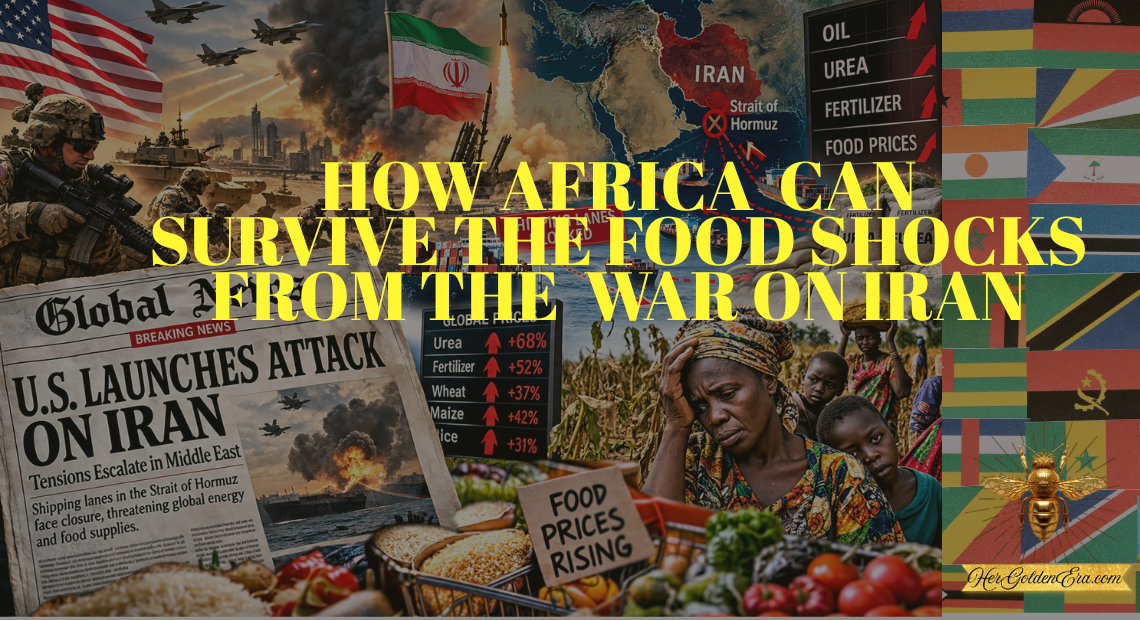
When the war began at the end of February 2026, the Strait of Hormuz was effectively closed.
Nearly a quarter of global urea exports normally come from the Middle East through that corridor.
Fertilizer, which lets a small plot grow more, was priced out of reach, and while world prices eased, farmers in Tanzania were still paying more than double.
Urea prices rose from around US 400 a tonne to over US850 in April.
A ceasefire was announced on 8 April, and by June the world price had fallen back to about US$453. worldbankwto
If you only read the global price chart, you might think the problem passed.
It didn’t reach the farmer’s receipt at the same time . In July, global urea was around US 400 a tonne.
While Tanzania was paying about US 770, Malawi about US 975 and South Africa about US1,059.
The same analysis warns that high fertilizer costs are likely to stop farmers in East and Southern Africa from buying enough before planting, and that food inflation may peak from late 2026 to mid-2027.
In Kenya, at least 26% of the fertilizer supply passes through the Strait. Fertiliser Shock Raises Africa’s Food Price Risks +2
A war can end on the shipping chart and still be fought at the farm gate.
A strong El Niño is now forecast to last until at least February 2027, and agencies expect hunger needs to rise as the year progresses.
West Africa’s regional reserve could cover about three million people, against more than 54 million facing the lean season.
I will not call the coming hunger season inevitable.
But it is predictable, and a predictable hazard is a choice.
From my perspetcive The choice has five parts, and every one of them comes from the 3 wars I have experienced.
Land for women. The women who farm must be able to own the land they work. Title is what lets them borrow for irrigation, seed and equipment, and without it they cannot take part in the modernization every government now demands.
Dried fruit. Mango alone loses 40 to 45% of its harvest before it is eaten. Dried properly, it keeps for months at tropical temperatures, needs no sugar, no refrigeration and no fuel to eat, and can be stored in a thousand places instead of one.
Cooperatives. The Women’s Institutes and India’s Lijjat show how: women organized as co-owners, paid on delivery, weighing everything in and out.
Workshops. Standards, training and equipment turn kitchens into suppliers. The pallets, specifications and batch codes of the American system are what let many small producers sell to one buyer.
Distribution. A reserve is useless if it cannot move. It needs local agents, school and clinic buyers, and a rule that stock is eaten and replaced, so it never goes stale.
Surplus is not an accident.
It is a decision made in the years of plenty for the years of lean. The rain will come or it will fail, and the prices will rise or they will fall.
The only question we control is whether the shelf is already full when it does.
With hundreds of thousands of people in vulnerable rural districts facing acute food insecurity, Tanzania has an opportunity to act before the next shock deepens the crisis: preserve more of its harvest, strengthen women-led food processing, and establish a distributed reserve of locally produced, shelf-stable foods.
As Tanzania faces the risk of climate-related crop losses, rising agricultural input costs and disruptions to food supply, strengthening national food security requires more than increasing production.
The country must also find ways to preserve what it already grows, reduce post-harvest losses and build reliable reserves before a crisis develops.
I have developed a practical intervention system using and learning from methods in each war, as a lesson to inform me how to create solutions against hunger.
My project is a Women’s Dried-Fruit Food Security Network, designed to transform seasonal surpluses of mangoes, pineapples, papayas and tomatoes into shelf-stable food products for institutional and emergency distribution.
The proposed model would establish 40 women-led cooperatives across four regional hubs, employing approximately 1,000 women in fruit collection, washing, sorting, cutting, solar drying, packaging, quality control and distribution.
Using solar and hybrid drying technology, the network would aim to process 1,200 tonnes of fresh produce annually into approximately 151 tonnes of dried products, subject to crop availability and verified processing yields.
Production would be organised around Tanzania’s agricultural geography, with mangoes sourced from suitable southern and coastal districts, pineapple and papaya from verified growing areas, and tomatoes from established production centres including Iringa, Dodoma, Morogoro and Mbeya. Regional packing and storage facilities would maintain food safety, traceability and stock rotation.
Finished products could be distributed through approved government programmes, hospitals, clinics, schools, mosques, churches and humanitarian organisations.
Dried fruit would provide supplementary energy and nutrients, while dried tomatoes could enrich soups, sauces and institutional meals. The products would complement, rather than replace, staple foods, protein sources and other components of a balanced emergency food basket.
The proposed network would give the government an opportunity to become an anchor customer through competitively priced supply contracts.
At illustrative wholesale prices of TZS 24,000 per kilogram for dried fruit and TZS 18,000 per kilogram for dried tomatoes, the full 151-tonne production target would represent approximately TZS 3.53 billion in gross annual sales.
These figures are preliminary planning assumptions, not verified market prices or confirmed government expenditure.
The first step would be a feasibility study to verify crop surpluses, seasonal availability, processing costs, food-safety requirements, storage capacity and institutional demand.
Small production trials and confirmed purchasing arrangements should precede large-scale investment.
Food security is not only about growing more food.
It is also about preventing good food from going to waste, creating the infrastructure to preserve it, and ensuring that it reaches people when they need it most.
-By placing women at the centre of this supply chain, Tanzania could strengthen rural livelihoods while developing an additional layer of protection against future food shortages.
We cannot control the price of urea.
We can control how much of what is already grown reaches a plate.
If post-harvest loss runs at 30% or more, and as high as 40 to 45% for mango, then every kilo that is dried and saved is a kilo of food that needed no fertilizer, no new land and no extra water.
It was already grown.
My program is replicable across the African continent.
My name is Renae Bruce-Miller, I am a professional consultant in African Agro processing based in Dar es Salaam Tanzania.
Through Her Golden Era, I am interested in identifying practical agro-processing, aquaculture and blue-economy opportunities that can connect African and African-descended women to real markets.
I center my work around African women in Agro Processing opportunities for food expansion and securiy that deserves serious investigation
—not because every woman should become a farmer, but because the value chain raises a much bigger question:
What high-value products are already being produced around us, exported from Africa and the Caribbean, and purchased by the world—and why are women not capturing more of that value?
That is the question behind Her Golden Era, if you are ready to explore opportunities in preventing hunger by advancing women in agro processing
CLICK HERE FOR OUR CONSULTANCY PAGE lets connect today