
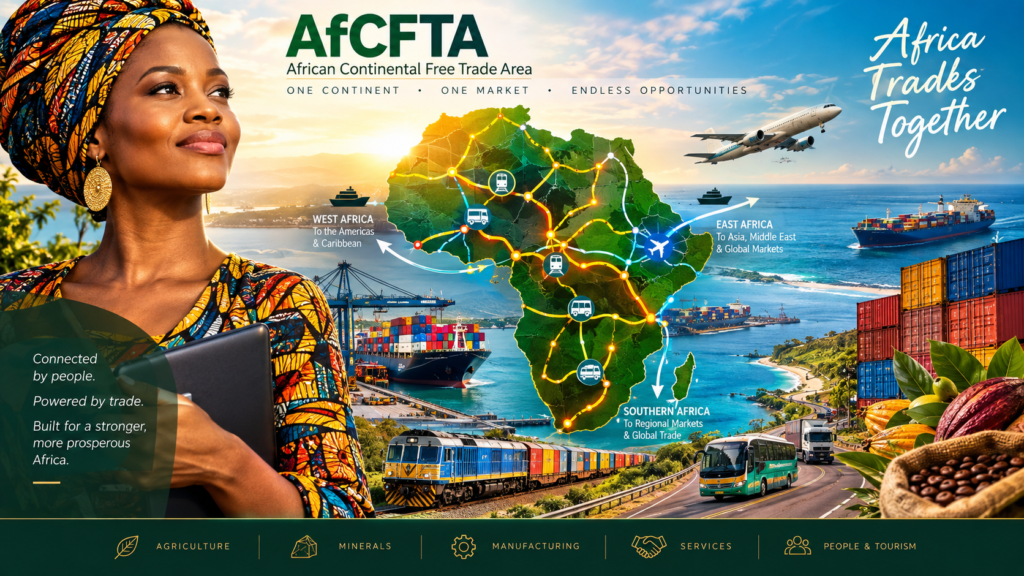
Africa’s Next Trade Opportunity: Building the Logistics Network Behind AfCFTA
Africa does not have a shortage of products, producers or markets. One of the biggest opportunities now emerging is the infrastructure that connects them.
The AfCFTA is Africa’s largest free trade agreement, uniting 55 AU member states to create a single continental market of over 1.3 billion people and a combined GDP of approximately US$3.4 trillion.
The African Continental Free Trade Area (AfCFTA) is designed to create a single African market for goods and services and to encourage regional value chains, investment and the movement of people and capital.
But a continental market only becomes commercially meaningful when a business in one country can actually move its products to customers in another country efficiently and affordably. (Trade.gov)
That is where roads, railways, ports, shipping and logistics businesses become part of the AfCFTA opportunity.
The Big Picture
Think of Africa’s emerging trade network as a series of connected arteries:
Producer → local logistics → road/rail → regional hub → port → shipping → international market
Roads provide flexibility. Rail moves large volumes over long distances. Ports connect the continent to the world’s oceans. Shipping then carries African products to other African markets and to the Caribbean, Europe, the Middle East, Asia and the Americas.
The opportunity is not necessarily to own every part of this system.
It is to build businesses that connect the pieces.
Rail Is Beginning to Change the Map
East and Southern Africa already provide a useful example.
The Tanzania-Zambia Railway Authority (TAZARA) connects the port of Dar es Salaam with Zambia and forms part of the wider Southern African transport network.
It carries both freight and passengers. Cross-border passenger services between Tanzania and Zambia resumed in February 2026, restoring an important people-and-trade connection. (Tazara)
TAZARA is also being revitalised through a US$1.4 billion rehabilitation programme, intended to strengthen its freight capacity and its role as a regional trade corridor. (ZRL)
Meanwhile, Tanzania’s new Standard Gauge Railway is expanding the country’s rail network inland. Its planned connections toward Mwanza and the Great Lakes region could strengthen links between Dar es Salaam and markets including Rwanda, Burundi and the DRC. Tanzanian and Congolese businesses are already exploring how to use the railway for increased trade. (The Citizen)
This creates an important distinction:
Dar es Salaam is not currently connected by one continuous railway directly to the Atlantic.
Rather, Africa is developing multiple east-west corridors that can increasingly connect through road, rail and logistics hubs.
LOGISTICS COMPANIES ARE ALREADY BUILDING THE NETWORK
This is not simply a future idea. Companies are already stitching Africa’s transport corridors together.
Africa Global Logistics (AGL) operates across 51 African and international markets, combining port, road, rail, warehousing and other logistics services and explicitly positioning its network as part of the infrastructure supporting intra-African trade and AfCFTA.
DSM Corridor Group moves cargo from Dar es Salaam by rail to Kapiri Mposhi in Zambia, where trucks can take it onward into Zambia or the DRC.
Tanzanian companies such as Alama Africa are also combining sea freight, road transport, SGR and TAZARA rail services with warehousing and customs clearance to move cargo between Dar es Salaam and markets across East and Central Africa.
The lesson for a smaller entrepreneur is important: she does not have to build the infrastructure herself; she can build a business around coordinating and connecting the infrastructure that already exists.
THE BUS IS PART OF THE TRADE NETWORK TOO
At the smaller end of the market, scheduled buses are already functioning as an informal and increasingly organized parcel network across East Africa.
Bus operators and booking platforms offer businesses and individuals the ability to send packages between cities and across borders, with examples including Kampala–Nairobi, Kampala–Kigali, Kampala–Goma and Kampala–Dar es Salaam.
This matters enormously to small traders: a shop owner does not need a truckload of merchandise to participate in regional trade.
A few cartons of clothing, beauty products, food products, spare parts or other permitted goods can travel on an existing passenger route and be collected by the buyer at the destination or sent directly to their door step on motorbike.
In effect, the bus has become the small trader’s regional delivery network—connecting the woman selling ten cartons to a buyer hundreds of kilometres away without requiring her to purchase transportation infrastructure of her own.
Look West: The Lobito Corridor
On the other side of the continent, a different piece of the puzzle is already operating.
The Lobito Atlantic Railway connects Kolwezi in the DRC’s Copperbelt to the Port of Lobito on Angola’s Atlantic coast through approximately 1,739 kilometres of railway. The railway is already operating, carrying minerals as well as agricultural, industrial and commercial cargo. (Lobito Atlantic)
In August 2024, copper transported by rail from Kolwezi reached Lobito and was loaded onto a vessel bound for Baltimore in the United States. (Lobito Atlantic)
That is the model in miniature:
African production → African railway → African Atlantic port → international shipping → American market.
The Lobito Corridor is also being developed toward Zambia, with a planned railway connection intended to link the Zambian Copperbelt into the Atlantic corridor. The African Development Bank describes the wider corridor as linking Angola, the DRC and Zambia and potentially supporting agricultural as well as industrial trade. (African Development Bank)
Now Put the Pieces Together
The really interesting opportunity appears when these corridors are viewed as a network rather than as individual railway projects.
Imagine a Tanzanian producer shipping goods inland by road or rail.
The goods could move:
Dar es Salaam → Zambia/DRC
while other goods could move:
DRC/Zambia → Angola → Atlantic
And, as connections between corridors improve, businesses could increasingly choose between eastern and western gateways depending on destination, price, capacity and transit time.
This creates something much larger than a railway.
It creates the possibility of an increasingly interconnected African logistics system.
And once cargo reaches an efficient African port, it no longer matters whether its final customer is in another African country, the Caribbean or North America.
It becomes an international shipment.
The Port of Lobito, for example, already has shipping connections serving Europe, the United States and other global markets. Existing services have demonstrated routes into the US, Europe and beyond. (Lobito Atlantic)
The Road Network Is Just as Important
Rail will not replace trucks.
It will make trucks more useful.
A truck can collect agricultural products from a farm, take manufactured goods from a factory to a rail terminal, deliver products from a railway station to a warehouse, or complete the final journey from a port to the customer.
This is known as multimodal logistics:
Truck + Rail + Ship
rather than relying on one mode of transportation for the entire journey.
That is particularly important for SMEs.
A small Tanzanian processor may not have enough goods to fill a container or charter transportation.
But 20 small businesses may.
A logistics company that aggregates their cargo can turn dozens of small shipments into one commercially viable consignment.
That is where smaller African logistics entrepreneurs can enter the system.
The Bird’s-Eye View
The emerging picture looks something like this:
EAST AFRICA
Tanzania • Kenya • Uganda • Rwanda • Burundi
↓
Road + Rail + Inland Logistics Hubs
↓
Zambia / DRC / Southern Africa
↓
Two major directions
EAST → Dar es Salaam → Indian Ocean → Africa / Asia / Middle East
WEST → DRC/Zambia → Lobito → Atlantic → West Africa / Europe / Americas
And the network can increasingly work in reverse:
Imported machinery, packaging, technology and consumer goods → African ports → rail/road → African businesses.
This is what makes logistics so important to AfCFTA.
Trade does not grow simply because tariffs fall.
Trade grows when people can find customers, make sales and move products.
The Opportunity for African Women
You do not have to own a fleet of trucks to participate.
One particularly interesting low-impact logistics business model would be a:
Women’s Regional Trade & Freight Consolidation Company
The business would act as a logistics coordinator for small and medium-sized African producers.
Instead of buying trucks, ships or warehouses initially, the entrepreneur builds a network of customers and transport partners.
She could:
- Find African producers who want to sell outside their home market.
- Identify buyers in neighbouring countries.
- Combine several small shipments into consolidated cargo.
- Partner with licensed trucking companies for collection.
- Book rail or shipping space through established operators.
- Coordinate customs documentation through licensed clearing agents.
- Track the shipment digitally.
- Arrange final-mile delivery.
- Charge a coordination, consolidation or freight-management fee.
Her company becomes the bridge between the producer and the transport infrastructure.
Example
Imagine five Tanzanian women producing:
- dried fruit
- spices
- seaweed products
- natural cosmetics
- packaged foods
Individually, none may have enough volume to negotiate attractive freight rates.
The logistics company could consolidate their products into one shipment destined for Zambia, the DRC or another regional market.
The entrepreneur doesn’t need to own the truck.
She owns the customer relationship, the logistics coordination and the network.
Why This Model Is Interesting
It can begin relatively small.
A woman could start with:
Laptop + phone + logistics software/spreadsheets + customs/clearing partners + trucking partners + freight-forwarding relationships.
Revenue could come from:
Logistics coordination fee + consolidation margin + documentation fee + delivery fee + optional warehousing/fulfilment fee.
As the customer base grows, the company could eventually add:
collection centres → small warehouses → refrigerated storage → trucks → regional distribution hubs.
The business therefore grows with trade, rather than requiring a huge infrastructure investment on day one.
And there is a broader reason to watch this space.
ECA estimates that AfCFTA could increase intra-African trade in transport services by almost 50%, with transport accounting for a significant share of the gains in services trade. (Uneca)
Africa is therefore not only creating a bigger market for products.
It is creating a potentially much bigger market for the businesses that move those products.
THE GOLDEN OPPORTUNITY
The next African logistics giant does not necessarily have to begin with 500 trucks.
It could begin with 500 African businesses that need someone they trust to get their products across a border.
As Africans increasingly buy, sell, manufacture and invest in one another’s markets, the people who make those transactions simpler, cheaper and more reliable will become an increasingly important part of the continent’s trade economy.
HER MOMENT
For an African woman, or a woman in the diaspora looking to build a business back into Africa the opportunity is not necessarily to own the trucks, trains or ships.
It is to become the logistics link between African businesses and the markets they want to reach.
A small freight-coordination and cargo-consolidation company could begin with approximately
US$5,000–$15,000 for registration, a basic digital system, marketing, working capital, professional logistics support and initial customer acquisition, while transport assets are outsourced to established operators.
If the business coordinates US$50,000–$100,000 in monthly cargo and earns an average 5–10% gross coordination margin, that represents approximately US$2,500–$10,000 in monthly gross revenue before operating expenses.
The objective is not to chase enormous volumes immediately, but to establish reliable routes, repeat customers and profitable trade relationships in one corridor, then expand into neighbouring markets as demand develops.
For a woman who can build trust between producers, buyers and transport providers, the infrastructure already being built across Africa can become the platform on which her own regional logistics business grows.