ALOE VERA: Africa and the Caribbean’s Green Gold Opportunity
From backyard plant to global beauty, wellness and beverage ingredient, aloe vera could become one of the most interesting value-add opportunities for tropical entrepreneurs.
For generations, aloe vera has been one of those plants that seemed almost too ordinary to notice.
It grows in hot climates. It survives periods of drought. It can be found in gardens, farms and sometimes growing almost wild. Grandmothers have used it on skin and hair for generations.
But behind that humble plant is a global commercial industry spanning cosmetics, personal care, beverages, nutraceuticals, pharmaceuticals and functional ingredients.
And that creates an intriguing question for Africa and the Caribbean:
What happens when we stop selling the leaf and start selling what the leaf can become?
THE OPPORTUNITY
The global aloe vera industry is already substantial—and estimates vary considerably depending on whether researchers count raw aloe, extracts, ingredients, finished products or the wider aloe market.


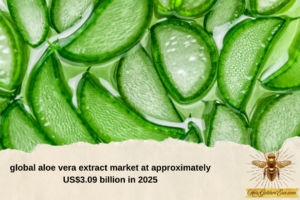
One 2026 market estimate puts the global aloe vera extract market at approximately US$3.09 billion in 2025, projecting it to reach US$8.86 billion by 2034. Another market estimate places the broader aloe vera market at about US$3.8 billion in 2025, with a projection of approximately US$7.5 billion by 2035. (Fortune Business Insights)
The precise number matters less than the direction.
Aloe is no longer simply a traditional remedy. It has become an industrial ingredient.
And the most interesting part of the opportunity may not be growing more aloe.
It may be processing more of the aloe already being grown.
Aloe vera is particularly suited to tropical and subtropical regions. Scientific literature documents cultivation in Kenya, Tanzania, Ethiopia and Nigeria, as well as across the Caribbean, including Jamaica and other Antillean islands. Aloe is also cultivated extensively in countries such as Mexico, India, China, Thailand, Israel and South Africa. (PubMed Central (PMC))
That gives African and Caribbean producers an unusual advantage: the crop is already compatible with the climate.
The challenge is commercialisation.
A farmer selling fresh leaves is participating at the lowest-value end of the chain.
A company selling a standardized cosmetic-grade aloe ingredient is participating much further up the value chain. And a company selling a finished branded aloe product—particularly into international markets—is further up again.
WHY ALOE?

Aloe vera is interesting because a single crop can feed several industries.
The inner leaf contains a water-rich gel containing polysaccharides including acemannan-,
Acemannan is a bioactive polysaccharide found in the inner leaf gel of Aloe vera, known for its immune-boosting, antiviral, wound-healing, and gastrointestinal benefits.
along with sugars, amino acids, minerals and other compounds. Modern research continues to investigate the properties and industrial applications of aloe polysaccharides. (PubMed)
That gives entrepreneurs multiple possible markets:

BEAUTY
- Facial moisturizers
- After-sun products
- Body gels
- Face masks
- Serums
- Soothing creams
- Cleansers
- Body lotions
- Shaving products
HAIRCARE
- Leave-in conditioners
- Curl creams
- Scalp products
- Hair masks
- Styling gels
- Moisturizing sprays
- Shampoo formulations
- Natural hair treatments
FOOD & BEVERAGES
- Aloe drinks
- Aloe-infused fruit beverages
- Functional beverages
- Aloe cubes
- Beverage concentrates
- Smoothie ingredients
INGREDIENTS
- Cosmetic-grade aloe gel
- Concentrated aloe
- Aloe powder
- Botanical extracts
- Bulk ingredients for manufacturers
WELLNESS & PHARMACEUTICALS
Aloe is also used in various health-related products, although this is an area where processing, dosage, regulatory compliance and scientific evidence become particularly important.
Aloe has genuine commercial and research interest, but it should not be marketed as a miracle cure.
The U.S. National Center for Complementary and Integrative Health notes that topical aloe gel is generally well tolerated and that some research suggests benefits for certain skin conditions and burn healing. Evidence for many other claimed uses remains limited. (NCCIH)
THE AFRICAN AND CARIBBEAN ADVANTAGE
There is something particularly compelling about aloe for regions that already produce tropical crops.
Unlike crops that require enormous amounts of water or sophisticated growing systems, aloe is a succulent adapted to relatively dry environments.
It can therefore fit into agricultural systems where water availability is a constraint.
Research has documented aloe cultivation across East Africa and the Caribbean, while Barbados is currently exploring a cooperative-led aloe project specifically designed to move local production into higher-value finished and semi-finished products. (Frontiers)
That Barbados example is worth watching.
Because it illustrates the fundamental opportunity:
Don’t just grow what the world wants. Process what the world wants.
THE SOLUTION
The opportunity is to build regional aloe value chains.
Instead of:
Farmer → fresh leaf → middleman → exporter
the model becomes:
Farmer → collection centre → processing facility → standardized ingredient → African/Caribbean brand → regional market → export market
That single change can transform the economics of the crop.
THE BEAUTY OPPORTUNITY
This is arguably one of the most attractive entry points.
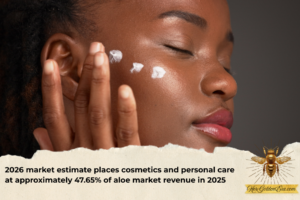
Aloe has long been incorporated into skincare and personal-care products, and cosmetics and personal care represent a major portion of the commercial aloe market. One 2026 market estimate places cosmetics and personal care at approximately 47.65% of aloe market revenue in 2025. (Mordor Intelligence)
And beauty entrepreneurs do not necessarily need to build a giant factory.
A small processing company could begin by producing a standardized aloe gel ingredient, then work with cosmetic formulators to turn that ingredient into finished products.
ALOE AND HAIRCARE
Haircare may be particularly interesting for African and Caribbean entrepreneurs because the consumer already understands the value proposition.
A Safer Haircare Opportunity
For Black women, the search for healthier hair may also be creating an important new market for botanical ingredients such as aloe vera.
Research has found endocrine-disrupting and asthma-associated chemicals including phthalates, parabens, fragrances and other chemical classes in hair products marketed to or commonly used by Black women.
One study testing 18 products identified 45 chemicals of concern, while subsequent research found that several commonly used Black hair products displayed measurable hormonal activity in laboratory assays.
More recent biomonitoring research has also linked hair-product use with higher concentrations of several phthalate, phenol and paraben biomarkers.
This creates an opportunity to build a new generation of transparent, plant-forward haircare products in which consumers can understand exactly what they are putting on their scalps and hair.
Aloe vera is particularly interesting because its gel can serve as a hydrating and conditioning ingredient in products such as leave-in treatments, curl creams, scalp gels and hair masks.
For African and Caribbean entrepreneurs, the opportunity goes further: locally grown aloe could become the foundation for a cleaner, traceable, regionally produced haircare industry, combining aloe with other botanical ingredients.
The goal is not simply to replace one chemical with another, it is to create products formulated, tested and transparently labelled around the needs of Black consumers.
Aloe gel can provide a water-based, soothing and conditioning component in formulations.
The competitive advantage isn’t necessarily the aloe itself.
It is the formulation, sourcing story, quality, branding and distribution.
THE BEVERAGE OPPORTUNITY
Aloe beverages represent another potential value-added market.
Aloe gel can be processed into beverages, concentrates and products containing aloe pieces or pulp.
But this is where entrepreneurs need to take food safety particularly seriously.
The yellow latex beneath the leaf skin contains anthraquinones such as aloin. Processing intended for food and beverages therefore requires appropriate separation, filtration and quality control. Research on aloe beverage processing specifically identifies aloin removal, stabilization and pasteurization as important processing considerations. (PubMed Central (PMC))
A commercial aloe beverage facility should therefore not be built around the idea of:
“Extract the gel and put it in a bottle.” It needs a controlled food-processing system.
That can include: Washing → trimming → filleting → gel extraction → filtration → aloin control → formulation → pasteurization → cooling → filling → quality testing
Food-processing research has identified filtration, acidification, pasteurization and storage controls among important quality and safety points in aloe juice production. (ScienceDirect)
That sounds complicated.
But complexity is precisely what creates a barrier to entry—and therefore an opportunity for businesses that can do it properly.
THE POWDER OPPORTUNITY
Then there is perhaps the most interesting ingredient opportunity of all:
aloe powder.
Powder solves one of aloe’s biggest commercial problems:
fresh aloe is mostly water.
That makes transportation, storage and international shipping more expensive and complicated.
Converting aloe into a stable concentrated powder dramatically changes the logistics.
Aloe powders can be produced using technologies including spray drying and freeze drying, among other approaches. (ScienceDirect)
The resulting ingredient can potentially be sold B2B to: Cosmetic manufacturers, Haircare companies, Supplement companies, Beverage companies, Food manufacturers, Natural-product formulators
This is where a small African or Caribbean processor can potentially move from being a consumer brand to becoming an ingredient supplier.
And B2B ingredients can be extremely interesting because one customer may purchase kilograms or tonnes rather than one bottle at a time.
THE POTENTIAL
Here is where the aloe story becomes especially interesting.
One hectare of well-managed aloe can produce substantial quantities of fresh leaves, although yields vary enormously according to cultivar, climate, irrigation, planting density and management.
One agronomic study reported 60.6 tonnes of fresh leaves per hectare and 25.8 tonnes of gel per hectare under optimized conditions. Other agricultural sources use more conservative commercial assumptions of approximately 40 tonnes of leaves per hectare. (ScienceDirect)
Processing losses are significant.
One analysis of aloe processing estimates that approximately 40–45% of the fresh leaf becomes gel, while the skin accounts for roughly 45–55%. (ScienceDirect)
That means a processor handling: 1 tonne of fresh aloe leaves could potentially obtain roughly:
400–450 kg of crude gel
before further filtration, stabilization and processing losses.
A SMALL-SCALE ALOE BUSINESS
Let’s imagine an entrepreneur does not begin with a massive industrial factory.
Instead, she establishes a small regional processing centre capable of handling approximately:
500 kg of fresh aloe leaves per processing day.
Assume: 500 kg leaves/day × 20 processing days/month = 10 tonnes of leaves/month
Using a simplified 40% gel recovery assumption: 10,000 kg leaves → approximately 4,000 kg crude gel
The actual saleable quantity will depend on processing losses, formulation, filtration and stabilization.
But now the entrepreneur has a raw-material platform.
WHAT WOULD THE SMALL FACTORY LOOK LIKE?
A modest first-stage facility could be surprisingly compact.
RAW MATERIAL AREA- Fresh leaves arrive from farmers.
WASHING AREA-Leaves are cleaned and sorted.
FILLETING AREA-The green outer skin is removed and the inner gel separated.
EXTRACTION AREA-The gel is collected and processed.
FILTRATION-Fibres and unwanted material are removed and the product is treated to control undesirable compounds.
STABILIZATION-The gel is stabilized for its intended application.
FORMULATION ROOM-For beverage or cosmetic products.
PASTEURIZATION-Required for appropriate beverage products.
FILLING & PACKAGING-Bottles, jars, pouches or drums.
COLD STORAGE-Where required by the product specification.
QUALITY-CONTROL AREA-Testing should include appropriate microbiological, chemical and physical controls.
The real investment thesis is therefore:
The money is not simply in growing aloe. The money is in achieving reliable yields, efficient processing, quality certification and higher-value markets.
THE BIGGER AFRICAN OPPORTUNITY

Africa does not necessarily need to compete with established aloe producers by trying to become the world’s cheapest producer of raw leaves.
It could compete through origin, formulation, processing and storytelling.
Imagine an aloe company sourcing from: Tanzania + Kenya + Ethiopia
or
Ghana + Nigeria or a Caribbean cooperative sourcing from: Barbados + Jamaica + Trinidad
The company could build a regional supply network while processing locally.
THE INVESTMENT
The investment does not have to begin at $100,000.
Indicative capital: $2,000–$10,000
This is primarily a branding and distribution business.
| START-UP CAPITAL | WHAT YOU CAN BUILD | WHAT THE MONEY CAN COVER | PRIMARY REVENUE | GROWTH PATH |
|---|---|---|---|---|
| $5,000 | 🌿 Micro Aloe Brand | Source locally grown aloe; basic processing equipment; sanitation setup; small-batch formulation; containers, labels and initial testing; simple branding and marketing | Aloe hair gel, skin gel, masks, scalp treatments | Build customer base → reinvest → develop your own processing |
| $10,000 | 🧪 Micro Processor + Brand | Better extraction/filtration equipment; stainless work surfaces; small processing area; preservation/stabilization; packaging equipment; laboratory testing; initial raw-material supply | Own-brand products + bulk aloe gel sold to salons, spas and small cosmetic makers | Increase production → supply other brands → add beverage products |
| $25,000 | 🏭 Small Aloe Processing Hub | Dedicated food/cosmetic processing space; improved extraction and filtration; tanks and pumps; filling/packing equipment; refrigeration; quality-control setup; working capital | Bulk stabilized gel + branded hair/skin products + potential beverage line | Contract manufacturing → larger B2B customers → concentrate/powder production |
Industrial aloe processing lines can reach very high capital costs, which is precisely why a staged development strategy makes sense. (Made in China)
ALOE VERA: THREE WAYS TO ENTER THE BUSINESS
THE REVENUE LADDER
$5,000 Grow/SOURCE → MAKE → BRAND → SELL
↓
$10,000
SOURCE → PROCESS → SELL B2C + B2B
↓
$25,000
SOURCE → PROCESS → FORMULATE → MANUFACTURE → SUPPLY OTHER BRANDS
WHAT COULD THE NUMBERS LOOK LIKE?
If a micro processor eventually sells 1,000 kg of stabilized aloe gel per month at an illustrative average realized price of $4/kg, that represents:
1,000 kg × $4 = $4,000/month
or approximately $48,000 annual gross sales.
But that is revenue, not profit. Raw materials, labour, packaging, utilities, testing, preservation, transport, marketing, taxes and other costs must be deducted.
And this is precisely why the business becomes more interesting as the entrepreneur moves up the value chain.
Selling: 1 kg of raw aloe leaves is one business.
Selling: 1 kg of processed cosmetic-grade aloe ingredient is another.
Selling: a $12 bottle of premium aloe hair treatment
is another entirely.
HER GOLDEN ERA INVESTMENT INSIGHT
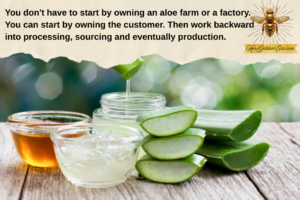
You don’t have to start by owning an aloe farm or a factory. You can start by owning the customer. Then work backward into processing, sourcing and eventually production.
That makes aloe particularly interesting for the low-budget entrepreneur: the first $5,000 can be used to prove demand, while subsequent investment can be directed toward the part of the value chain that customers are actually willing to pay for.
THE NEXT MOVE
For the entrepreneur reading this and thinking:
“I have aloe growing around me. Could this actually become a business?”
Don’t begin by buying machinery, Begin by proving the market.
1. MAP THE ALOE : Identify farmers and wild/household production within a 50–100 km radius.
2. TEST THE LEAVES: Different cultivars and growing conditions can produce very different raw materials.
3. MEASURE YIELD: Determine how many kilograms of fresh leaves produce how many kilograms or litres of usable gel.
4. TEST ALOIN LEVELS: Particularly if food or beverage production is contemplated.
5. IDENTIFY BUYERS : Talk to cosmetic manufacturers, spas, haircare companies, beverage businesses and ingredient distributors.
6. START WITH BULK GEL: It is considerably simpler than attempting a sophisticated powder operation immediately.
7. DEVELOP THREE SIGNATURE PRODUCTS- For example: Aloe Skin Gel Aloe Hair Gel Aloe Botanical Drink
8. BUILD THE BRAND AROUND ORIGIN
Don’t simply call it “Aloe Vera Gel.” Tell consumers where it came from.
Grown in Africa. Processed in Africa. Made for the world.
9. BUILD QUALITY SYSTEMS EARLY
International buyers will care about consistency, microbiology, contaminants, traceability, specifications and documentation—not simply whether the product is “natural.”
10. SCALE INTO INGREDIENTS
Once the business has proven demand, move from finished products into B2B aloe gel, concentrate and powder.
Aloe Vera- a Common Hero
There is something almost poetic about aloe vera as an investment opportunity.
It is not a rare plant. It doesn’t need to be discovered. It doesn’t need to be imported.
In many African and Caribbean communities, it is already there.
The opportunity is to look at that ordinary green leaf differently.
Not as a backyard remedy. Not simply as a crop. But as a raw material for an international botanical-products industry.
The global market is already buying aloe for cosmetics, personal care, beverages and ingredient applications. Research continues to explore aloe polysaccharides and their industrial applications, while market forecasts point to continued growth across multiple product categories. (Fortune Business Insights)
HER GOLDEN ERA | THE INVESTMENT TAKEAWAY
The Opportunity: A globally established botanical ingredient with strong applications in beauty, personal care, beverages and wellness.
The African/Caribbean Advantage: Climate suitability, existing cultivation and a large opportunity to move from raw leaves into value-added processing.
The Entry Point: Start with stabilized gel and finished beauty products.
The Scale-Up: Add beverages, concentrates and eventually powder.
The Big Opportunity: Become a regional supplier of standardized aloe ingredients rather than simply an exporter of raw leaves.
The Golden Era Question: What other plants are growing around us that the world is already paying someone else to process?
The question for Africa and the Caribbean is therefore not whether the world wants aloe.
It already does.
The more interesting question is:
Who is going to turn our aloe into the products the world is willing to pay more for?
And that may be where the real Green Gold begins.
“look around you—there may be an industry hiding in plain sight