


Mozambique: A Culture Shaped by the Ocean
Mozambique is a country whose story has been shaped by movement of people, languages, ideas and cultures across the Indian Ocean. Bantu communities have lived here for centuries, while centuries of Indian Ocean trade brought Arab, Swahili, Persian and Indian influences to the coast. Portuguese traders and colonial rule later left another lasting layer, with Portuguese becoming the country’s official language. The result is a remarkably diverse cultural landscape, reflected in Mozambique’s languages, food, music, architecture, dress and traditions.

But Mozambique’s culture cannot be separated from its people. Across the country, traditions continue through music, dance, storytelling, craftsmanship and communal celebrations.
The colourful capulana, a traditional printed cloth worn and used in many ways remains an important part of everyday and ceremonial life, while musical traditions include instruments such as the timbila and marimba. Along the coast, centuries of Indian Ocean exchange can still be felt in the architecture, cuisine and rhythms of daily life.
Mozambique gained independence from Portugal in 1975, beginning a new chapter in the country’s history. Today, its cultural identity is neither simply African nor European, coastal nor inland—it is a rich tapestry woven from many histories. Perhaps that is what makes Mozambique so captivating: you don’t simply encounter a destination here; you encounter layers of history living side by side.
Bazaruto Archipelago
Where the Indian Ocean Keeps Mozambiques Best Secrets


There are places you visit. And then there are places that seem to receive you.
The Bazaruto Archipelago belongs to the second kind.
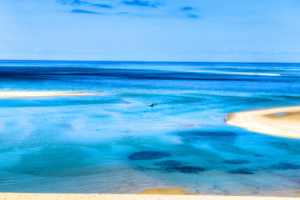
Far off the coast of Mozambique, where the Indian Ocean stretches into an extraordinary palette of turquoise, sapphire and deep blue, six islands rise from the sea like fragments of another world. Bazaruto, Benguerra, Magaruque, Santa Carolina, Bangue and Shell are scattered across a protected marine wilderness where enormous dunes meet white sand, shallow lagoons shimmer beneath the African sun, and the horizon seems to have forgotten where the ocean ends and the sky begins.
This is not simply a beach destination. It is a place to slow down. To breathe differently. To remember that luxury does not always arrive wearing a watch.
Sometimes it arrives barefoot.
Bazaruto: Where Culture Meets the Ocean

The Bazaruto Archipelago is not an untouched postcard floating off Mozambique’s coast—it is a living part of the country’s rich coastal culture. For generations, communities here have depended on the Indian Ocean for food, livelihoods and travel, with fishing woven deeply into everyday life. The islands’ relationship with the sea reflects Mozambique’s wider Indian Ocean heritage, where African traditions have met centuries of Arab, Swahili, Indian and Portuguese influences. In Bazaruto, that history is felt less in grand monuments than in the rhythm of island life: fishermen heading out with the tides, boats moving between communities, local markets, traditional foods and stories passed from one generation to the next.
The people of Bazaruto are therefore an essential part of its beauty. Their knowledge of the sea, the reefs, the tides and the islands is as valuable as the spectacular landscape itself. For the traveller, taking time to meet local communities and experience island life offers something a luxury resort alone cannot provide—a glimpse into a culture shaped by the ocean for generations.
In Bazaruto, the sea is not merely the view from your veranda; it is the thread that connects the people, their traditions and their way of life.
🐚 Golden Passport Tip: Take the Memory, Leave the Shell
Those beautiful shells scattered along Bazaruto’s beaches may look like the perfect souvenir, but in the Bazaruto Archipelago National Park, shells are part of the ecosystem and visitors are not permitted to remove them from the park. The rule extends to coral, rocks and other natural or cultural artefacts. This is more than a regulation—it is a small act of respect for an extraordinary marine environment. So take the photograph, collect the memory, and leave the shell where the tide placed it. The next woman who walks this beach deserves to discover its treasures too.
The Journey Is Part of the Story
Getting to Bazaruto is part of what makes arriving feel so special.
You leave the mainland behind and cross the water, watching Mozambique’s coastline gradually disappear. The further you travel, the more the ordinary world seems to loosen its grip.
Then, almost suddenly, the islands appear.
Sand. Sea. Dunes. Green vegetation, A sweep of brilliant blue stretching in every direction.
The first impression is almost cinematic, but there is something wonderfully grounding about it too. There are no crowded boulevards or towering hotels competing for your attention. The islands invite you to look outward—to the sea, the sky, the movement of birds and the changing light across the dunes.
You begin to understand that the attraction here is not simply what there is to do.
It is how it feels to be here.
An Archipelago of Contrasts
Bazaruto is beautiful in a way that feels almost improbable.
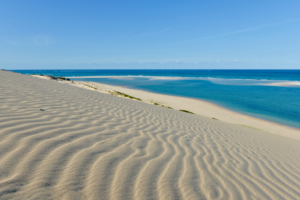
The islands are shaped by wind and water, with towering sand dunes rising behind beaches that seem impossibly pale. Inland, pockets of vegetation break up the sand, while lagoons and tidal flats create ever-changing patterns along the coastline.
And beneath the water, another world begins.
The archipelago sits within a protected marine environment known for its extraordinary biodiversity. Coral reefs, seagrass beds and coastal waters provide habitat for an array of marine life, including dolphins, turtles, rays and the remarkable dugong.
For travelers accustomed to thinking of an African safari as something that happens on land, Bazaruto offers another possibility:
a safari of the sea.
The Blue Hour Belongs to the Ocean
Spend a morning on the water and the archipelago begins to reveal another personality.
Boats skim across the shallows, Dolphins may appear alongside the vessel, Sea turtles move through the water with an ancient, almost effortless grace.
And beneath the surface, the reefs create flashes of colour and movement that make it easy to lose track of time.
For the adventurous traveler, the possibilities include snorkeling, diving, sailing, fishing and exploring the islands by boat.
But you don’t have to be an adrenaline seeker. There is equal pleasure in simply sitting on a quiet stretch of sand with your feet buried beneath it, watching the tide move in and out.
Perhaps that is one of Bazaruto’s greatest gifts. It allows you to participate—or simply be.
Benguerra: Barefoot Sophistication
If Bazaruto feels wild and expansive, Benguerra offers another expression of island life.
It is the kind of place where luxury and nature can exist comfortably beside one another.
Imagine waking slowly in the morning, stepping outside and finding the Indian Ocean waiting beyond the palms.
Breakfast becomes an event because there is nowhere else you need to be.
The afternoon might involve a boat trip, a swim, a walk along the beach or an hour beneath the shade of a tree with a book you’ve been meaning to finish for six months.
And then comes evening, The heat softens.The sky begins to change. The ocean takes on darker shades of blue.
You realize that you have spent an entire day doing very little and somehow feel that you have accomplished exactly what you came for.
This Is a Place for the Woman Becoming
There is something particularly compelling about Bazaruto for the woman who has entered her Golden Era.
Because at this stage of life, travel can become less about collecting destinations and more about choosing experiences that actually give something back.
The frantic itinerary loses its appeal.
The question becomes: Will this place restore me?
Bazaruto has the ingredients for that kind of escape. Space. Silence. Beauty. Warm water. Long horizons.
And the rare luxury of not being constantly required to perform.
For a woman who has spent years building businesses, raising children, caring for family, navigating relationships, surviving reinventions and carrying responsibilities that rarely make it onto a résumé, there is something deeply restorative about arriving somewhere where nobody needs anything from you.
You can simply exist.
Beyond the Beach
But Bazaruto should not be reduced to a luxury beach escape.
The archipelago is part of Mozambique’s extraordinary coastal ecosystem and is deeply connected to the communities and livelihoods surrounding these islands.
Fishing has long been central to life in the region, while tourism provides another important economic pathway.
That creates an interesting question for the sophisticated traveler:
What does responsible luxury look like here?
It can mean choosing operators who take marine conservation seriously. It can mean learning about the communities whose lives are connected to these waters.
It can mean understanding that the pristine beach you photograph is not simply scenery—it is part of a living ecosystem.
And increasingly, travelers are looking for exactly this kind of connection. They want beauty, certainly.
But they also want their money and their presence to mean something.
A Different Kind of Investment

Bazaruto is also becoming interesting from another perspective: investment.
The islands sit within one of Mozambique’s most distinctive tourism environments, combining exceptional marine assets, natural beauty and an international luxury-travel proposition.
For investors and entrepreneurs watching Africa’s tourism sector, destinations like Bazaruto raise compelling possibilities around high-value hospitality, marine tourism, conservation-linked experiences, wellness, private retreats and carefully designed luxury accommodation.
The opportunity, however, is not simply to build more rooms.
The more interesting question is how to create experiences that respect what already makes the destination extraordinary.
Because once you have destroyed the thing people came to see, no amount of luxury can recreate it.
The future of Bazaruto may therefore belong to those who understand that nature itself is the asset.
When the Sun Begins to Fall
There is a particular moment in Bazaruto when the day seems to exhale.
The sun begins its descent. The dunes become silhouettes. The water catches the last fragments of gold.
Someone is walking barefoot along the shoreline, leaving a temporary trail of footprints behind her. And for a moment, there is nowhere else to be.
No email. No deadline. No meeting. No noise. Just the Indian Ocean moving gently toward the shore, Perhaps this is why certain destinations remain in us long after we leave them. Not because we saw everything.
But because, for a brief moment, we felt entirely present.
The Taste of Mozambique
Where the Ocean Comes to the Table’

In Mozambique, the ocean doesn’t simply surround you.
It feeds you.
Along the country’s spectacular coastline, seafood is part of the rhythm of life—brought in from the Indian Ocean and transformed into meals that are wonderfully simple, deeply flavourful and unforgettable.
The first thing you notice is the freshness.
Prawns are firm and succulent. Lobster is sweet and delicate. Crab is rich and briny, while freshly caught fish arrives at the table with that unmistakable taste of the sea—clean, delicate and alive with flavour.
And then there is Mozambique’s famous peri-peri. Bright, fiery and fragrant, the chilli sauce brings heat to the sweetness of the seafood without overpowering it. Grilled prawns brushed with garlic, lemon, butter and peri-peri are the kind of meal that requires very little ceremony.
Just your hands. A cold drink. The sound of waves nearby. And perhaps a table facing the sunset.
Across destinations such as Maputo, Pemba, Vilanculos and the Bazaruto Archipelago, seafood takes on different personalities. Sometimes it is grilled over charcoal. Sometimes cooked with coconut. Sometimes served simply with rice, vegetables and a squeeze of lime.
The ingredients don’t need much help.
The ocean has already done most of the work.
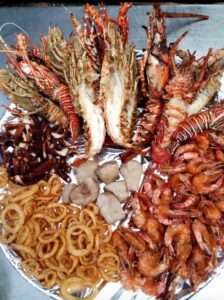
There is something particularly delicious about eating seafood this close to where it was caught. The prawns taste sweeter. The fish tastes cleaner. The crab seems almost impossibly fresh.
And perhaps that is the real luxury of Mozambique. Not elaborate presentation. Not complicated recipes.
But sitting beside the Indian Ocean, watching the sun fall into the water, while a plate of perfectly grilled prawns arrives at your table.
You take the first bite. Sweet. Smoky. Spicy. Fresh.
And suddenly you understand why, when people talk about Mozambique, they often remember the food almost as vividly as they remember the beaches.
Come for the ocean. Stay for the seafood.
HER GOLDEN ERA TRAVEL NOTE
Best for: Luxury escapes, romantic getaways, wellness retreats, marine adventures, multigenerational travel and travelers seeking nature with sophistication.
Look for: Island hopping, snorkeling, diving, sailing, marine wildlife encounters, sand dunes, secluded beaches and conservation-focused experiences.
The Golden Era perspective: Don’t simply visit Bazaruto. Learn the story of the islands, the ocean and the communities that call this extraordinary part of Mozambique home.
Travel philosophy: Go slowly. Spend thoughtfully. Leave lightly.Her
Her Golden Passport Takeaway
Travel here with curiosity, respect and a light footprint. Ask before photographing people, support local guides and businesses where possible, respect community traditions and remember that the beaches, reefs and waters are not simply attractions—they are home. The most meaningful souvenir from Bazaruto may be the memory of having experienced its beauty while leaving a little more of it behind for the people and generations who call these islands home.
The Golden Era Traveler
The Golden Era woman does not need to travel to prove that she has arrived. She travels because she has finally learned to ask a different question:
What kind of life do I want to experience?
Bazaruto offers one possible answer. A life with more horizon. More ocean. More beauty. More time.
A life where luxury can mean privacy rather than extravagance, adventure without exhaustion, and mornings that begin with the sound of water instead of an alarm.
Perhaps you come for the beaches. You stay for the sea. And somewhere between the first boat crossing and the final sunset, you remember something wonderfully simple:
You are allowed to enjoy the life you worked so hard to build.
Bazaruto is waiting.
And the Indian Ocean has all the time in the world.