
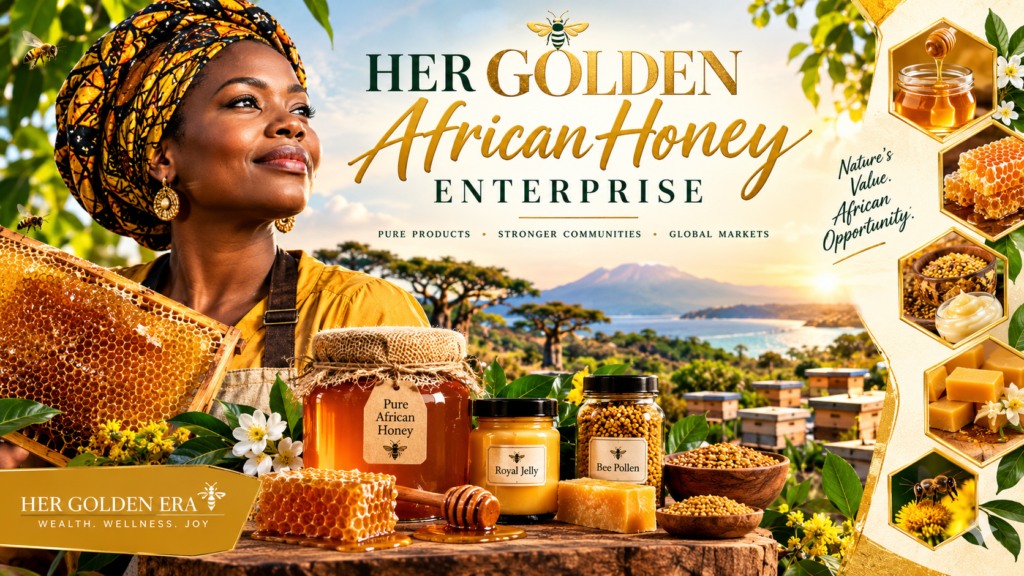
HER GOLDEN HONEY ENTERPRISE
beyond the sweetness
Africa has one of the world’s great underdeveloped honey resources. From the miombo woodlands of Zambia and Tanzania to Ethiopia’s highlands, West Africa’s savannahs and the forests of Central Africa, bees are producing a portfolio of products that can move far beyond raw honey.
The opportunity is not simply keeping bees and selling honey. It is building a small processing company that buys from beekeepers, improves quality, packages the honey, and captures value from the wax, comb and other bee products that are frequently sold cheaply or discarded.
The global apiculture market—including honey and other bee products—was valued at approximately $9.31 billion in 2024 and is projected to reach $11.78 billion by 2030. Honey products represent the largest segment. (Grand View Research)
THE GLOBAL MARKET IS ALREADY BUYING
Natural honey is a substantial international commodity. In 2024, the United States imported approximately $650 million of natural honey, the European Union $366 million, Germany $234 million, Japan $137 million and the United Kingdom $123 million. (World Integrated Trade Solution)
The European market is particularly relevant to African producers. The EU imported 163,700 tonnes of honey worth €359.3 million from outside the EU in 2023, while Germany alone imported about 41,000 tonnes. (European Commission)
There is also a market above ordinary bulk honey. European buyers increasingly look for traceable, certified, organic, Fairtrade, monofloral and sustainably produced honey. CBI identifies Germany, the UK, France, Poland, Belgium and Spain as important European markets. (CBI)
That distinction matters. Africa does not necessarily need to compete with the world’s biggest honey exporters on volume. A smaller processor can compete through origin, traceability, distinctive floral varieties, quality and presentation.
AFRICA ALREADY HAS THE RAW MATERIAL
Africa’s honey story stretches across almost every region of the continent.
| African region | Countries with established or emerging honey activity |
|---|---|
| East Africa | Ethiopia, Tanzania, Kenya, Uganda, Rwanda, Burundi, South Sudan |
| Southern Africa | Zambia, South Africa, Malawi, Zimbabwe, Mozambique, Angola, Namibia, Botswana, Eswatini, Lesotho |
| West Africa | Burkina Faso, Ghana, Nigeria, Benin, Togo, Côte d’Ivoire, Senegal, Mali, Niger, Guinea |
| Central Africa | Cameroon, Central African Republic, Democratic Republic of Congo, Gabon, Republic of Congo |
| North Africa | Morocco, Algeria, Tunisia, Egypt, Libya |
| Indian Ocean | Madagascar, Mauritius, Comoros, Seychelles |
The scale varies enormously between countries, and not every country is a significant commercial exporter. But the important point is that African honey is already crossing borders.
FAO has previously identified Ethiopia as Africa’s leading honey producer, while noting that Africa recorded the world’s highest growth rate in honey production over the decade covered by its analysis. (FAOHome)
Tanzania is particularly interesting. In 2024 it exported 444 tonnes of natural honey worth about $1.12 million, with Germany, Ireland, the Netherlands and the United States among its principal destinations. (World Integrated Trade Solution)
Zambia exported approximately 1,187 tonnes worth $3.11 million in 2024, supplying South Africa, the United States, the UK and Norway. (World Integrated Trade Solution)
South Africa exported about 513 tonnes worth $2.46 million, primarily into neighbouring Botswana, Namibia, Eswatini, Lesotho and Mozambique. (World Integrated Trade Solution)
Uganda exported approximately 55 tonnes in 2024, with China, the Democratic Republic of Congo, Kenya and Canada among its destinations. Interestingly, Uganda also imported 227 tonnes, demonstrating that African honey markets can operate in both directions rather than being purely export markets. (World Integrated Trade Solution)
Madagascar, Mozambique, Nigeria, Benin, Ghana and Algeria also appear in 2024 international trade data, although their export volumes are considerably smaller. (World Integrated Trade Solution)
THE REAL OPPORTUNITY IS THE HIVE — NOT JUST THE HONEY
A bee colony produces an entire basket of commercial products.
| Product | What it becomes | Commercial uses |
|---|---|---|
| Liquid honey | Bottled, bulk, flavoured or monofloral honey | Food, beverages, baking, hospitality, cosmetics |
| Comb honey | Sections of edible honeycomb | Premium retail, gifts, hotels, specialty food |
| Beeswax | Filtered and moulded wax | Candles, cosmetics, balms, furniture polish, food coatings, pharmaceutical applications |
| Bee pollen | Dried pollen granules | Food, supplements and wellness products |
| Royal jelly | Fresh or freeze-dried product | Supplements and specialty wellness products |
| Propolis | Extract, tincture or ingredient | Cosmetics, personal care and specialty wellness |
| Honey-based products | Blends, sauces, drinks and spreads | Retail, hospitality and specialty foods |
Beeswax deserves particular attention.
FAO notes that beeswax can command a higher value per kilogram than honey and identifies cosmetics, pharmaceuticals and candle-making among its principal uses. It also notes that beeswax is frequently neglected or discarded during honey extraction in tropical countries. (FAOHome)
That creates an unusually attractive by-product opportunity.
Tanzania demonstrates what this can look like at commercial scale. CBI reports that Tanzania exported 440 tonnes of beeswax in 2023, making it the fourth-largest non-European exporter that year. Tanzania also produced approximately 1,898 tonnes of beeswax in 2022. (CBI)
CBI also reports historical European honey and beeswax price levels illustrating the value difference: honey around €3/kg versus beeswax around €12/kg in the cited analysis. Actual prices vary by grade, certification, origin and buyer. (CBI)
That means a woman processing honey does not necessarily have to increase the number of hives to increase the value of the business.
She can become better at capturing what the existing hives already produce.
AFRICAN HONEY CAN SELL ON ORIGIN
One of Africa’s advantages is botanical diversity.
Acacia, miombo woodland, eucalyptus, sunflower, citrus, forest and wildflower honeys can produce different flavours, colours and aromas. FAO distinguishes between monofloral honey, derived predominantly from one plant source, and multifloral honey from several botanical sources. (FAOHome)
That creates a branding opportunity.
Instead of simply selling:
“African Honey — 500g”
a processor could develop products around identifiable origins:
Tanzania Miombo Forest Honey
Zambia Wildflower Honey
Ethiopian Highland Honey
Kenyan Acacia Honey
Madagascar Forest Honey
The distinction has commercial value only when the origin and product characteristics can genuinely be supported. Traceability therefore becomes part of the product rather than merely paperwork.
A LOW-IMPACT BUSINESS MODEL
The woman investor does not have to begin by owning hundreds of hives.
A lower-impact model is a honey aggregation and processing company.
She establishes relationships with beekeepers and cooperatives, purchases honey that meets defined quality standards, brings it to a small processing facility, tests moisture and quality, settles and filters it appropriately, packages it under her brand and sells through retail, hospitality and selected export buyers.
The same facility can recover beeswax instead of throwing it away.
That creates a simple circular model:
Beekeepers → Honey collection → Quality testing → Processing → Bottling + Comb Honey + Beeswax → Local / Regional / Export Markets
Later, the company can introduce pollen, propolis and royal jelly where there is sufficient beekeeper capacity and a qualified processing system.
This is important because royal jelly and pollen should not simply be added to a product catalogue because they sound valuable. They require different harvesting, handling and quality considerations. Honey and beeswax provide a much simpler starting point.
THE EXPORT DOOR IS ALREADY OPEN
Africa’s position is not theoretical.
CBI identifies Tanzania and Burkina Faso as African countries that have shown significant growth in honey exports to Europe, while Zambia has established relationships with European buyers. It also identifies Ethiopia, Angola, Kenya, Zambia and Tanzania as African origins with potential for higher-quality and certified honey. (CBI)
Tanzania’s existing export pattern is especially interesting because Germany, Ireland, the Netherlands and the United States are already buying Tanzanian honey. (World Integrated Trade Solution)
The European market does, however, require serious quality control. Honey entering the EU must originate from authorised countries and comply with residue-monitoring and food-safety requirements. Current authorised African origins include countries such as Burkina Faso, Benin, Ethiopia and Uganda. (CBI)
For a new African processor, that makes the first commercial step finding the buyer and understanding the specification before investing heavily in certification or equipment.
THE WOMAN-OWNED HONEY PROCESSOR
A practical first company could operate from a small food-grade processing room rather than an industrial factory.
Illustrative start-up snapshot
| Item | Planning figure |
|---|---|
| Small processing/settling equipment | $3,000 |
| Stainless tables, containers & filtration | $1,500 |
| Moisture/quality testing equipment | $1,000 |
| Bottles, labels & initial packaging | $1,500 |
| Beeswax recovery equipment | $750 |
| Registration, branding & basic compliance | $1,250 |
| Initial honey purchasing/working capital | $4,000 |
| Indicative starting capital | $13,000 |
This is a planning illustration, not a quotation. Equipment, premises, country requirements, packaging and working-capital needs will change the actual number.
At this scale, the objective is not to build a giant honey factory. It is to establish a reliable supply network and prove that the processor can consistently convert raw honey into higher-value products.
A simple revenue illustration
Suppose the business eventually processes 1,000 kg of honey per month.
If 700 kg is sold as branded retail honey at an average realised price of $7/kg and 300 kg is sold in bulk at $4/kg, that produces approximately $6,100 in monthly honey revenue.
If recovered beeswax adds another $200–$300, monthly sales could reach roughly $6,300–$6,400.
If total purchasing, packaging, labour, transport, utilities and operating expenses consume approximately 75% of sales, the remaining operating contribution would be around $1,575–$1,600 per month.
| Snapshot | Illustration |
|---|---|
| Initial capital | $13,000 |
| Monthly sales | ~$6,350 |
| Monthly operating contribution | ~$1,600 |
| Annual operating contribution | ~$19,200 |
| Simple annual return on initial capital | ~148% |
| Simple capital payback | ~8 months |
These figures should be treated as a business-planning example rather than a promised ROI. The actual result depends heavily on the price paid to beekeepers, product yield, retail pricing, packaging costs, seasonality, working capital and whether the business can actually sell its planned volume.
The model becomes more interesting as the company develops premium monofloral honey, comb honey, beeswax and eventually certified products, because the objective is to increase value per kilogram rather than simply process more kilograms.
THE OPPORTUNITY NOW
For an African woman—or a woman from the African diaspora—the honey opportunity does not require starting with a thousand hives or building a factory.
It can begin with relationships: a network of beekeepers, a small hygienic processing facility, reliable quality testing and a brand capable of telling the story of where the honey came from. Tanzania, Zambia, Ethiopia, Uganda and other African honey-producing regions already demonstrate that African bee products can enter international markets. The bigger opportunity is to capture more of the value after the honey leaves the hive—through processing, packaging, beeswax recovery, premium honey, comb honey and eventually other bee products. With relatively modest equipment and disciplined working capital, a woman entrepreneur can build a business that starts locally, sells regionally and eventually meets the specifications of international buyers.
Africa doesn’t need to produce more honey before women can build businesses around it. It needs to capture more value from the honey it already produces. (FAOHome)
READY TO EXPLORE THE OPPORTUNITY?
My name is Renae Bruce-Miller, and I am a professional consultant in African agro-processing, based in Dar es Salaam, Tanzania.
If this business opportunity has you thinking, “Could I actually do this?” — let’s talk.
I offer practical business and market-entry consultations for women who want to turn promising agricultural products and processing opportunities into viable businesses. Together, we can examine the market, supply chain, investment level, regulatory considerations and potential route to market and determine where to begin, what you need and what your next move should be.
CLICK HERE FOR OUR CONSULTANCY PAGE lets connect today
Sources
The principal trade figures above use 2024 World Bank WITS/UN Comtrade data; market and African-sector context is drawn from FAO, the European Commission and CBI. (World Integrated Trade Solution)