
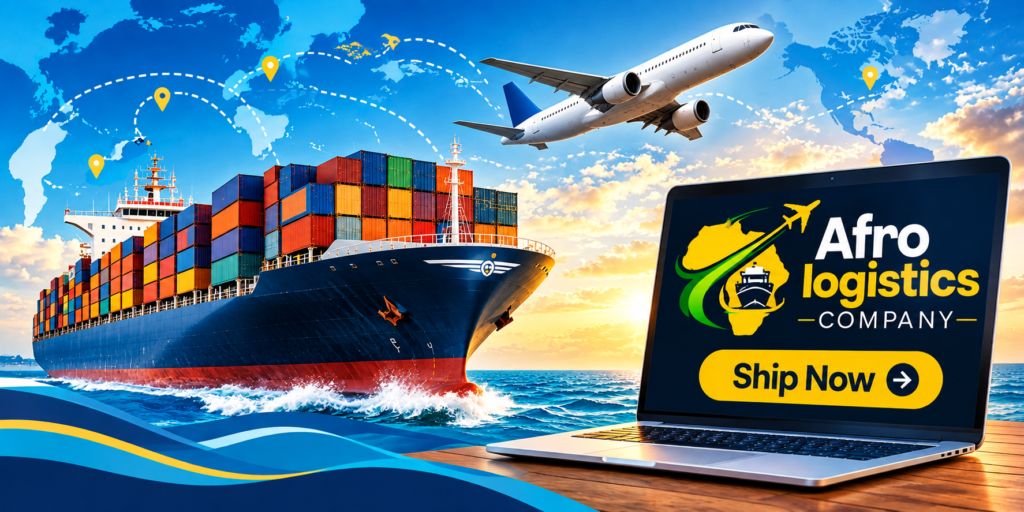
THE MISSING LINK
How to Build a Freight Forwarding Business Connecting Africa, America and the Caribbean
There is a business hiding inside the movement of goods between three worlds.
For generations, Africans and Caribbeans have exchanged people, culture, food and ideas across the Atlantic. The United States has become a critical marketplace for both African and Caribbean products. African cities are growing rapidly. Caribbean governments are actively looking toward Africa for new trading relationships. Diaspora consumers are already buying products from home.
But the physical infrastructure connecting these markets has not developed at the same speed.
That creates an opportunity.
Not necessarily to buy a ship.
Not necessarily to buy a fleet of trucks.
And certainly not to begin by building a giant logistics company.
The opportunity is to build a specialist freight-forwarding and trade logistics company that makes it easier for African producers, Caribbean businesses and diaspora consumers to move goods across the Atlantic.
And for the Golden Era woman looking for a serious, scalable business, this is worth examining.
THE OPPORTUNITY
A trade relationship that has barely been built
Africa and the Caribbean have an extraordinary historical connection, yet their modern commercial relationship remains surprisingly small.
Research by the International Trade Centre and Afreximbank found that current bilateral goods trade between Africa and the Caribbean was only about US$729 million, but estimated that it could rise to approximately US$1.8 billion annually by 2028 if value addition, trade facilitation and logistics improve. (Afreximbank)
A later 2025 analysis identified an even larger potential opportunity—up to approximately US$2.1 billion of additional trade within five years—and found that 57% of unrealised trade potential was associated with logistical challenges. (Afreximbank)
That is the number to pay attention to.
The problem is not simply that Africa and the Caribbean do not want to trade.
It is that moving the goods is still too difficult.
The 2025 AfriCaribbean Trade and Investment Forum subsequently made direct air and maritime connections one of the region’s explicit priorities. More than US$300 million in deals were announced at the 2025 forum, including projects involving logistics, infrastructure, manufacturing and trade. (Afreximbank)
Jamaica has also formally joined Afreximbank, giving the country access to trade guarantees, project finance and other instruments intended to support sectors including manufacturing, logistics and agriculture. (Afreximbank)
In other words:
The institutions are talking about building the corridor.
The private sector now has to build the businesses that use it.
A VERY OLD BUSINESS IDEA — WITH A NEW MARKET
The concept is not new.
Britain built enormous commercial networks around moving goods between Europe, West Africa and the Caribbean.
In the nineteenth and twentieth centuries, companies such as Elder Dempster developed regular shipping services between Britain and West Africa. Its ships carried textiles, cement, machinery and other manufactured goods toward West Africa while returning with commodities including cocoa, palm oil, timber, rubber, copper and other products. (Liverpool John Moores University)
There was an entire commercial ecosystem around the ships:
producer → exporter → shipping company → port → importer → wholesaler → retailer → consumer.
The shipping line was only one part of the business.
The same principle can be seen in Jamaica’s own history.
THE JAMAICA PRODUCERS LESSON
One of the most fascinating examples is Jamaica Producers.
In the 1920s, Jamaican banana farmers discovered that producing bananas was not enough.
They needed a reliable way to get those bananas to the British market.
In 1929, Jamaican farmers formed the Jamaica Banana Producers Association. By 1931, the organization had created its own shipping company and operated refrigerated vessels carrying Jamaican bananas to Britain. By 1937, Jamaican banana exports had reached approximately 360,000 tonnes, representing about half the value of Jamaica’s total exports at the time. (Jamaica Producers)
The lesson is profound:
The farmers did not simply need a product. They needed logistics.
Decades later, Jamaica Producers expanded again into logistics and in 2007 acquired RAM Shipping, a freight-forwarding business connecting the UK and Caribbean. That transformed the company from a producer into a more integrated logistics operation. (Jamaica Producers)
That is precisely the kind of lesson today’s entrepreneur can study.
You do not have to own every truck, warehouse or vessel.
You need to control the customer relationship and coordinate the network.
THE BARREL ECONOMY: THE OTHER GREAT LESSON
There is another Caribbean logistics story that should not be overlooked.
The barrel.
For decades, Caribbean migrants in Britain, the United States and Canada have sent barrels containing food, clothing, household goods and other necessities back home.
Jamaica’s own government has described these goods as a form of “remittances in kind”—an important supplement to cash remittances. (Jamaica Information Service)
Jamaica Customs still maintains a dedicated barrel-clearance process, and Jamaican authorities have repeatedly documented the importance of the barrel trade, particularly around Christmas. (Jamaica Customs Agency)
The business has evolved.
Today, companies are combining barrel shipping with:
- online ordering
- consolidation
- warehousing
- customs clearance
- home delivery
- tracking
- e-commerce
Mailpac, for example, launched an online barrel-packing and shipping platform and estimated that its technology and commercialisation investment would be less than J$30 million, while targeting US$1–2 million in annual barrel revenue over time. (Jamaica Observer)
The lesson is again simple:
A shipping business does not have to be about ships.
It can be about organising thousands of small shipments into one efficient commercial system.
THE CARIBBEAN IS LOOKING TOWARD AFRICA
This is where the opportunity becomes particularly interesting.
CARICOM and African institutions are actively trying to increase trade between the two regions.
The Africa–Caribbean Trade and Investment Forum has now been held repeatedly, with the goal of turning historical and cultural relationships into commercial relationships.
In 2025, Afreximbank and CARICOM stakeholders explicitly identified transport and logistics as one of the sectors where deeper cooperation is needed. They also committed to supporting direct air and maritime connections. (Afreximbank)
And this is not merely diplomatic language.
The 2025 forum attracted more than 2,100 delegates from 80 countries and produced more than US$300 million in announced trade and investment deals. (Afreximbank)
Jamaica is particularly interesting because it already has:
- a major port
- established Caribbean shipping relationships
- a large diaspora
- significant US trade
- an established food and agricultural export sector
- a long history of shipping
- access to the wider CARICOM market
- growing institutional interest in Africa
Jamaica imported approximately US$7.5 billion of goods in 2025, while exports were approximately US$1.65 billion. Imports of raw materials/intermediate goods and consumer goods both increased during the year. (Jamaica Observer)
The United States alone traded approximately US$3.1 billion in goods with Jamaica in 2025. (United States Trade Representative)
So Jamaica is not an isolated little island market.
It is part of a much larger trading system.
AND THEN THERE IS AFRICA
Africa’s demographic story makes the long-term opportunity even more interesting.
Africa remains the world’s fastest-growing major population region, and the African Development Bank projects that by 2050 the continent will contain approximately one-third of the global labour force. The Bank also points to a potential agricultural market exceeding US$1 trillion. (African Development Bank)
Africa’s economy is also growing.
The African Development Bank projected continental economic growth of 4.2% in 2025 and 4.3% in 2026, supported in part by private consumption. (African Development Bank)
As populations become larger, more urban and wealthier, demand grows for:
- packaged foods
- clothing
- beauty products
- cosmetics
- pharmaceuticals
- household goods
- machinery
- electronics
- construction materials
- agricultural inputs
- automotive parts
- health products
- processed foods
- luxury and lifestyle goods
And increasingly, African countries are looking not only toward Europe, China and America, but toward each other and the Global South.
That is where AfCFTA becomes important.
The opportunity is not simply:
Africa → Caribbean
It is:
Africa → Caribbean → North America
and potentially:
North America → Caribbean → Africa
while also moving goods within Africa itself.
THE MISSING PIECE
Here is the interesting contradiction.
Africa and the Caribbean are explicitly talking about increasing trade.
Businesses are looking for new markets.
Diaspora consumers already want products from home.
Jamaican businesses already have decades of experience exporting products.
African manufacturers and agricultural producers increasingly want international markets.
But the Africa–Caribbean trade relationship remains tiny.
And according to the ITC/Afreximbank research, logistics accounts for a substantial portion of the unrealised trade potential. (Afreximbank)
That suggests an opportunity for a company whose job is very simple:
Make Africa–Caribbean trade easier.
THE AIR-CONNECTIVITY CLUE
There are no scheduled nonstop passenger services between Jamaica and Africa as of September 2026. Kingston has no direct African service, and Montego Bay likewise has no scheduled nonstop African connection. (Flight Connections)
But the story is changing.
In December 2020, Nigerian airline Air Peace operated a historic direct Lagos–Montego Bay flight carrying more than 130 passengers. Jamaica described it as the first nonstop flight from Nigeria to the island and an exploration of future commercial airlift. (Jamaica Information Service)
In October 2025, Air Peace announced scheduled monthly services connecting Lagos and Accra with Antigua and Barbados, describing the move as a new direct West Africa–Caribbean connection. (Air Peace)
Then, in March 2026, the Caribbean’s first large-scale commercial flight directly to Africa connected St Kitts with Abuja, carrying more than 100 people from eight Caribbean countries. (Jamaica Observer)
The aviation infrastructure is beginning to move.
And every new passenger route potentially creates additional belly-cargo capacity.
The absence of a direct Jamaica–Africa route today should therefore not be presented as evidence that the market does not exist.
It may be evidence that the market has not yet been properly connected.
THE POTENTIAL
How big is the freight-forwarding business?
The answer depends on how the market is defined.
Recent industry estimates vary considerably because some studies count only international forwarding services while others include broader logistics, warehousing, brokerage and transportation activities.
Transport Intelligence estimates the global freight-forwarding market at approximately €208.1 billion in 2025, with projected growth toward €233 billion by 2030. (Transport Intelligence)
Another 2026 industry estimate puts international freight forwarding at approximately US$117.7 billion in 2025, growing to US$155.2 billion by 2030. (The Business Research Company)
Other broader market definitions produce substantially larger figures.
The important point is therefore not whether the industry is “worth $120 billion or $225 billion.”
It is that freight forwarding is already a huge global service industry growing alongside international trade.
Africa itself represents a significant market.
One 2026 industry estimate puts Africa’s freight-forwarding market at approximately US$18.2 billion in 2025, projected to reach approximately US$27.7 billion by 2032. (Ken Research)
And the broader African logistics market is estimated at approximately US$185 billion in 2025. (Ken Research)
For a new entrepreneur, the question is therefore not:
“Can I compete with the global logistics giants?”
It is:
“Can I own a profitable niche inside a giant market?”
THE BUSINESS MODEL
The smartest starting point may be an asset-light freight-forwarding company.
Instead of buying ships, aircraft and warehouses, the company coordinates existing infrastructure.
Think:
CUSTOMER
African manufacturer
African farmer
African food processor
Jamaican importer
Caribbean retailer
Diaspora consumer
US wholesaler
↓
YOUR COMPANY
Pickup
Documentation
Consolidation
Freight booking
Customs coordination
Tracking
Insurance
Delivery
↓
CARRIER NETWORK
Shipping line
Airline
Truck company
Warehouse
Customs broker
Local delivery company
↓
DESTINATION
Jamaica
Caribbean
United States
Africa
You become the orchestrator.
FIVE BUSINESS MODELS TO CONSIDER
1. Africa → Caribbean Consolidation
A company could collect smaller shipments from multiple African exporters and consolidate them into larger commercial shipments.
For example:
Accra → Kingston
Instead of one small Ghanaian food producer trying to negotiate international shipping alone, the forwarding company combines:
- shea products
- cocoa products
- packaged foods
- textiles
- beauty products
- furniture
- artisan goods
into commercially viable consolidated freight.
2. Africa → Caribbean → Diaspora
This scenario is particularly powerful.
Imagine a Jamaican retailer wants African products.
The forwarding company handles:
Accra → Kingston → Miami/New York/Toronto
The Jamaican business becomes the Caribbean distribution point.
The freight company is not merely transporting cargo.
It is helping create a regional distribution network.
3. America → Caribbean → Africa
The traditional barrel model could be expanded into commercial freight.
For example:
Miami → Kingston
could handle:
- household goods
- food
- clothing
- equipment
- small business inventory
- spare parts
- beauty supplies
But the company could then develop a second direction:
Miami → Kingston → Accra
That creates a triangular trade network rather than a one-way shipping service.
4. African Products for the Caribbean
This could be one of the most interesting niches.
African manufacturers already produce products that could appeal to Caribbean markets:
- shea butter
- cocoa
- coffee
- spices
- dried foods
- textiles
- fashion
- natural cosmetics
- furniture
- art
- packaged foods
- agricultural products
The freight company can become the bridge.
It can even maintain a catalogue of African suppliers and help Caribbean buyers discover products.
At that point, the business begins to resemble a combination of:
freight forwarder + sourcing company + trade platform.
5. Specialist Freight
A new company does not have to handle everything.
It could specialize in:
Food
African and Caribbean food products.
Beauty
African beauty and personal-care products.
Healthcare
Medical equipment and approved health products.
Agriculture
Seeds, equipment, irrigation components and agricultural machinery, subject to applicable import controls.
E-commerce
Small commercial shipments from African brands to diaspora consumers.
Perishables
Flowers, specialty foods, seafood, fresh produce and other temperature-sensitive products.
The niche can then become the company’s competitive advantage.
THE GOLDEN ERA WOMAN’S OPPORTUNITY
The Golden Era woman does not necessarily have to become a shipowner.
She could become a trade infrastructure entrepreneur.
Imagine a company founded by a Black woman or a group of black women with a network comprising of:
- a US office
- an African operations partner
- a Jamaican or Caribbean distribution partner
- relationships with shipping lines
- relationships with airlines
- customs brokers
- warehouses
- trucking companies
- digital tracking
- an online booking platform
She does not own every asset. She owns the network, customers, brand and data.
And that can be enormously valuable.
THE INVESTMENT
The biggest misconception about freight forwarding is that you must start with enormous capital.
You don’t necessarily need to.
There are at least three levels.
LEVEL 1 — FREIGHT AGENCY
Approximate concept:
US$10,000–$30,000
Potential uses:
- company formation
- website
- freight software
- insurance
- marketing
- trade memberships
- sales
- legal/compliance advice
- small office
- working capital
At this stage, the company can partner with established licensed forwarders and carriers.
LEVEL 2 — SPECIALIST FREIGHT FORWARDER
Potentially:
US$50,000–$250,000+
depending heavily on jurisdiction, licensing, staff, facilities and working-capital requirements.
Now the business could add:
- warehouses
- consolidation
- staff
- freight contracts
- customs relationships
- multiple origin countries
- multiple destination markets
- dedicated customer service
- technology
LEVEL 3 — INTEGRATED LOGISTICS COMPANY
Potentially:
US$500,000 to several million dollars
This is where the company begins owning or controlling:
- warehouses
- trucks
- distribution centres
- container capacity
- cold storage
- fulfilment
- regional offices
- technology
- customs operations
The important point is:
You don’t begin at Level 3.
You build toward it.
A CRITICAL REGULATORY POINT
The company must decide what it actually wants to be.
A freight-forwarding business operating in US ocean trades can fall under the Federal Maritime Commission’s Ocean Transportation Intermediary framework.
A US-based ocean freight forwarder or NVOCC generally requires FMC licensing and financial responsibility. The FMC currently specifies financial responsibility of US$50,000 for a US-based ocean freight forwarder and US$75,000 for a US-based NVOCC. (Federal Maritime Commission)
There is also an experience requirement for a US-based applicant’s qualifying individual, including three years of demonstrable OTI experience. (Federal Maritime Commission)
That does not mean an entrepreneur needs to abandon the idea.
It means the startup structure matters.
One route is to initially operate as a sales/coordination business working with licensed freight-forwarding partners while building volume and expertise.
Another is to hire or partner with an experienced qualifying individual and pursue the appropriate licenses.
Customs brokerage is a separate regulatory function. In the United States, conducting customs business for others requires a CBP customs broker license. (CBP)
Jamaica similarly maintains a licensed customs-broker system, and Jamaica Customs states that commercial declarations and imports with a CIF value of US$5,000 or more generally require clearance through a licensed customs broker. (Jamaica Customs Agency)
So the smartest founder does not try to do everything herself.
She builds a compliance network.
THE REAL COMPETITIVE ADVANTAGE
The opportunity is not necessarily to offer the cheapest freight rate.
Large companies can often beat a small startup on scale.
The smaller company can win customers through:
Simplicity
“One company handles the shipment from pickup to delivery.”
Trust
Customers know exactly where their goods are.
Cultural intelligence
The company understands African, Caribbean and diaspora customers.
Small-business friendliness
A manufacturer shipping 200 kilograms should receive the same attention as a major corporation.
Consolidation
Small exporters share container or airfreight capacity.
Transparency
Customers see:
pickup → warehouse → export → vessel/aircraft → customs → delivery.
Specialisation
Instead of being “another freight company,” the brand becomes:
the Africa–Caribbean trade specialist.
THE NEXT MOVE
A woman seriously considering this business should not begin by buying a truck.
She should begin with one trade corridor.
STEP 1 — Choose the first corridor
For example:
Accra → Kingston
or
Lagos → Kingston
or
Nairobi → Kingston
or
Dar es Salaam → Miami → Kingston
The objective is to prove one route.
STEP 2 — Identify ten products
Do not begin with “everything.”
Choose ten categories with realistic demand.
For example:
- African beauty products
- Packaged foods
- Cocoa products
- Coffee
- Textiles
- Furniture
- Spices
- Agricultural products
- Artisan products
- Small commercial inventory
Then determine:
Who wants to buy these?
STEP 3 — Interview 50 buyers
Find:
- Jamaican retailers
- Caribbean supermarkets
- African restaurants
- beauty retailers
- wholesalers
- diaspora entrepreneurs
- hotels
- restaurants
- African product distributors
Ask them:
What products do you currently struggle to import?
That question could reveal the business.
STEP 4 — Interview 25 African exporters
Find producers in Ghana, Nigeria, Kenya, Tanzania, South Africa, Rwanda and other promising markets.
Ask:
What stops you from selling into the Caribbean?
The answer may be:
- shipping cost
- documentation
- lack of buyers
- customs
- small shipment size
- unreliable delivery
- lack of knowledge
- payment risk
Every repeated answer represents a possible service.
STEP 5 — Get freight quotes
Ask several carriers and forwarders for rates on the same shipment.
For example:
500 kg Accra → Kingston
Compare:
- air freight
- LCL ocean freight
- FCL ocean freight
- consolidation
- customs
- insurance
- destination charges
- last-mile delivery
Now calculate your gross margin.
STEP 6 — Build THE FIRST CONTAINER
Don’t wait for hundreds of customers.
Find perhaps:
10 businesses × 100 kg each = 1,000 kg
and consolidate their shipments.
You have now created your first commercial test.
STEP 7 — Build THE DIGITAL LAYER
The customer should eventually be able to:
Get quote → book shipment → upload documents → pay → track → receive delivery.
The technology does not have to be complicated at first.
Even a professionally designed website, customer portal, payment system and shipment-tracking workflow can dramatically improve the experience.
STEP 8 — Add THE BARREL
Once the commercial system works, add the diaspora consumer.
Instead of:
“Send your barrel home.”
the proposition becomes:
“Send almost anything home.”
Barrels.
Boxes.
Pallets.
Commercial inventory.
Vehicles.
Equipment.
E-commerce orders.
And eventually:
African products going the other direction.
STEP 9 — BUILD THE TRIANGLE
This is where the company becomes much more interesting.
Instead of thinking:
Africa → Jamaica
think:
AFRICA
↓
JAMAICA / CARIBBEAN
↓
NORTH AMERICA
And:
NORTH AMERICA
↓
JAMAICA / CARIBBEAN
AFRICA
Now the company is creating a three-market logistics network.
STEP 10 — OWN THE CUSTOMER, NOT THE SHIP
This may be the most important principle.
A startup does not need to own the vessel.
It needs to own:
- the customer
- the booking
- the data
- the relationship
- the brand
- the shipment visibility
- the trade network
As volume grows, the company can negotiate better carrier rates.
Then it can lease warehouse space.
Then dedicated consolidation space.
Then trucks.
Then perhaps a warehouse.
And eventually, if the economics justify it, dedicated vessel or aircraft capacity.
THE BIGGER VISION
There is a much bigger company hiding inside this idea.
Imagine an online platform called:
Africa–Caribbean Trade Exchange
A Jamaican buyer searches for:
Shea butter — Ghana
and sees verified suppliers.
A Ghanaian manufacturer searches:
Jamaica distributor — beauty products
and sees Caribbean buyers.
A Jamaican supermarket orders 500 kg.
The platform calculates:
Pickup + consolidation + ocean freight + customs + delivery.
Payment is processed.
The shipment is tracked.
The Jamaican distributor receives the goods.
And the freight company earns money from the movement.
That is no longer simply freight forwarding.
It becomes trade infrastructure.
WHY THIS MOMENT IS IMPORTANT
Africa and the Caribbean are already being encouraged by their institutions to trade more.
Afreximbank and ITC have identified logistics as one of the major barriers to unlocking that trade. CARICOM and African institutions are working toward stronger commercial relationships and direct transportation links. Jamaica has joined Afreximbank. New Africa–Caribbean aviation links are beginning to appear. (Afreximbank)
Meanwhile, the global freight-forwarding industry is already worth hundreds of billions of dollars, depending on how the sector is defined. (Transport Intelligence)
And the historical lesson from Jamaica Producers is sitting right there:
When producers cannot reliably reach markets, somebody has to build the bridge.
Today, the bridge is no longer necessarily a fleet of ships.
It can be a sophisticated network of people, ports, warehouses, technology, customs specialists, carriers and customers.
THE GOLDEN ERA TAKEAWAY
For the woman who wants to build something powerful, freight forwarding may not look glamorous at first.
But look beneath the surface.
Every product sold internationally has to move.
Every African manufacturer looking for a Caribbean customer needs logistics.
Every Jamaican retailer buying African goods needs logistics.
Every Caribbean producer trying to reach Africa needs logistics.
Every diaspora entrepreneur importing inventory needs logistics.
And every new trade relationship creates another shipment.
The opportunity is not to move boxes.
The opportunity is to become the company that makes an emerging trade corridor possible.
START SMALL.
One country.
One port.
One product category.
One customer group.
One container.
Then build the network.
Because the next generation of global trade may not be about choosing between Africa, America and the Caribbean.
It may be about connecting them.