
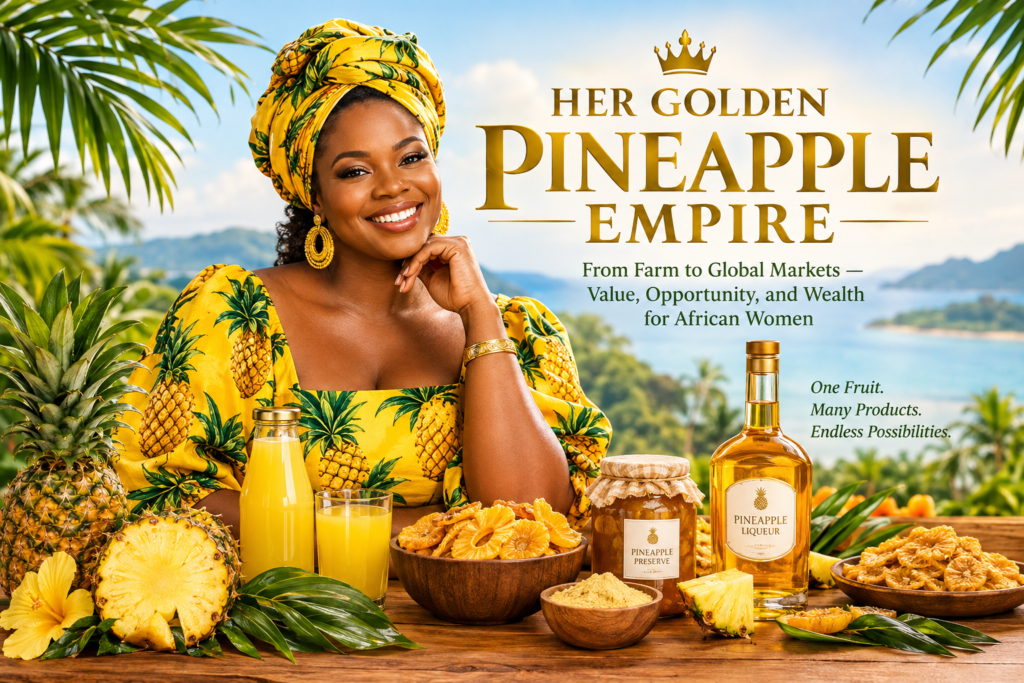
HER GOLDEN PINEAPPLE ENTERPRISE
The woman who sees a pineapple sees a fruit. The woman who sees everything inside it sees a business.
There are some fruits that announce themselves.
The pineapple does it with a crown.
It arrives at the market looking almost finished before anyone has done anything to it: golden flesh beneath a rough skin, a sharp sweetness, a tropical fragrance and a form that seems designed for the centre of a table. We cut it, eat it and throw away what remains.
But the pineapple is an unusually generous commodity.
Its flesh can become juice. Its pieces can become preserves. Its surplus can become dried fruit. Its dried fruit can become powder. Its flesh can become puree. Its flavour can become essence. And its agricultural surplus can move into beverages, bakery products, confectionery, food service, hospitality and, at the more regulated end of the value chain, premium liqueur.
That changes the question.
The question is no longer simply: How much can I make growing pineapples?
It becomes: How much value can I create from the pineapple I can already source?
A Global Pineapple Economy Worth Billions
That distinction matters because pineapple is not a small global crop.
Approximately 29.3 million tonnes of pineapples were produced worldwide in 2024.
The fresh pineapple market alone was valued at approximately US$11.54 billion in 2024. That figure refers specifically to the fresh-pineapple segment, rather than every processed pineapple product sold around the world.
And that distinction is important.
There is no single universally accepted figure for the entire pineapple economy because different market researchers count different things. Some measure fresh fruit. Others include canned pineapple, juice, concentrates, puree, powders, ingredients and downstream consumer products.
The important point is not to pretend those numbers can simply be added together.
The important point is to understand what they reveal.
Pineapple is a global commodity market worth billions of dollars before we even begin climbing the value chain.
Costa Rica, the Philippines and Indonesia remain among the world’s largest producers, while Nigeria is one of the world’s leading producers and Africa’s pineapple industry continues to expand.
For the entrepreneur, that distinction is important.
A woman does not need to capture the whole pineapple market.
She needs to find a profitable corner of it.
Africa Is Already Producing the Raw Material
Africa is not beginning at zero.
In 2024, Nigeria produced approximately 1.61 million tonnes of pineapple, making it Africa’s largest producer. Angola produced about 809,000 tonnes, Ghana approximately 695,000 tonnes, Benin about 484,000 tonnes, and Tanzania approximately 469,000 tonnes. Malawi produced about 385,000 tonnes, while Cameroon produced approximately 319,000 tonnes.
The significance of those numbers is not simply that Africa grows pineapples.
It is that Africa has raw material at scale.
Tanzania alone harvested approximately 18,923 hectares of pineapple in 2024, producing 469,000 tonnes. That places the country among the significant pineapple-producing economies globally, even though its pineapple industry is nowhere near as internationally visible as Costa Rica’s.
Ghana provides another interesting example because its pineapple economy already extends beyond farming into export, processing and employment.
Research examining Ghana’s pineapple sector found that pineapple production and processing were profitable activities, while marketing captured a different and more difficult economic position. The study identified capital, fruit supply and packaging materials among the factors influencing processors’ profitability.
This is precisely where the opportunity begins to move away from the farm.
And Then There Is the Caribbean
For African-descended women, the pineapple story does not stop at Africa.
The Caribbean has its own pineapple economy.
The Dominican Republic produced approximately 630,000 tonnes in 2024, according to FAOSTAT-based data. Jamaica produced approximately 51,200 tonnes, while Cuba produced about 23,900 tonnes. Guyana, which sits on the South American mainland but participates in the wider Caribbean economy, produced approximately 39,200 tonnes.
Jamaica is particularly interesting because the country’s agricultural investment agency has identified pineapple as an investment opportunity. Its investment profile reported pineapple export earnings rising from approximately US$4.03 million in 2020 to US$8.57 million in 2023, while noting growing interest in varieties such as Sugar Loaf and MD2 for premium markets.
So the opportunity is not simply African.
A Jamaican woman can look at the fruit growing at home.
A Ghanaian woman can look at the fruit growing around Nsawam.
A Tanzanian woman can look at what is being produced in her own agricultural regions.
And an African American woman does not necessarily have to travel to Africa to participate.
The United States itself produced approximately 168,000 tonnes of pineapple in 2024, according to FAOSTAT-based data, although the U.S. market is overwhelmingly supplied by international trade rather than domestic production.
That creates an interesting diaspora proposition: source locally where possible, source internationally where necessary, and add value wherever the economics make sense.
The Woman in the Pineapple Economy
Women are already present in this value chain.
The question is where they are participating—and where they are capturing value.
Ghana offers unusually useful evidence.
Research into the Ghanaian pineapple industry found that female employment in export-oriented pineapple production had positive effects on women’s income, asset ownership and household economic resources. The research also found that joint participation of women and men in horticultural employment was associated with greater household decision-making power for women.
More recently, Ghana launched Women in Pineapple Production (WIPP), an initiative involving Swisscontact, HPW Fresh & Dry and the Chamber of Women in Agribusiness Ghana. The programme specifically addresses women’s access to training, inputs, technical support and markets in pineapple production.
That matters because it demonstrates something bigger than a single project.
Women do not have to enter agriculture only as farm labour.
They can participate as producers, aggregators, processors, brand owners, packagers, distributors and exporters.
And sometimes the most accessible entry point is not farming at all.
It is processing.
Start Where the Resistance Is Lowest
A woman looking at pineapple does not necessarily need to purchase land.
She may begin by purchasing fruit from farmers.
Pineapple processing can create a bridge between the farmer and the consumer without requiring the entrepreneur to own the entire agricultural system.
The value chain can therefore become a ladder:
FRESH PINEAPPLE → DRIED PINEAPPLE → PINEAPPLE POWDER → PINEAPPLE PUREE → JUICE → PRESERVES → PINEAPPLE ESSENCE → LIQUEUR
The order is not meant to suggest that every business must follow every rung.
It is a way of seeing the commercial possibilities.
Each step requires more processing, more equipment, more packaging discipline and, in some cases, more regulation.
But each step also changes what the customer is buying.
A fresh pineapple is a fruit.
A packet of dried pineapple is a shelf-stable snack.
A bag of pineapple powder is an ingredient.
A pouch or drum of pineapple puree is a food and beverage input.
A bottle of juice is a beverage.
A jar of pineapple preserve is a branded food product.
Pineapple essence is a flavour ingredient that can enter manufacturing.
A bottle of pineapple liqueur is an adult beverage with an entirely different pricing architecture.
This is the essence of value addition.
The First Rung: Dried Pineapple
Dried pineapple may be one of the clearest places to begin because it addresses one of the agricultural industry’s oldest problems: perishability.
Fresh pineapple has a limited shelf life. Processing changes the clock.
FAO’s guidance on pineapple processing describes a hierarchy in which fresh fruit has the highest value but limited shelf life, while processing allows pieces, off-size fruit and other usable portions to move into products such as dried fruit, juice and preserved products.
The opportunity is especially interesting for women because dried fruit can begin at relatively modest scale.
A small processor can source mature fruit, wash and prepare it, slice it, dry it under controlled conditions, package it and sell it through supermarkets, specialty food shops, hotels, airlines, gift boxes and online channels.
Ghana has already demonstrated this model. Historical value-chain work documented women operating small pineapple-drying businesses, purchasing fruit from established farmer networks and selling packaged dried pineapple domestically and into European markets.
The lesson is not that every dried-fruit business will succeed.
It is that the business model is real.
The Second Rung: Pineapple Powder
Powder takes the same raw material one step further.
Instead of selling pineapple primarily as something to eat, the entrepreneur sells it as an ingredient.
Pineapple powder can potentially serve food manufacturers, beverage companies, bakeries, confectioners, smoothie and wellness brands, seasoning and flavour applications, and hospitality businesses.
The global pineapple powder market has been estimated at approximately US$799 million in 2024, illustrating that powdered pineapple is not merely a small retail novelty but part of a broader ingredient economy.
The advantage is shelf stability and transportability.
A pineapple that would have required refrigerated handling as fresh fruit can become a concentrated, packaged ingredient with a much longer commercial life.
The critical issue is quality.
Moisture control, food safety, drying temperature, grinding, particle size, packaging and storage all become part of the product.
This is where the entrepreneur stops being simply a fruit seller and starts behaving like a manufacturer.
The Third Rung: Pineapple Puree
This is one of the opportunities we should not overlook.
Puree is the bridge between the farm and the industrial food-and-beverage manufacturer.
Instead of selling pineapple directly to a consumer, the processor can sell a standardized pineapple ingredient to another business.
Pineapple puree can be used in beverages, smoothies, sauces, desserts, ice cream, bakery products, confectionery, cocktails and food-service applications.
The global pineapple puree market has been estimated at approximately US$799 million in 2024, with forecasts placing it above US$1 billion over the following decade.
The significance for an African processor is not simply the size of that market.
It is the possibility of selling pineapple B2B.
A hotel may buy juice.
A supermarket may buy preserves.
But a beverage manufacturer, bakery, dessert company or food-service distributor can buy puree repeatedly as an ingredient.
That can create a different kind of business relationship.
The processor is no longer asking:
Who wants to buy my pineapple?
She is asking:
Which manufacturer needs pineapple as an input?
That is a much larger commercial conversation.
The Fourth Rung: Juice
Juice takes pineapple back toward its liquid form—but now the business is no longer selling fruit.
It is selling a beverage.
This opens an entirely different market: supermarkets, cafés, hotels, restaurants, airlines, schools, offices, wellness businesses and hospitality venues.
Pineapple juice is already a substantial international category.
For African and Caribbean entrepreneurs, there is another advantage.
Juice allows the entrepreneur to use fruit that may not meet the visual requirements of the premium fresh-fruit market.
A pineapple does not have to be beautiful enough for the supermarket shelf to become beautiful enough for a bottle.
That is an important principle in agro-processing:
processing can turn agricultural imperfection into commercial value.
The Fifth Rung: Pineapple Preserves
Preserves introduce another kind of value.
Now pineapple becomes something that can sit on a breakfast table, inside a hotel gift basket, beside a cheese board, on a pastry menu or in a specialty food shop.
The product can be positioned as everyday food or as premium tropical pantry merchandise.
This is where packaging and brand storytelling begin to matter almost as much as the fruit.
A woman does not have to compete only on the price of pineapple.
She can compete on:
origin, flavour, presentation, ingredients, story and experience.
A Jamaican pineapple preserve can tell one story, A Tanzanian pineapple preserve can tell another.
A Ghanaian pineapple preserve can tell another, And an African American woman creating a Florida-sourced or diaspora-inspired product can create another.
The commodity is the same.
The enterprise is not.
The Sixth Rung: Pineapple Essence
Here the pineapple leaves the supermarket aisle and enters the ingredient industry.
Pineapple essence can be supplied in liquid or powdered forms and used in products such as beverages, confectionery and baked foods. The category also extends into personal-care and other formulation markets.
Current market estimates vary substantially because researchers define “essence” differently. One 2025 estimate places the global pineapple essence market at approximately US$207 million, while other research produces considerably different totals.
That is a reason to treat the category carefully rather than inflate its value.
But the commercial principle is clear.
A processor who can consistently create a safe, standardized pineapple flavour ingredient is no longer selling only to households.
She can sell to manufacturers.
And that is where pineapple begins to intersect with the much larger world of food ingredients.
For an entrepreneur, this can also create an opportunity to move beyond selling a finished consumer product.
Instead of creating one pineapple drink, she can potentially supply the flavour that appears in many different products.
The Seventh Rung: Pineapple Liqueur
At the top of this particular ladder sits pineapple liqueur.
This is no longer simply food processing.
It is beverage manufacturing, branding and hospitality.
Pineapple’s natural aroma, sweetness and tropical identity make it compatible with the premium cocktail and culinary world, but alcohol production introduces a completely different regulatory environment.
Licensing, excise duties, alcohol manufacturing requirements, labelling, packaging, distribution and age restrictions must be understood before entering the category.
That makes liqueur a higher-resistance opportunity than dried fruit.
But it also illustrates the larger principle of the pineapple economy.
The same fruit can enter several industries.
Food.
Beverages.
Hospitality.
Tourism.
Gifting.
Specialty retail.
Food ingredients.
And potentially international trade.
What Could the Numbers Look Like?
The table below is deliberately structured as an illustrative micro-processing model, not a promise of profitability.
It assumes a processor starts with 1,000 kg of fresh pineapple and sells into a small branded or wholesale market. Actual yields, fruit costs, labour, packaging, electricity, equipment depreciation, distribution, taxes and selling prices will vary significantly by country and scale.
The purpose is to show how the economics can change as the same commodity moves up the value chain.
| Product | Illustrative output from 1,000 kg fresh pineapple | Illustrative sales revenue | Illustrative total processing cost* | Illustrative gross return | Indicative processing ROI |
|---|---|---|---|---|---|
| Dried pineapple | ~140 kg | $1,120 | $820 | $300 | 37% |
| Pineapple powder | ~110 kg | $1,210 | $920 | $290 | 32% |
| Pineapple puree | ~650 kg | $1,625 | $1,050 | $575 | 55% |
| Pineapple juice | ~550 litres | $1,650 | $950 | $700 | 74% |
| Pineapple preserves | ~2,400 × 250g jars* | $4,800 | $1,800 | $3,000 | 167% |
| Pineapple essence | ~10–20 kg concentrated ingredient* | $1,800 | $1,050 | $750 | 71% |
| Pineapple liqueur | ~800 × 500ml bottles* | $14,400 | $8,500 | $5,900 | 69% |
*These are planning assumptions for illustrating the value ladder, not current quotations or guaranteed yields. Puree, essence, preserves and liqueur economics are particularly sensitive to extraction method, concentration, formulation, packaging, licensing, excise, wastage, quality standards and market positioning.
The table should therefore be read in the way an investor reads a preliminary feasibility model:
not as a promise, but as a question.
What happens when I stop selling the pineapple only as fresh fruit?
What happens to the economics when I control drying?
What happens when I control packaging?
What happens when I create a branded product?
What happens when I sell puree to another manufacturer?
What happens when I sell a flavour ingredient rather than a finished drink?
That is where the enterprise begins to become interesting.
The Real Opportunity May Be in the Fruit That Does Not Make the Export Grade
One of the most important features of pineapple processing is that the processor does not necessarily need every fruit to look perfect.
Export and premium fresh markets impose specifications.
Processing creates another outlet.
Fruit that is too small, irregularly shaped or cosmetically imperfect may still contain excellent flesh.
The processor can therefore create relationships with farmers around quality specifications appropriate for processing, rather than paying premium prices for fruit destined for the fresh export market.
This can potentially create a more efficient relationship between farmer and processor.
The farmer gets another market.
The processor gets raw material.
The consumer gets a product.
And less agricultural value is lost simply because the fruit does not look perfect.
The Diaspora Opportunity
This is where pineapple becomes particularly interesting for African American and Caribbean women.
The opportunity does not require every woman to become a farmer in Africa.
An entrepreneur in Florida can work with Florida-grown fruit or establish relationships with Caribbean, African or Latin American suppliers.
A Jamaican woman can build around Jamaican Sugar Loaf or MD2.
A Ghanaian woman can work with local growers and processors.
A Tanzanian entrepreneur can build a processing business close to production.
An African American entrepreneur can build a consumer brand in the United States while sourcing through compliant suppliers.
The geography can change.
The business principle does not.
Commodity → Value Addition → Market → Enterprise → Investment Possibility.
That is the part of African agro-processing that deserves much more attention.
Africa does not necessarily need to export every opportunity in its rawest form.
Sometimes the greater opportunity is to process more of what it already grows.
The Pineapple Is Not the Business
This is perhaps the most important distinction.
The pineapple is the raw material, The business is everything built around it, The procurement network, The processing method, The food-safety system, The packaging, The brand, The distribution, The market, The customer, The repeat purchase.
And eventually, the ability to scale.
A woman does not necessarily have to own a pineapple plantation to own a pineapple enterprise.
She may own the processing equipment, She may own the brand, She may own the distribution relationship.
She may aggregate fruit from twenty farmers, She may produce dried pineapple for hotels, She may supply powder to food manufacturers, She may sell puree to beverage and dessert manufacturers, She may bottle juice.
She may develop a pineapple essence for food manufacturers, She may build a premium Caribbean preserve line.
Or, after establishing the necessary licenses and capital structure, she may move into specialty beverages.
The pineapple simply gives her a place to begin.
The Investment Question
The temptation in agriculture is to begin with land.
But for many women, particularly women entering agro-processing for the first time, the better question may be:
Where is the least complicated point at which I can create value?
Dried pineapple may require less regulatory complexity than liqueur.
Powder may require more technical control but offer a shelf-stable ingredient.
Puree may provide a B2B route into manufacturers, food service and beverage companies.
Juice may provide a larger consumer market but require stronger food-safety and packaging systems.
Preserves may allow a relatively accessible branded-food model.
Essence may move the entrepreneur into a more technical ingredient business serving other manufacturers.
Liqueur may offer higher-value positioning but requires a substantially more regulated business environment.
There is no universal starting point.
There is a sequence.
And the sequence matters.
The objective is not to conquer the market.
It is to find a profitable corner of it.
HER GOLDEN PINEAPPLE ENTERPRISE
The pineapple may arrive from a farm in Tanzania, Ghana, Nigeria or Jamaica.
It may come from a family farm in the Caribbean.
It may be sourced domestically in North America or through an international supplier.
What happens next is the entrepreneur’s decision. And, with the appropriate investment, licensing and technical expertise, it can become a premium beverage.
The woman who sees only a pineapple sees a commodity. The woman who sees the flesh, the juice, the dried fruit, the powder, the puree, the essence, the preserve, the beverage, the hospitality product and the gift box sees an enterprise.
That is how a commodity becomes a company.
And that is how she begins building Her Golden Pineapple Enterprise.
A NOTE FROM HER GOLDEN ERA
My experience as an international business-development professional, foreign investor, seaweed entrepreneur and agro-processor has given me first-hand experience of the practical barriers between African opportunity and successful enterprise.
My work through Her Golden Era is now expanding that experience into market research designed to help women identify and understand African investment and enterprise opportunities.
I research African agricultural commodities, value chains, processing opportunities, markets and investment entry points and translate that research into practical opportunity stories for women.
Her Golden Era researches, tells, discovers and connects.
We want to help African women agro-processors, manufacturers, exporters, entrepreneurs and business ownersand women of the African diaspora looking toward Africa—understand how to participate responsibly, legally, successfully and strategically.
Businesses to support.
Markets to enter.
Companies to partner with.
Investment opportunities to understand.
We do not want to simply promote investment. We want to lead the conversation responsibly.
My name is Renae Bruce-Miller. I am a professional consultant in African Agro-processing based in Dar es Salaam, Tanzania.