

I‘ve always had a habit of being ahead of the curve.
In my work on trade and food systems, that means seeing trends others can’t yet see.
For Example:In July 2016, four months before his first election, I wrote in a published newspaper article, that a Trump presidency would make the US more insular and cut trade partnerships, and that Caribbean and African nations would feel the pain of the trade fallout first and worst.
-Nearly a decade later, Trump’s US tariffs upended trade for African and Caribbean nations, with some of the poorest countries hit hardest, and the uncertainty is still not resolved.
That’s the Cassandra’s curse: no matter how accurate the prediction, no one believes it until it’s too late.
I have another prediction, concerning African food security but I wont write sbout it explicity this time,
instead of writing another long article on the importance of African women in global food systems, I asked AI to do the visualizing.
I had it model a worst-case scenario: what happens to the world if African women stopped farming overnight.
The point isn’t to predict a strike.
It’s to show how much rests on the shoulders of African women and to make the case for two reforms: secure land ownership for African women, and real support to formalize and scale women-led businesses across agricultural food systems.
My thesis does not come from the land of imagination but rooted in resl world material facts.
According to FAO- Women supply roughly 40-50% of agricultural labor in sub-Saharan Africa (higher in some countries)plus most of the post-harvest processing, storage, and market trading. Smallholder farms produce most of the food Africa eats.
Yet women typically own far less land and get a fraction of the credit.
Additionally ,most farmers are in their late thirties to mid-forties, based on six-country survey based on data from HelpAge International also reporting that a significant share of older farmers are women, and that the farming population is ageing in parts of the continent. It also gives the example that 70% of Mozambique’s Small Farmers’ Union members are over 45, and the median age in Zimbabwe’s farmers’ union is 45. (Those are union members, not all farmers.)
So Naurally-I became curious and asked A.I. -What would happen If African Women stopped farming overnight?
I gave the model a prompt, requesting day 1-30 then at 3 month, 6 months 1 year and 5 years progression.
and his is what we discovered:
(Figures are approximate and commonly cited ranges, so verify any you plan to publish.)
Days 1-30: The silent fields
- Days 1-3: Fields go unplanted. Rural markets thin out. Urban shoppers barely notice at first, since stored grain and imports cover the gap.
- Week 1: Local prices for fresh vegetables, cassava, and legumes jump 20-50%. Informal markets, run largely by women, are half empty. Cocoa, coffee, tea, and cashew harvests stall.
- Weeks 2-3: Governments declare emergencies and urgently seek imports. Global commodity traders react: cocoa futures spike first, since West Africa grows about 60% of the world’s supply.
- Week 4: Urban food inflation hits double digits. Early protests begin. Households lean on reserves and remittances.
Month 3
- The planting window is closing or closed for the main season, so the harvest hole is now locked in.
- African import demand surges, tightening already-stressed grain, rice, and vegetable oil markets and pushing up prices in Asia and the Middle East.
- Chocolate, shea-based cosmetics, tea, and coffee see visible price hikes in Europe and North America. Kenyan and Ethiopian cut-flower and vegetable exports to Europe collapse.
- Food riots break out in several capital cities. Humanitarian agencies warn of famine conditions in the Sahel and Horn of Africa.
Month 6
- Stored food runs out. Hunger becomes widespread, with malnutrition spiking among children.
- Governments spend heavily on emergency imports, straining currencies, debt, and fuel prices.
- Without women’s unpaid care work and food preparation, the broader household economy (water, fuel, childcare, informal trade) begins to unravel too.
- Global food prices are up sharply. Importing nations in the Middle East and South Asia face their own unrest as African demand competes for supply.
Year 1
- A second missed harvest. Mass hunger, migration toward cities and borders, and political instability, with some governments facing collapse.
- International aid operations are overwhelmed.
- Global cocoa and coffee markets are in structural shortage, with some crops in long-term decline as untended trees and plantations deteriorate.
- A diplomatic reckoning starts: the world finally has to negotiate with the people it was relying on.
Year 5
-
Collapse: Fragmented states, entrenched food insecurity, large refugee flows, and a permanently restructured global commodity system.
Specific City and Country profiles, all ending in collapse:
Figures are approximate and commonly cited ranges
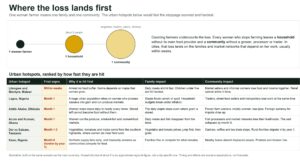

Tanzania
Why women matter: Agriculture employs well over half the workforce, and women do the bulk of planting, weeding, harvesting, and processing of maize, rice, cassava, and beans. They also dominate local produce trading.
- Month 1: Maize and bean planting stops in the southern highlands (Mbeya, Iringa, Ruvuma), the country’s grain basket. Markets in Dar es Salaam, Arusha, and Mwanza see vegetable and tomato prices jump first.
- Month 3: Maize prices surge, and neighboring countries that normally import Tanzanian grain (Kenya, Zambia, DRC) lose their supply. Cashew, coffee, and tea harvests rot or go unpicked.
- Month 6: Urban hunger sets in. Zanzibar, which imports much of its food, is hit hard. Seaweed farming, which is almost entirely done by women, also stops, ending a coastal income stream.
- Year 1: Grain reserves are exhausted. Rural-to-urban migration overwhelms Dar es Salaam and Dodoma.
- Year 5: A structurally food-importing country with no foreign exchange to pay for imports. Chronic malnutrition has stunted a generation.
Nigeria
Why women matter: Nigeria is the world’s largest cassava producer and a leading yam producer. Women dominate cassava processing (garri, fufu, starch), small-scale vegetable and legume farming, and the vast informal market trade in cities.
- Month 1: Garri and fresh produce vanish from markets in Lagos, Ibadan, Onitsha, and Kano. Without women processors, cassava harvested by anyone else spoils within days because it can’t be stored raw.
- Month 3: Food inflation, already high, becomes unmanageable. Nigeria is Africa’s most populous country, so national demand for imported rice and wheat overwhelms the market, and pressure on global grain prices becomes visible.
- Month 6: Mass protests across northern and southern cities. Cocoa output from Ondo and Cross River falls sharply. Insecurity in the north and the Middle Belt worsens as desperate communities compete over remaining food.
- Year 1: Famine conditions in the north. Large migration pushes toward neighboring countries and the coast.
- Year 5: A state of 200+ million people with no domestic food base, fragmented authority, and the world’s largest hunger crisis.
Ethiopia
Why women matter: Women do much of the weeding, harvesting, threshing, and food processing for teff, the national staple behind injera, and for enset and coffee. They also manage most household dairy and small livestock, and make up the large majority of the cut-flower workforce.
- Month 1: Teff planting halts across the highlands. Injera, which women prepare daily in nearly every household, stops being made, so even stored grain doesn’t become food.
- Month 3: Addis Ababa faces shortages. Cut-flower farms around Lake Ziway and Addis, a major foreign-currency earner exported mostly to Europe, shut down as their workforce disappears.
- Month 6: Coffee, Ethiopia’s top export and the heart of its economy, goes unharvested and unprocessed. Foreign currency dries up just as the country needs to import grain.
- Year 1: Famine, with echoes of 1984 but without the rural labor base to recover. Highland and lowland communities both face starvation.
- Year 5: Ethiopia, once a symbol of coffee’s origin, is a collapsed food economy. Millions have fled toward Kenya, Sudan, and Djibouti.
Ghana
Why women matter: Ghana is a top-two global cocoa producer. Women are central to cocoa farm labor and, above all, to shea collection and processing in the north, to yam and cassava farming, to fish smoking and processing on the coast, and to the powerful market-trading networks of Accra, Kumasi, and Takoradi.
- Month 1: Fresh produce, smoked fish, and cooked street food disappear from Accra and Kumasi markets. Shea nut collection stops in the north, hitting both food oils and the global cosmetics supply.
- Month 3: Cocoa harvest and drying fall far short. Global chocolate makers, already dependent on West Africa, face a supply crisis, and chocolate and cosmetics prices climb worldwide.
- Month 6: The cedi collapses as cocoa revenue vanishes. Imports of rice, a major staple, become unaffordable. Northern Ghana faces famine first.
- Year 1: Coastal fishing communities lose their processing economy. Urban unrest grows.
- Year 5: A once-stable country with its main export industry in ruins and its food distribution network gone.
Malawi
Why women matter: Malawi is already one of the most food-insecure countries. Around 80% of the population farms, and women do most of the maize cultivation behind nsima, the daily staple, as well as much of the labor in tobacco, tea, and sugar.
- Month 1: Maize planting stops in the rainy-season window. Because Malawi has almost no buffer, hunger arrives in weeks rather than months.
- Month 3: Tobacco, the main export, goes unharvested, ending foreign-currency income. Maize prices spike beyond reach for most households.
- Month 6: Famine conditions are declared. With few reserves, no money to import, and limited access to the sea, relief cannot get in fast enough.
- Year 1: Mass starvation, and children under five hit hardest. Cross-border movement into Mozambique, Zambia, and Tanzania.
- Year 5: One of the first countries to completely collapse, with the population dramatically reduced and the state unable to functionn
The FINANCIAL FALLOUT WOULD BE IN THE DOUBLE DIGIT TRILLIONS


The comparison point
Across all five, the pattern is the same: women aren’t just farm workers, they’re the processors, storers, traders, and cooks who turn crops into food. Take any one link away and the food chain breaks. That’s why you can’t replace them with machinery or hired labor on any realistic timescale.
Estimated GLOBAL economic costs across multiple time horizons.
These are illustrative estimates built from rough anchor figures, not a forecast, shown are annual losses and cumulative totals separately, since people often mix them up.
Anchor Figures
- Africa’s GDP is roughly $3 trillion, and agriculture and food processing/trade account for about 20-25% of it directly.
- Africa imports around $75-100 billion in food annually and would need far more.
- The global chocolate, coffee, tea, and cosmetics sectors that depend on African inputs are worth hundreds of billions.
- Africa has about 1.5 billion people. Feeding even half of them with emergency aid at under a dollar a day costs well over $100 billion a year.
Estimated costs (USD)
Period |
Annual loss |
Cumulative total |
|---|---|---|
Year 1 |
$2-3.5 trillion |
$2-3.5 trillion |
Year 3 |
$3-5 trillion |
$8-13 trillion |
Year 5 |
$3-6 trillion |
$14-24 trillion |
What drives each figure
Year 1 ($2-3.5T)
- Lost African farm, processing, and trade output: $0.5-0.8T
- Wider collapse of African GDP as the household and informal economy unravels: $0.8-1.2T
- Emergency food imports and humanitarian aid: $0.3-0.6T
- Global commodity shocks (cocoa, coffee, grain, vegetable oil, cut flowers) and supply-chain disruption: $0.3-0.6T
- Debt defaults and financial losses for lenders and investors: $0.1-0.3T
Year 3 ($3-5T annual)
- State collapse and conflict in several countries, with the costs of war, refugee movements, and border security landing on Europe, the Middle East, and neighboring regions
- Permanent loss of tree-crop capacity (cocoa, coffee) as untended plantations die
- Global food inflation feeding political instability in import-dependent countries elsewhere
Year 5 ($3-6T annual)
- A lost generation: stunting and malnutrition cut future productivity across a continent
- Permanent restructuring of global food and commodity supply chains
- Ongoing refugee and security costs worldwide
Useful comparisons
- COVID-19’s global economic cost is commonly estimated at about $12-14 trillion over several years, so your scenario reaches that scale by about year 4 and exceeds it by year 5.
- The 2008 financial crisis cost roughly $10-20 trillion in lost output, depending on method.
- Unlike those events, this one has no recovery, so the losses compound rather than fade.
Not captured
- Human lives: hundreds of millions of people at risk, which no dollar figure reflects honestly.
- Unpaid care work: women’s unpaid labor (water, fuel, childcare, cooking) is worth hundreds of billions a year by itself, and most of it never shows up in GDP statistics.
For Anyone thinking this is not a likely scenariio- I also asked A.I to to draw a real time analysis on Fertilizer, Water, Environmental impacts, all inputs required to have peaceful and peoductive farming.
These are the CUŔRENT PRESSURES TO FARMING IN AFRICA BASED ON 2026 FORECASTS AND INPUTS.


The system has less slack than we assume, and women’s labor is part of what holds it together.
If we are being honest, there are factors affecting our food security that are beyond our immediate ability to solve. We cannot control every extreme weather event, reverse every degraded landscape overnight, or immediately eliminate the rising cost of fertilizer, water insecurity and other environmental pressures confronting African agriculture.
But when we consider the full picture of food insecurity, water insecurity, rising input costs and increasing environmental stress, can we really afford not to seriously focus on supporting female farmers with every practical opportunity we can create?
Because if the woman farmer is not part of our shock-absorption strategy, our options are not nearly as strong as we would like to believe.
A POTENTIAL SOLUTION:
I began in seaweed as a processor, one of the value chains where African women do most of the farming, and I’ve spent my career as a consultant and agro processor watching where food systems break and who holds them together.
In Africa-It is almost always women.
That’s why I now run a platform called Her Golden Era for older female agro processors, where I do the deep market research, viability analysis and entry-point mapping that rarely reaches them.
I also create content on business development, menopause and wellness, because there is a deep gap in what we know about older Black women-and the women who feed Africa shouldn’t have to build their businesses without knowledge of their own bodies, our posiions on wellness also recognizes that older women’s health, energy and income affect their capacity to farm and process.
I’ve also developed a project that puts women on a clear pathway to land ownership, scaling, financing and business development, designed as a two-country model across Tanzania and Ghana, both of which appear in the scenario above.
This project includes inputs from the Global African Diaspora under African Union mandates for linkages.
In my view The legal ground is shifting in the favor of African female farmers.- It just requires initiative, structure and energy.
POSITIVE OUTLOOK:
Both Ghana and Tanzania ‘ land laws protect women’s land rights, though customary practice still lags.
AfCFTA gives both access to a single continental market, and its Protocol on Women and Youth in Trade is designed to remove barriers for women-led enterprises.
The African Union’s CAADP Kampala strategy sets targets for agrifood output, intra-African trade and post-harvest loss reduction that agro-processing directly serves.
The money and market access are moving too:
2026 is the UN’s International Year of the Woman Farmer, the EU is shaping its next Gender Action Plan, and both countries have preferential EU market access.
Law, trade rules and capital are converging on women farmers.
My work is to turn that alignment into land titles, financing and scaled businesses.
I don’t just advocate for women farmers and agro-processors. I build the pathway from land title to scaled, financed business, in the two countries where law, trade rules and funding are lining up.
I’ am seeking funders, development finance partners, policymakers and agribusiness leaders who want to help turn that pathway for female farmers and Agro Processors into reality.
If this initiaive appeals to you do, message me.
Troy ignored its Cassandra and fell. But Pharaoh believed Joseph, protected his agriculture, and fed a region through the lean years.
We can choose which story we are in, and I dont want to be the one to say “I told you so” , because too much is at risk.
To visit our platform click here https://hergoldenera.com/
NEWSPAPER ARTICLE MENTIONED ABOVE
The foresight on a President Trumps impact on Trade is only a few lines in a bigger trade argument concerning Brexit , but still accurate nonetheless.