

In our last article, we discussed predictions about the future.
What if the future of African food security didn’t lie somewhere in the unknown, at the convergence of time and calamity, but lived in the annals of history for us to review, study and collect practical notes to apply to our present situation?
It turns out history has a lot to offer in lessons of food security, allowing us to save time, energy, money and effort in safeguarding against famine in Africa.
Naturally, the key is to proactively use the years of plenty to increase production and preservation for the years of lean.
But in an environment such as Africa, where post-harvest loss can be as high as 30% or more in some crops, preservation and storage take on a different meaning. Post-Harvest Capture.
I have spent over six years analyzing Tanzania’s food systems and its ability to preserve foods for the future, and what I found is that beyond grains there are large opportunities for improvement.
You may be asking yourself: Renae, why would we be discussing food preservation when the African sun is shining and the grass is still green outside?
Honestly, we cannot afford not to discuss food preservation systems NOW, as a countermeasure to risks of African famine.
FOUR WARS, ONE HUNGER SEASON
From my research in Tanzania, what I keep finding is the same thing: the crops are there, the women are there, and a large share of the harvest is lost before it reaches a plate.
But I came to this question of food preservation long before I set foot in Africa.
I came to it as a child, standing in an American school cafeteria, staring at a white cans of food designed out of a supply chain system meant to feed the US army.
I share with you my experience of four wars from the vantage point of food. Each taught me something different, and together they point to a season I believe is coming for Africa and what we can do about it:
Part 1: The War That Built the System. How World War II turned canning, packing and distribution into a way of life, and what that meant for a girl from Jamaica in an American school cafeteria in the 1980s.
Part 2: The War That Emptied Our Shelves. What Gulf War 1 taught me when canned foods basically vanished from Jamaica, the dollar climbed, and prices followed, taking Jamaican inflation into a place of irriversible economic damage.
Part 3: The War That Fed Itself. How Gulf War 2 preparedness showed two ways to keep food moving: a ration system in Iraq and the commercial abundance of America powered by a subsidized, contracted and enabled food processing system.
Part 4: The War That Priced Out the Farm Why the war in Iran shows that the next shock arrives through fertilizer, and what women, dried fruit and cooperatives can do about it.
Please read together, they make one concise argument: hunger is predictable, preparation is a choice, and the women who already work the fields can be the ones who make that choice real.
AFRICA AT RISK FOR FOOD INSECURITY
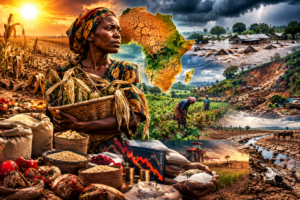

The 2026-27 season is shaping up as a stress test for African food systems.
In Sudan, South Sudan and Somalia, IPC analyses identify areas at risk of Famine through January 2027, and in the Democratic Republic of Congo and Nigeria, millions more face Emergency-level hunger. Now a very strong El Niño is layering climate on top of conflict:
Kenya’s drylands have 2.7 million people in Crisis or worse.
Uganda’s Karamoja has seen crops fail entirely, and Southern Africa is bracing for drought across Zimbabwe, Mozambique, Malawi, Zambia and Madagascar, where FEWS NET expects needs to rise sharply as 2027 progresses.
Across West Africa and the Sahel, more than 54 million people endured this year’s lean season, while the regional reserve could cover only about 3 million.
Even my precious Tanzania, where harvests have kept prices low, is warned to expect flooding that threatens crops, storage and roads.
One report says FEWS NET expects southern Africa’s needs to peak from November 2027 to March 2028, which could be an indication that the worst is yet to come in the next IPC projection windows 2027-2028.
Almost none of these crises is a surprise, and that is the point: A predictable hazard calls for preparation before hunger arrives, which is what preservation is for and the point of this article.
WHAT IS FAMINE?
According to the Integrated Food Security Phase Classification: Famine is an extreme, catastrophic shortage of food that leads to widespread acute malnutrition, starvation, and death.
It means that there is an extreme shortage of food and that several children and adults within a certain area are dying of hunger on a daily basis.
famines arise gradually due to long-term drivers like conflict, climatic shocks, deep poverty, and inequality.
Famines are never inevitable – they are always predictable, preventable, and man-made.
Famine conditions have already begun in several African countries, such as Sudan and Somalia.
The war in Iran has increased the price of fertilizer, and irregular rainfall in 2026 has affected at least one growing cycle.
Meanwhile, Kenya, parts of Tanzania such as Tanga, and the Democratic Republic of Congo have been hit by erosion and mudslides after heavy rains.
The human impact is the loss of farms, seeds, warehouses and the ability of farmers in affected areas to quickly resume their regular planting schedules.
This analysis of famine management should therefore be treated as less speculative and more preventative as an opportunity for correction.
WHAT WE CAN LEARN FROM WAR IN PREPARATION FOR FOOD INSECURITY
Though I have never lived through or experienced famine in my lifetime, I have lived through the impressions and impacts of 4 wars on food.
I am going to lean in deeply into my personal background to illustrate this in 4 wartime scenarios, so that we can take away meaningful solutions that can be replicated immediately in African nations at risk for food insecurity.
WHY WAR?
I am not an expert but, as far as agriculture is concerned, famine and war in my mind- are the same thing.
From my perspective, armies are my best case study to accurately express how humans experience food security- or the lack thereof.
For Example: To deploy a wartime army,means managing the built-in risks of hunger, and the exact conditions of famine, on day one.
From my observation:
A famine is close to a war without an enemy, in agricultural terms.
- A military in the field is a population with no farmland, no permanent kitchens, no fresh water, no seeds and no resupply from nearby farms.
- A deployed army has no arable land for farming, no irrigation system, and its number one mission is survival.
- A community facing famine has no arable land for farming, no access to farm resources, and its number one mission is survival.
POST WWII 2 FOOD PROCESSING & DISTRIBUTION SYSTEMS
Let’s begin in America, the undispued victors of World War 2, because it is the country I am most familiar with on this topic and my personal inspiration behind this article- as the countrys whose food system I had the privilege of analyzing most closely.
I experienced WWII food systems decades after they were designed and I invite you into this deep dive into what those food system learning opportunities may look like, and what we can gain from examining one of the greatest food security systems in the world at the height of its greatest food needs.
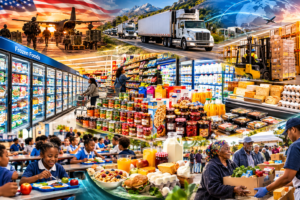

America is a great country, and like all great things, it had to fight great wars to achieve and sustain its greatness. Through an analysis of history, we can see that America’s greatness arrived between WWI and WWII.
Many experts will tell you this was because of military prowess: new inventions of guns, airplanes, tanks, ammunition and other shiny things that go BOOM.
But for me-food was what made America a superpower.
The truth is, no matter how many guns, rounds of ammunition and vehicles were created for the theater of war, without food to feed the massive armies, a war can be lost on the third day of any battle.
My awareness began between the ages of 8-12, when I first migrated from Jamaica to America-giving me a front row seat to examining Americas food system beginning with her supermarkets.
The American supermarkets were like nothing I had ever seen before: aisles and aisles of food in colorful packaging, meats, cereals and snacks in abundance.
In contrast to the neatly stacked colorful packages on neatly rowed shelves- Walls and tiles were stark white and bright white fluorescent lights illuminated everything from above while the glossy white floors refleced light from below.
Giving everything an unearthly sparkling shine.
Food, delicious food- was on full display in its full glory, like a movie scene but food was the star
–for a child from a developing nation, this appeared as a temple or a shrine.
– I later came to think an American supermarkets as cathedral of American capitalism, variety, ingenuity and excess.
As a small child it was hard not to become both overwhelmed and excited at the exact same time in an American supermarket.
Don’t get me wrong, we had supermarkets in Jamaica and canned foods: Grace Bully Beef, Vienna sausages, Betty condensed milk, Baked Beans, Gloria Evaporated Milk and sardines.
But our supermarkets and canned products were nothing like an American Pantry Pride A Winn Dixie, A Publix or a Pathmark displaying processed food as a way of life- was an extraordinary adventure for me.
I was impressed by an endless variety of breakfast cereals, who could choose which one?
Rice Krispies? Cheerios? Frosted Flakes? Special K? Cookie Crisps, Capn Crunch? Trix? Raisin Bran?
Potato Chips in shiny foil packaging of differen shapes: Cheez Balls, Frito Lays, Fritos, Doritos, Cheetos, Wise-What’s an Onion Ring?
Fresh produce of every variety, fruits and vegetables, red globe grapes, table grapes, green grapes, and Red apples, Golden Delicious Apples , Granny Smith Green Apples, Oranges, Grapes and Pears.
Large Gallons of Milk, Dairy as far as the eye can see: Heavy Cream, Whole Milk, Skim Milk, 2% Milk. Cheese, Cream Cheese, Cheddar Cheese, Mozzarella Cheese, Parmesan Cheese,Kraft Singles Cheese,Cheese and more Cheese. Homogenized, Pasteurized and Emulsified.
the offerings were endless: BALL PARK, OSCAR MAYERS, KRAFT, SWANSONS, CAMBELLS HORMEL,NABISCO, PLANTERS, SMUCKER’S, NESTLÉ, HEINZ, GENERAL MILLS, CHEF BOYARDEE, AUNT JEMIMA, WELCH’S, DOLE, DEL MONE GOYA,MRS. BUTTERWORTH’S, KELLOGG’S, RED BARRON, SNAPPLE, WRIGLEY’S, STOUFFER’S, BIRDS EYE, COCA COLA, HERSHEYS, M&M
–Who were these people?
These were the brands that were the hallmarks of American foods, the processors, preservers and manufacturers, all competing for the consumer through their packaging.
All using either food preservation technology or supply chain systems developed and expanded during WWII to supply the Army and America with food.
This was my introduction to American foodways.
I remember analyzing our shopping cart for the first time.
–This olive oil came from Spain.- Where is Spain?
Grapes from California?
Cherries from Washington, Idaho potatoes, Pure Florida Orange Juice, Hawaiian Pineapples.
– A foods location was part of the branding and a geography lesson for me.
Ingredients, bar codes, bottle shapes, glass jars, cans,16 oz. net weight, batch numbers, brands and slogans-didnt escape my observation either.
-nothing was ever out of season and everything was fresh and firm.
I captivated
THE CANS WERE THE CLUES
My education did not end in the supermarket, but began inside the school cafeteria.
In elementary school, the meals provided at breakfast and lunch did not consist of anything fresh, save for apples, oranges and the occasional Bartlett pear.
The American public school foods consisted mainly of dried, single-serve boxed cereals; “eggs” that didn’t look or taste like eggs; packaged apple juice; packaged “fruit salad” cups or diced pears, sealed in heavy syrup-sometimes served right on the tray; packaged single serve milk boxes; reboiled cut carrots and green beans, mixed vegetables from a can; meatloaf from-only God Knows where, stretched with breadcrumbs or oatmeal and a shiny blood red glossy sweet glaze on the top.


We had recangle Pizzas ( do not ask) Ravioli and Chilli from canned red beans, rehydrated potato flakes for mashed potatoes; gravy from a can; fish fillet sandwiches from quesionable frozen white fish, chicken nuggets from processed chicken parts-grilled cheese sandwiches; and macaroni and cheese made from a cheese you could never buy in a store.
Tuna sandwiches from a can and mayonnaise from a jar, oatmeal, and peanut butter and jelly from a can for our white bread sandwiches.
Sweet corn and peas from a can, and Bartlett pears from a can.
You see the theme here?
-Almost everything we ate in American Public Schools was already canned or preserved in some way.
At first my poor little Jamaican mind was shocked.
A lunch tray would comprise a main dish and maybe three other items, but the only foods I recognized were the apples, the occasional fresh pear or orange, and the milk.
I tried everything, but it all had a specific taste I couldn’t identify. It wasn’t a bad taste, just not a familiar food taste.
It was like the aroma you get when you open a box of new sneakers or cornflakes:
Newness. Different from freshness.
I did not understand that the taste I was experiencing was a processed-food taste, nor did I properly understand the difference, but I knew it wasn’t the same.
The American girls I sat next to hardly ate their food and said it was “nasty.” They otped to bring their own lunches from home.
I thought the cafeteria food was okay because I was taught never to waste food, even though I did not like most of it
-I had to respect it.
But the girls reactions only made me even more curious aboutour food than I already was.
JAMAICA & TANZANIA SIMILAR FOOD WAYS
I came from Jamaica, where up to that point- food was mainly fresh, with the exception of saltfish, pickled mackerel and some cured meats.
I never had a frozen fish stick, a chicken nugget or meatloaf.
I did not know food could be frozen, reheated and served.
My father, like many other parents in the towns, farmed alongside his day job and kept a farm in the countryside. Our farm was in Clarendon, and he brought home fresh produce once a week.
My paternal great-grandmother, my paternal grandmother and both grandfathers farmed.
Most of what my tongue knew as food had been calibrated for freshness. even more than that- I knew where my food came from and made an effort to know what every tree looked like and how every animal was slaughtered for meat.
I have come to realize that tanzania has a similar food culture, food grown in farms and brought home only to be supplemented by foods in supermarkets-helping to measure out gaps in food availabily with freshness.
In America I had no such footing from which to build a relationship with my food and what exactly I was eating.
But I wanted to know more, because this kind of food was new to me.
In fact, as I collected my lunch at the cafeteria counter, I would always try to peer into the kitchen to see what they were cooking, so I could understand what the girls meant.
I would notice large white cans with just words written on them.
No brands, no colors, just a large white can with black writing:
APPLE SAUCE, PEANUT BUTTER, BEEF, BARTLETT PEARS, RED BEANS, RAVIOLI, SAUERKRAUT or GRAPE JELLY.
Say what you will healthy or not- no child in the American Public School sysem was going hungry.
I asked my teacher where the cans came from, and she said, “SURPLUS.”
That’s all I got. SURPLUS. It seemed I was expected to know exactly what that meant, but I did not.
MORE CANS AT HOME
When I was 10, I went to live with my Grand Aunt in Harlem, New York.
Aunt Phena was a retired teacher, about 70 years old, living in the Wagner Housing Project.
About once a month, she would come home with the same food I had seen in the school cafeteria kitchen, only in smaller cans:
PEANUT BUTTER, GRAPE JELLY, PORK AND BEANS, RED BEANS, APPLE SAUCE, SWEET CORN, BEEF, PORK, RAISINS, boxes of CORN FLAKES, elbow macaroni, and the BUTTER and finally CHEESE in brown cartons, a block shaped like a brick, about a foot long
.- Still arguably the best cheddar cheese known to many New Yorkers of a certain age.
On the packages it would clearly say: USDA, NOT FOR SALE.
At least now I knew who was behind it: the US Department of Agriculture.
But when I asked Aunt Phena where it came from, she said, “The GOVERNMENT.”
I now had three words I didn’t have before: USDA, GOVERNMENT, SURPLUS.
We didn’t have Google in the 80s, but we had encyclopedias and dictionaries, and I researched and learned that the USDA was the branch of the American government responsible for farming and food. -Ah! So there was a farm somewhere.
From “Government Surplus” I understood that these were commodity processed foods bought by the Government from farms and processors and redistributed to school children and senior citizens to combat hunger.
I also learned that the system behind them, the canning, packaging and distribution, had been built to feed an army.
I now understood something no one explained while teaching us about World War 2.
If children and seniors were fed by the same machinery that fed the Army, it meant that an army’s first line of combat was against hunger.
I began to see the world differently- Every army warship and aircraft deployed with thousands of soldiers was just a shiny, massive metal platform of hungry people.
– No land for farming, no rain, just mouths to be fed, all day, every day, three times a day.
My brain had taken me somewhere no one else could go with me.
Whenever I walked into a supermarket, I was confronted with the reality that nothing here was grown here. I began an unhealthy fascination with labels and food sources.
Not the plain white ones; those didn’t appear in supermarkets. The pretty ones, with colors, letters, words.
What was the path from the farm to the store?
CURIOSITY got me here. Now I had to keep going.
Here is what I found:
WORLD WAR 2, AMERICAS FOOD VICTORY
Successful Management of food systems literally decided the victors in World War 2.
We know Germany and Japan relied on taking from others, raiding villages for food and ran into supply collapse and resistance, while the UK and US built systems that paid producers and trained local processors and designed food systems and logistics, which followed them wherever they went.
-So How did they do it?
Consider the scale of what America’s food system had to do during WWII.
At its peak in 1945, the US military numbered 12.2 million people, and every one of them had to eat, three times a day, wherever the war had put them: on ships, in deserts, in jungles, in snowbound forests.
That is roughly 36 million meals a day, and more than 13 billion meals a year.
To compare the size of it, 12.2 million is about the population of South Sudan, estimated at 12.4 million in 2026, or of Tunisia, at 12.4 million.
Imagine feeding every man, woman and child in South Sudan, three meals a day, from the other side of two oceans.
That is what the system did at its peak, and it also fed its allied armies as well.
In 1944, 13% of the US food supply went to the military, 4% to 42 other Lend-Lease recipients and 2% to the Soviet Union, and Lend-Lease food supplied a vital 10 percent of Britain’s food supply.
The difference between a population of 12 million fed on the front line of a war and one facing the risk of famine at home is not only land or sunshine.-
It is a system. By Allyn Vannoy +4
My experience from here on was living in a post-WWII food system of manufacturing and preservation, and in all the systems left behind by the aftermath of a war fought and won decades before.
The science of canning, packaging, drying, preserving and distributing, developed during the war years, now became a way of life.
The food was only half of what the war left behind. The other half was the plumbing, the mechanisms of farm to supermarket.
FOOD INNOVAION ECHNOLOGY FROM WORLD WAR 2
In honesty -without the machine of World War II, America would not have a glorious a cathedral of capitalism as the modern supermarket.
To move food across oceans, the Army needed pallets, and in the summer of 1942 the Quartermaster General ordered a million of them for its depots; the four-way pallet that a forklift can enter from any side was developed during those years. The idea of shipping food as standard unit loads, not as loose cases, is the direct ancestor of how supermarkets are stocked today.
The war effort needed frozen and concentrated foods, which is how an Army request in 1945 for 500,000 pounds of palatable orange juice concentrate led to the frozen orange juice in every American freezer, and how frozen, pre-cooked troop meals in compartmentalized trays were soon copied by Swanson, which launched the TV Dinner in 1953. refrigerated warehouse capacity and portable truck refrigeration expanded in wartime (Frederick McKinley Jones’s units were used by the military), laying the groundwork for the postwar supermarket frozen food aisle.
Food Contractors had to meet written military specifications for weight, packaging and shelf life, and inspectors checked the product. Regional Quartermaster market centers handled bulk buying and depot distribution. Large food companies took these habits into peacetime: standard specs, batch codes, statistical sampling, and centralized warehouses feeding chain stores.
Moisture-proof wraps, coated cans, waxed cartons and flexible packaging all advanced because rations had to survive heat, humidity and rough handling. After the war, the same materials became the standard for supermarket packaging.
It needed written specifications, with weight, packaging and shelf life defined and checked by inspectors.
When the war ended, the contractors who had learned to meet US Government Food standards did not unlearn them.
They pointed the same system at the supermarket.
The net weights, food source, traceability, batch numbers and uniform packages I studied as a girl were not decoration.
They were a logistics system wearing a bright label.
And that is exactly what Africa’s small processors are missing: not the food, and not the skill, but the system around it.
A standard pack size, a pallet, a written specification, a batch record. These unglamorous things are what allow a thousand women to sell to one buyer.
Even more, I understood how food systems developed during wartime could be the backbone of survival for a country’s most vulnerable populations during peacetime.
THE WOMEN WHO PRESERVED A NATION
In 1939 the British government asked the Women’s Institutes to set up 200 fruit preservation centres. By the end of 1940 there were 2,600.
They did not build an organization from scratch. The Women’s Institutes already had 328,000 members in roughly one in three villages. The government supplied sugar and the women supplied labor, kitchens and discipline. Every pound of fruit was recorded, a small levy on each can paid for equipment, and the finished produce was sold back at agreed prices. By 1945 more than 5,300 tons of fruit that would have rotted had been preserved.
Across the Atlantic, estimates of women who worked on American farms, in canneries and dairies through the Women’s Land Army run from about 2.5 million to nearly 3.5 million. Many stayed in agricultural work after the war.
India shows the same pattern in peacetime. Lijjat Papad began in 1959 with seven women and now involves around 40,000 women across India. The dough is mixed centrally to a fixed recipe, and the women are paid when they hand in their work. Below-standard product is not sold.
Africa already has what these systems used: women in the fields, and women in village savings groups, cooperatives and church and market associations. What it lacks is the structure around them.
WHY DRYING, NOT CANNING
The Women’s Institutes had sugar, and jam and canned fruit need a lot of it. Britain and America both rationed it, and the shortage held canning back.
Look at the sugar picture in East and West Africa today. Tanzania’s mills have a capacity of about 800,000 tonnes, but produced only around 411,000 by April 2026 against demand near 550,000, and prices jumped in June. Kenya produces roughly half of what it consumes. Ghana imports almost all of its sugar. Sugarcane is also thirsty, needing roughly 12,000 to 20,000 cubic metres of water per hectare.
Drying needs sun, air, clean water to wash the fruit, and a rack. It needs no sugar and no refrigeration.
It also passes the test I keep coming back to, the conditions of war and famine. A food for those conditions must keep without power, need no water or fire to eat, be light enough to carry, be dense in nutrition, and be stored in many places so no single warehouse decides everything. Dried fruit meets all five.
WHAT TO DRY FIRST
Mango. Tanzania produces about 700,000 tonnes a year, nearly all of it from smallholders. Studies put post-harvest loss at 40 to 45%, and the harvest comes in one glut from November to January.
Banana. About 3.26 million tonnes in 2024. Dried slices and green-banana flour carry real calories, and the supply runs year-round.
Pineapple. Smaller volume, but it dries well and rounds out the product line.
Grapes. Dodoma produced about 16,000 tonnes in 2018/19 with two harvests a year, and Tanzania imports dried grapes. The catch is variety: raisins usually come from seedless grapes, so trials come first.
Avocado does not dry well, but rejected fruit can be pressed for oil.
HOW MUCH, CAN WE HONESTLY CAPTURE
If We capture just 5% of the mango crop, 35,000 tonnes, we can get roughly 3,500 to 4,400 tonnes of dried fruit. As a 30-gram daily ration for children, pregnant women and school meals, that supplies 320,000 to 400,000 people for a year.
As calories, it is only about five or six days of full diet for a million people. Dried fruit is a micronutrient and energy bridge, not a replacement for grain. That is why it is the first line of defense, not the last.
It keeps, too. Tunnel-dried mango, pineapple, papaya and banana held for eight months at tropical temperatures in a Ghanaian study, and chilling extended most to twelve. So the stock has to be eaten and replaced on a cycle. That is the point: store what you eat, eat what you store.
CIRCLES, HUBS AND A RESERVE
The structure follows the Women’s Institutes:
- Preservation Circles in villages, where 15 to 30 women wash, slice, dry and sort, and record every kilogram in and out.
- District hubs that do final drying to a written standard, test, pack, store and sell. Dangerous or variable steps stay in one supervised place, as Lijjat does it, and a hub is also far easier to protect against loss than hundreds of kitchens.
- A regional federation for bulk contracts, training and the emergency plan.
The women co-own the enterprise, are paid on delivery, and sell to a guaranteed buyer such as schools, clinics and nutrition programs.
The government bodies in the picture are the Ministry of Agriculture, SIDO and TBS for training and standards, local councils whose women’s loan funds already exist, TFNC for nutrition, and the National Food Reserve Agency, which already manages a sugar reserve.
Britain also showed that reserves can be rotated. of 100,000 tons of emergency food stocks laid down before the invasion of Europe, only about 2% went out of condition, and nearly half went to relief overseas.
THE YEARS OF PLENTY
I was ten years old when I asked my teacher where the white cans came from, and she answered with one word. Surplus.
It took me thirty years to understand that surplus is not an accident.
It is a decision made in the years of plenty to be ready for the years of lean.
Africa has no such system-but
Africa has the fruit, the sun and the women. What it needs is the decision and meaningful action.
My name is Renae Bruce-Miller, I am a professional consultant in African Agro processing based in Dar es Salaam Tanzania.
Through Her Golden Era, I am interested in identifying practical agro-processing, aquaculture and blue-economy opportunities that can connect African and African-descended women to real markets.
I center my work around African women in Agro Processing opportunities for food expansion and securiy that deserves serious investigation
—not because every woman should become a farmer- but because the value chain raises a much bigger question:
What high-value products are already being produced around us, exported from Africa and the Caribbean, and purchased by the world—and why are women not capturing more of that value?
That is the question behind Her Golden Era, if you are ready to explore opportunities in advancing women in agro processing,