

HER GOLDEN ALLSPICE ENTERPRISE
From Jamaica to Africa and the Diaspora: the little spice with a much bigger business hiding inside it
Allspice is one of the world’s great agricultural curiosities.
It is not a mixture of spices, as its name suggests. It is the dried berry of Pimenta dioica, a tropical tree native to the Caribbean, Central America and southern Mexico. Jamaica is its best-known commercial origin, and Jamaican pimento has long carried a premium identity in international markets.
The berry smells and tastes like a remarkable combination of clove, cinnamon, nutmeg and pepper. That distinctive chemistry is precisely why allspice can move through several industries at once: food, beverages, flavoring, cosmetics, personal care and perfumery. Its essential oil is rich in eugenol and is commercially used as a fragrance material.
For African and Diaspora women, particularly Jamaican women living outside Jamaica, that makes allspice more interesting than simply another agricultural commodity.
The opportunity is not necessarily to grow the tree.
It may be to build a business around the Jamaican crop wherever the entrepreneur is located.
THE OPPORTUNITY
There is already a market for Jamaican allspice.
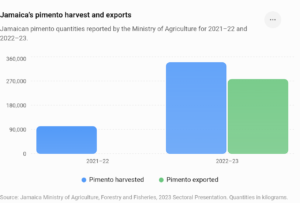
Jamaica’s Ministry of Agriculture reported that in 2022–23, the country harvested 338,819 kilograms of pimento, up 234% from the previous year’s 101,300 kilograms. Approximately 276,482 kilograms were exported, generating US$2.4 million, while local sales were valued at J$34 million.
The Jamaican government has also described the wider pimento industry as generating more than US$5 million annually from pimento berries, pimento leaf oil, pimento berry oil and other value-added products.
Those numbers are important because they reveal something that is easy to miss.
Jamaican allspice is not merely a spice.
It is a collection of commercial raw materials.
The berry can be sold whole or ground.
The berry can be distilled into oil.
The leaves can be distilled into oil.
The spice can become seasoning.
The oil can become a fragrance ingredient.
The crop can therefore support food companies, ingredient companies, cosmetic companies, fragrance businesses and specialty exporters.
THE JAMAICAN DIASPORA OPPORTUNITY
For Jamaican women living in the United States, Canada, the United Kingdom, the Caribbean, Africa and elsewhere, this creates a particularly interesting business proposition.
You do not necessarily have to be physically in Jamaica to participate in the Jamaican pimento economy.
A Diaspora entrepreneur could establish a sourcing relationship with Jamaican growers or processors, purchase Jamaican pimento under the appropriate export arrangements, and develop products in her market.
Alternatively, she could build the processing business in Jamaica and export finished products.
Another entrepreneur might establish a Jamaican-branded food company in the UK.
Another could create a specialty Caribbean ingredient business in the United States.
Another could develop pimento-based products for African supermarkets and hotels.
The location of the processing facility does not have to be the location of the farm.
That distinction creates room for Diaspora entrepreneurship.
AFRICA HAS A DEMAND STORY TOO
Africa should not be treated merely as a possible production location.
It is also a consumer market.
Jamaican allspice already has a premium identity among consumers who know Caribbean food, particularly jerk seasoning and Jamaican cuisine. The spice is also used in hospitality, sauces, meat preparation and mixed spices.
In markets such as Tanzania, Jamaican allspice can appear in supermarkets as a specialty imported product rather than a consistently available everyday ingredient.
That creates an interesting commercial gap.
A supermarket does not necessarily need another generic spice.
It may need a reliable Jamaican pimento supplier.
A hotel may need a dependable source for jerk seasoning.
A restaurant may want whole Jamaican pimento.
A food manufacturer may want an authentic ingredient for a Caribbean-inspired product.
A Diaspora entrepreneur can therefore connect Jamaican origin with African distribution.
The business does not have to be Jamaica versus Africa.
It can be Jamaica and Africa.
THE WOMEN ARE ALREADY IN THE VALUE CHAIN
This is where the opportunity becomes especially relevant to women.
Research conducted for Jamaica’s JaSPICE programme found that women already participate in the spice value chain through agricultural activities including planting and harvesting, while also participating in marketing agricultural products. Women and youth showed particularly strong interest in value-added agro-processing.
The problem is not that women are absent.
The problem is that the higher-value commercial layers are harder for them to enter.
The same study found that large-scale, export-oriented spice processing in Jamaica remained male-dominated, while women were more concentrated in smaller-scale value-added activities. Lack of finance, business-development services, accessible training and processing facilities were identified as important barriers.
That creates a very clear opportunity for women.
| Value-chain position | Evidence of women’s participation | Opportunity |
|---|---|---|
| Farming | Women participate in planting and harvesting | Producer businesses and farmer networks |
| Marketing | Women participate in selling agricultural products | Aggregation and market-linkage businesses |
| Processing | Strong interest among women, especially at small scale | Grinding, blending, drying and packaging |
| Food products | Women are interested in value-added processing | Seasonings, sauces, marinades and specialty foods |
| Essential oils | Jamaican pimento berry and leaf oils are established commercial products | Distillation, sourcing and ingredient businesses |
| Export | Higher-value export processing remains more male-dominated | Women-owned export and ingredient companies |
The commercial opportunity is therefore not to “bring women into” an industry in which they are absent.
It is to help women move further up an industry in which they are already participating.
THE GOLDEN ALLSPICE VALUE CHAIN
The value chain can be visualized as:
Jamaican growers → aggregation → curing/drying → cleaning → grading → whole berries → grinding → seasoning → food manufacturing → packaging → export → retail/hospitality
But there is another branch:
Pimento berries/leaves → distillation → essential oil → fragrance/cosmetics/flavoring → international ingredient buyer
That second branch is where many people who think of allspice purely as a kitchen spice miss the opportunity.
ALLSPICE IS ALSO A FRAGRANCE BUSINESS
This may be the most surprising part of the story.
Allspice essential oil is a recognized perfumery material.
Givaudan, one of the world’s major fragrance and flavor companies, lists Jamaican Pimento Berry Oil as a fragrance ingredient. The company describes its profile as spicy and aromatic, with peppery, cinnamic and balsamic facets, and identifies Jamaica as the country of origin.
Scientific literature also documents the use of allspice essential oil in perfumery, cosmetics and other manufactured products.
Its chemistry helps explain why.
Allspice berry oil can contain approximately 60–90% eugenol, depending on the material and origin. Eugenol is also a major aromatic component of clove and is widely recognized in perfumery.
Allspice therefore gives the fragrance industry something quite distinctive: a warm, spicy, clove-like material with additional cinnamon, pepper and balsamic character.
That makes pimento oil a completely different business from selling a bottle of ground allspice in a supermarket.
AND THEN THERE IS OLD SPICE
The history of Old Spice makes the connection even more fascinating.
The original men’s Old Spice fragrance, introduced in the late 1930s, is documented with pimento as one of its heart notes, alongside cinnamon, carnation, geranium, heliotrope and jasmine. Fragrance references identify the pimento note with Pimenta dioica, the plant commonly known as allspice or Jamaican pepper.
Old Spice also developed an unmistakable nautical identity, using sailing ships on its packaging and branding. Historical accounts document ships including the Grand Turk and Friendship among the brand’s early imagery.
There is a fascinating story connecting the ship imagery to Jamaica’s historic pimento trade and the movement of the spice across the Atlantic.
The fragrance contained pimento, and the brand built its identity around ships and maritime imagery.
The Jamaican connection is therefore real at the ingredient level.
FROM KITCHEN SPICE TO PERFUMERY INGREDIENT
This opens another value ladder.
| Raw material | Processing | Potential market |
|---|---|---|
| Dried pimento berry | Cleaning and grading | Food ingredient |
| Whole berry | Packaging | Retail and hospitality |
| Berry | Grinding | Spice and seasoning |
| Berry | Blending | Jerk seasoning and specialty blends |
| Berry | Food processing | Sauces, marinades and prepared foods |
| Berry | Steam distillation | Pimento berry essential oil |
| Leaves | Distillation | Pimento leaf essential oil |
| Essential oil | Formulation | Fragrance and cosmetics |
| Oil | Ingredient supply | International fragrance and flavor houses |
| Jamaican origin + finished product | Branding | Premium Diaspora and global markets |
The highest-value opportunity is not automatically at the bottom or top of the table.
It depends on the entrepreneur’s capital, technical capability, access to raw material and ability to meet quality and regulatory requirements.
But the existence of these multiple markets changes the economics of the crop.
There is more than one customer for the same tree.
THE GLOBAL ESSENTIAL-OIL CONNECTION
Jamaica’s Ministry of Industry, Investment and Commerce has specifically identified pimento among the Jamaican crops that could supply the international essential-oils economy.
In 2023, the Ministry described the global essential-oils market as potentially reaching US$15.3 billion by 2027 and identified opportunities for Jamaican food-processing, fragrance and cosmetic industries.
That figure is for the broader essential-oils market, not for allspice oil alone.
That distinction matters.
There is no clean, universally reported global market statistic for pimento oil by itself because essential oils are frequently classified within broader trade categories.
But the commercial evidence is very real.
Jamaican pimento leaf oil and berry oil are already being exported as specialized fragrance and ingredient materials. Trade records include Jamaican pimento leaf oil shipped to Turkey and Mexico and pimento berry oil shipped to international buyers.
A Jamaican woman does not therefore have to invent a new market.
The market already exists.
THE AFRICAN FRAGRANCE OPPORTUNITY
This creates another possibility for African women.
Africa has its own growing beauty, personal-care and fragrance economy.
A woman entrepreneur could therefore participate at several points without necessarily distilling the oil herself.
She could source Jamaican pimento oil.
She could formulate a fragrance.
She could develop a Caribbean-Africa perfume collection.
She could supply pimento-based fragrance ingredients to African cosmetic manufacturers.
She could create soaps, candles, body products or home fragrances.
She could combine Jamaican pimento with African botanical ingredients to create a distinctly Diaspora product.
The opportunity becomes particularly interesting when Jamaican origin becomes part of the brand story.
THE JAMAICAN DIASPORA BRAND
Imagine a woman in London building a premium Jamaican spice company.
Another in Atlanta develops Jamaican pimento seasoning for the African-American market.
A woman in Toronto creates a Caribbean food-service ingredient company.
A woman in Dar es Salaam introduces authentic Jamaican pimento and jerk products to East African hotels and supermarkets.
A woman in Kingston develops pimento berry oil for international fragrance buyers.
None of these businesses needs to look identical.
The common asset is the same:
Jamaican pimento.
The entrepreneur adds the next layer of value.
THE PATH OF LEAST RESISTANCE
For a woman who wants to enter this business without immediately investing in agriculture or industrial distillation, the easiest starting point is likely to be market development and product creation.
Find the customer first.
Then determine whether that customer needs whole Jamaican berries, ground spice, a seasoning blend, a food product or an ingredient such as pimento oil.
From there, the business can establish the supply relationship and determine where processing makes the most commercial sense.
That processing could take place in Jamaica.
It could take place in another Caribbean country.
It could take place in the United Kingdom.
It could take place in the United States.
It could take place in Africa.
The right location depends on the product, regulations, freight costs, customer requirements and access to technical processing.
This is important because the Jamaican raw material does not have to remain a Jamaican raw-material business.
It can become a global Diaspora business.
THE INVESTMENT
There are several possible entry points.
A small entrepreneur could begin with sourcing and retail packaging.
A larger operation could add grinding and blending.
A food entrepreneur could develop sauces, marinades or seasoning products.
A more technical operation could move into steam distillation and essential-oil production.
A still larger company could establish a network of Jamaican growers, operate aggregation and primary processing, manufacture finished products and export internationally.
Essential-oil production requires considerably more technical discipline than simply packaging dried spice. Quality, chemical composition, traceability, storage, testing and fragrance-industry standards all matter. Pimento oils can also be subject to fragrance-safety restrictions because of constituents such as eugenol and methyl eugenol.
This is therefore a field where quality creates commercial value.
THE EXPORT OPPORTUNITY
Jamaican pimento is a regulated export commodity.
JACRA requires an export licence for pimento and its by-products, while Jamaica’s export procedures also involve inspection, phytosanitary certification and exporter registration.
That is not simply bureaucracy.
For a premium Jamaican-origin brand, traceability and regulatory compliance can become part of the value proposition.
The entrepreneur who can reliably demonstrate:
Jamaican origin → quality → processing → testing → packaging → traceability
has something much stronger than an anonymous spice shipment.
THE BIGGER POSSIBILITY: JAMAICAN AGRO-PROCESSING FOR THE DIASPORA
This is where allspice becomes part of a much larger idea.
The Jamaican Diaspora does not have to participate in Jamaica’s agricultural economy only by sending money home.
It can participate through commercial ownership.
A Diaspora entrepreneur can establish a Jamaican sourcing company.
She can build farmer relationships.
She can invest in primary processing.
She can own a spice brand.
She can develop export-ready products.
She can create a fragrance ingredient business.
She can establish distribution in Africa.
She can connect Jamaican raw materials with global consumers.
That is a fundamentally different model from simply buying Jamaican products for resale.
It is Diaspora participation in the value chain.
THE GOLDEN ALLSPICE VALUE CHAIN
The complete opportunity looks something like this:
Jamaican farmer
↓
Aggregation and quality control
↓
Drying and cleaning
↓
Whole berry
Ground spice
Seasoning blends
Food products
Pimento berry oil
Pimento leaf oil
↓
Africa | Caribbean | UK | USA | Canada | Global Diaspora
↓
Supermarkets | Hotels | Restaurants | Food manufacturers | Cosmetic companies | Fragrance houses | Consumers
The entrepreneur can enter at almost any commercially appropriate point.
And that is why the tree itself should not be the only focus.
THE GOLDEN OPPORTUNITY
Allspice demonstrates something important about African and Diaspora agribusiness.
A woman does not always need to own the farm to own part of the opportunity.
She can own the relationship with the farmer.
She can own the processing.
She can own the formulation.
She can own the packaging.
She can own the brand.
She can own the distribution.
She can own the export company.
Or she can connect several of these pieces into one business.
For Jamaican women in the Diaspora, there is an additional advantage: the story, origin and cultural identity are already there.
Jamaica has the crop.
The Diaspora has markets.
Africa has consumers, hospitality, food manufacturing and a growing beauty economy.
The fragrance industry has a documented use for pimento oil.
And the women are already participating in the Jamaican spice economy.
The opportunity is to connect these pieces.
The seed—or in this case, the berry—is already golden.
Build more businesses around it.
And keep more of the value in the hands of the women who understand its story.
THE NEXT MOVE
The first question is not:
“Can I grow allspice?”
It is:
“Which market do I want to serve?”
A Jamaican woman in London may have a completely different opportunity from a Jamaican woman in Atlanta.
A woman in Kingston may be positioned to build an aggregation or processing business.
A woman in Dar es Salaam may see an opportunity to supply Jamaican pimento to African hospitality and specialty-food markets.
A woman with fragrance expertise may see the opportunity in pimento berry oil.
A woman with food-manufacturing experience may see the opportunity in seasonings, sauces and marinades.
The business begins by choosing the customer and then working backwards toward the appropriate Jamaican supply, processing location, certification, packaging and distribution model.
JAMAICAN PIMENTO
↓
Whole Berry
↓
Ground Spice
↓
Seasoning Blends
↓
Sauces & Food Products
↓
Pimento Berry Oil
↓
Pimento Leaf Oil
↓
Fragrance & Cosmetics Ingredients
↓
GLOBAL BRANDS + DIASPORA MARKETJamaica’s pimento harvest and exports
| period | harvest | exports |
|---|---|---|
| 2021–22 | 101,300 | |
| 2022–23 | 338,819 | 276,482 |
WANT TO EXPLORE THE OPPORTUNITY?
If you are considering entering the allspice business and want to understand where you could realistically enter the value chain, what products may offer the most accessible starting point, how to identify suppliers and customers, and what would be required to move from an idea to a viable African agribusiness, professional consultation can help you turn the opportunity into a practical pathway.
Renae Bruce-Miller is a professional consultant in African agro-processing based in Dar es Salaam, Tanzania. Through Her Golden Era, she examines practical opportunities across African agriculture, processing, trade and value addition, with a particular interest in helping entrepreneurs identify commercially viable entry points.
Interested in exploring your own allspice opportunity? Contact Renae Bruce-Miller for a consultation.