

HER GOLDEN CARIBBEAN AND AFRICAN NUTMEG ENTERPRISE
FRAGRANT GOLD: THE LITTLE SEED THAT TRAVELLED THE WORLD
The fruit hangs quietly beneath the leaves.
At first, there is little to suggest what is inside. Then, as it ripens, the yellow-gold skin breaks open and reveals a dark seed wrapped in a startling web of scarlet.
It looks almost too beautiful to be an agricultural commodity.
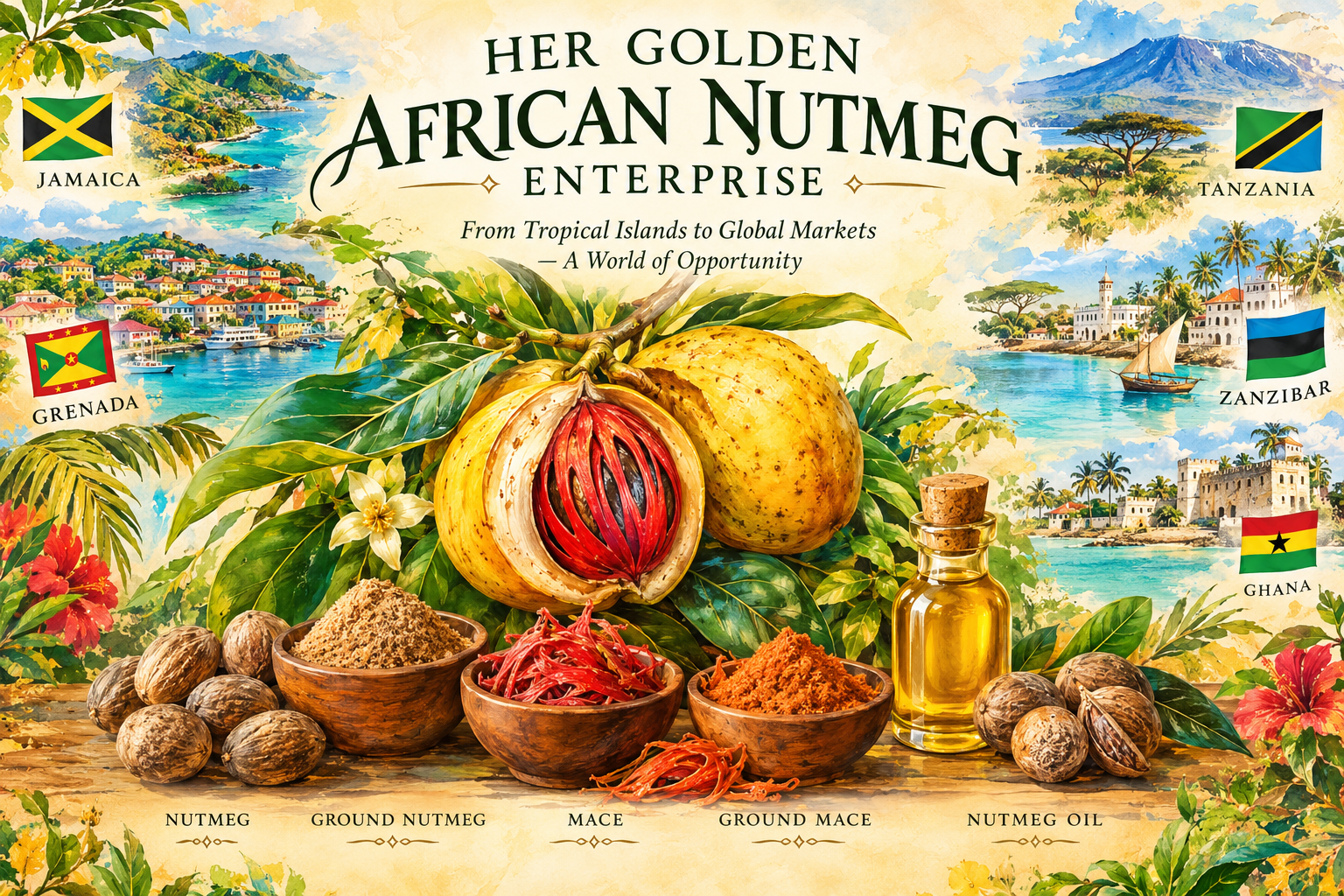
Yet this small tropical fruit produces two internationally traded spices.
The seed becomes nutmeg.
The crimson aril surrounding it becomes mace.
Both come from the same tree:
Myristica fragrans Houtt.
True nutmeg began its commercial journey in the Banda Islands of present-day Indonesia. From there, planting material eventually escaped the old centres of production and travelled through the Indian Ocean and into the Caribbean. Grenada built a substantial industry around it. Jamaica cultivated it. Zanzibar became part of the wider spice landscape.
Today, the same fruit can end up in a Christmas cake in London, a spice cabinet in Kingston, a bakery in Dar es Salaam or a food manufacturer’s ingredient room thousands of kilometres from the tree.
The remarkable thing about nutmeg is not simply that it travelled.
It is that the value travelled with it.
And Africa has an opportunity to capture more of that value.
THE OPPORTUNITY
Nutmeg is often treated as a small spice crop.
Commercially, that is a mistake.
The crop has several points at which value can be captured: cultivation, harvesting, drying, grading, processing, packaging and the separate preparation of mace.
There is also a more fundamental consideration.
Nutmeg is a long-term crop.
This is not an agricultural business where planting today means harvesting a large commercial crop next season.
The tree is dioecious, meaning male and female flowers occur on separate trees. Seed-grown trees do not reveal their sex immediately, and roughly half may turn out to be male and therefore non-fruiting.
That makes planting material a serious commercial decision.
Nutmeg is commonly propagated from fresh seed, but growers can also use marcotting or air-layering and grafting. Vegetative propagation has an important advantage: material can be taken from known productive female trees rather than waiting years to discover which seedlings will bear fruit.
Under favourable conditions, seed-grown trees may begin fruiting in roughly five to nine years. Vegetatively propagated trees can sometimes bear earlier, with Grenadian experience documenting fruiting as early as about three years from marcots. Full production takes considerably longer, with mature trees continuing to bear for decades.
That changes the investment equation.
If a woman wants a business that generates income sooner, buying land and planting an entirely new nutmeg plantation may not be the only — or even the most accessible — entry point.
Existing trees may already represent the faster asset.
THE TREE IS SLOW. THE VALUE CHAIN DOESN’T HAVE TO BE.
This is where nutmeg becomes interesting for an entrepreneur.
A mature female tree produces fruit more than once a year under suitable conditions. When the fruit ripens, it splits open naturally, exposing the mace and the seed.
The first commercial task is therefore not complicated:
capture the fruit without losing the value inside it.
The mace must be separated carefully.
The nutmeg seed must be dried properly.
The shell is eventually removed to reveal the familiar nutmeg kernel.
Poor drying can damage quality, while inadequate handling can lead to mould and other losses.
In other words, the business begins before the spice reaches a grinder.
And that is precisely where processing creates room for enterprise.
THE TWO PRODUCTS INSIDE ONE FRUIT
The nutmeg seed receives most of the attention.
But the red mace surrounding it is a commercial spice in its own right.
That matters.
A processor who handles the fruit properly is not dealing with one product.
She is handling a paired crop:
nutmeg + mace.
Nutmeg can be sold whole or ground.
Mace can be sold whole or ground.
Further processing can produce nutmeg oil, oleoresin and other ingredients for food, fragrance and related industries.
This creates a value chain in which the entrepreneur can move from agricultural commodity toward specialized ingredients.
The distinction is important because industrial buyers are not necessarily looking for attractive retail jars.
They may be looking for a consistent ingredient with known specifications, reliable supply and predictable quality.
That is where an African processing business can begin to look very different from a spice stall.
FROM SPICE CABINET TO PERFUME BOTTLE
There is another market hiding inside the nutmeg seed.
Fragrance.
Nutmeg is not simply something a baker grates into a cake or a cook adds to a sauce. The aromatic material from Myristica fragrans is also used in perfumery.
The International Fragrance Association’s ingredient glossary identifies nutmeg, nutmeg absolute, nutmeg CO₂ extract, nutmeg distillate, nutmeg extract, nutmeg oil, rectified nutmeg oil and nutmeg oleoresin as fragrance materials, describing their olfactory character as spicy, warm and balsamic. (IFRA)
This is a real commercial value chain.
DSM-Firmenich, one of the world’s major fragrance and flavor companies, lists Myristica fragrans nutmeg essential oil as a natural fragrance ingredient. Its technical materials describe nutmeg oil as spicy, warm, powdery, woody and terpenic, with applications in amber and powdery fragrance bases. The company also describes a low-safrole version designed to broaden its applicability in fragrance and flavor applications. (@dsm-firmenich)
That takes the nutmeg conversation somewhere entirely different.
The farmer is selling a spice.
The processor is selling an ingredient.
The extraction business can potentially be selling a fragrance raw material.
And the value can rise as the material becomes more specialized.
There is already a visible specialty market.
Eden Botanicals, for example, currently sells Myristica fragrans nutmeg absolute specifically for perfumery and related applications. Its listed retail price is US$93 for 15 ml and US$563 for 118.29 ml. Its steam-distilled nutmeg essential oil is also sold for perfumery, including a listed 1 kg price of US$259.25. (Eden Botanicals)
These are specialty retail prices for processed fragrance materials — not farmgate prices and not bulk commodity prices.
That distinction is critical.
But the prices demonstrate something commercially important:
the same seed can enter two very different industries.
Food.
And fragrance.
For an African entrepreneur, the question therefore becomes much more interesting:
Can African producers move further up the fragrance-ingredient chain?
That could eventually mean supplying properly processed nutmeg oil, developing standardized botanical extracts, or partnering with fragrance companies and independent perfumers seeking traceable natural materials.
It does not mean every nutmeg farmer needs to build a perfume factory.
It means the value chain should be understood before the business model is chosen.
A company might begin by supplying dried kernels.
Then move into cleaning and grading.
Then into food-grade oil.
And, with the right technical partner, testing and specifications, potentially into fragrance-grade ingredients.
There is a significant technical step between agricultural production and fragrance manufacturing. Buyers in this market care about consistency, analytical specifications, traceability and regulatory compliance.
Safrole is particularly important. IFRA maintains standards governing the use of safrole and related substances, and its current standards framework includes restrictions and specifications for fragrance materials. (IFRA)
That means a future African fragrance-ingredient business would need more than a still and a bottle.
It would need quality control, laboratory analysis, documentation and a buyer who knows exactly what specification is required.
That is not a barrier to the opportunity.
It is part of the opportunity.
THE AFRICAN NUTMEG QUESTION
Africa’s relationship with true nutmeg is sometimes obscured by the fact that another African tree, Monodora myristica, is also called African or calabash nutmeg.
They are different plants.
This article is about true nutmeg — Myristica fragrans — the mace-producing tree.
And there is evidence that true nutmeg is already cultivated within the African and Indian Ocean spice landscape.
Zanzibar’s national standard specifically identifies Myristica fragrans as the species covered for commercial nutmeg and mace.
That matters because it moves the discussion away from botanical possibility and toward commercial reality.
Zanzibar is not simply displaying nutmeg for tourists.
It recognizes true nutmeg and mace as commercial products.
ZANZIBAR: WHERE WOMEN ARE ALREADY IN THE SPICE ECONOMY
The gender story is particularly interesting in Zanzibar.
Women are documented as participating in the island’s spice economy through cultivation, processing, tourism and cooperative activity. Recent reporting from Pemba describes women spice farmers working within women’s cooperatives and notes nutmeg among the principal spices cultivated across the Zanzibar archipelago.
The evidence is strongest for women’s participation in the broader spice value chain, rather than proving that every woman is specifically a nutmeg grower.
That distinction matters.
But it also points to something important for Her Golden Era:
the infrastructure of women’s participation already exists.
Women do not necessarily have to enter agriculture by acquiring large farms.
They can participate through cultivation, harvesting, processing, packaging, tourism and trade.
For nutmeg, that could mean moving women closer to the higher-value stages of the chain.
GRENADA: WOMEN HAVE BEEN PART OF THE NUTMEG BUSINESS
Grenada provides stronger direct evidence.
Women have historically participated in nutmeg harvesting, and documentation of the country’s post-harvest system describes women making up a substantial part of the manual workforce involved in sorting and processing nutmeg.
That is significant because post-harvest work is not peripheral to the industry.
It determines what becomes export-quality product.
It determines how mace is handled.
It determines how nutmeg is graded.
And it determines how much of the harvest eventually earns a commercial price.
Grenada’s nutmeg industry also built an institutional structure around the crop through the Grenada Cooperative Nutmeg Association, founded by farmers in 1947.
Today the cooperative describes an industry involving thousands of farmers, receiving stations, processing stations, grading and international marketing.
The lesson is straightforward:
the tree created the crop. The system created the industry.
TANZANIA: THE QUESTION IS WHAT HAPPENS AFTER HARVEST
Tanzania is already part of the international nutmeg trade.
But the more interesting question is not whether Tanzania can grow nutmeg.
It is whether more value can be retained between the tree and the final buyer.
That begins with quality.
There are some reports from the Tanzanian context of nutmeg that appears healthy externally while the kernel inside can be damaged or unusable. That deserves proper agricultural investigation rather than an assumption about the cause.
The culprit could be disease, insects, maturity, harvesting, drying or storage.
For an entrepreneur, however, the commercial question is simpler:
How much of the harvested crop becomes saleable product?
If that percentage can be improved, the value of the existing harvest rises without necessarily planting another tree.
That is the kind of problem agro-processing businesses can solve.
THE ECONOMICS OF A LONG-LIVED TREE
Nutmeg rewards patience.
It also rewards planning.
A seed-grown orchard requires years before meaningful production begins, and maximum productivity comes much later. Historical agronomic work places full production around 15–20 years, while other Grenadian sources describe production continuing to build toward peak levels later in the tree’s life.
The important point is not a single magic number.
It is the shape of the investment:
early years require patience; mature years can provide a long production window.
That makes nutmeg different from annual crops.
For the investor, it can function as a long-duration agricultural asset.
For the processor, however, the equation is different.
The processor does not have to wait for the tree.
She can work with trees that already exist.
That distinction opens the door to a different class of entrepreneur.
THE PROCESSOR’S ADVANTAGE
Imagine a woman who does not own one hectare of nutmeg.
Instead, she knows twenty growers.
She knows when they harvest.
She understands what buyers reject.
She knows how to dry the crop.
She can separate mace properly.
She can grade the nutmeg.
She can package it.
And she has customers waiting.
Her business is not a plantation.
It is a supply system.
That model can be built around existing agricultural production and can grow as the buyer base grows.
It also fits the reality of many women who may have access to agricultural networks without having the capital, land or time required to establish a plantation from scratch.
THE POTENTIAL
The basic nutmeg trade is simple:
fruit → dried nutmeg → buyer.
A more developed business captures value at several points:
fruit → mace + nutmeg → drying → grading → processing → packaging → market.
And now there is another branch:
nutmeg kernel → extraction → food ingredient + fragrance ingredient.
At retail level, that might mean premium whole nutmeg, ground nutmeg and mace.
At B2B level, it could mean supplying hotels, bakeries, restaurants and food manufacturers.
At industrial level, it could mean ingredients such as oil or oleoresin.
At a more specialized level, it could mean properly characterized botanical materials for fragrance and personal-care applications.
The commercial opportunity therefore lies less in persuading people to consume nutmeg — the market already exists — and more in producing a product that is consistent, properly processed and reliably delivered.
Global trade confirms that the market is substantial. Indonesia alone exported more than US$111 million of nutmeg in 2024, while Tanzania’s recorded exports were much smaller. That gap does not automatically translate into a business opportunity, but it does show the scale difference between established production systems and Tanzania’s current export footprint.
The question for African entrepreneurs is therefore not whether nutmeg has a market.
It is:
where can African businesses capture more of the value?
THE INVESTMENT
These are illustrative planning tiers, not quotations or guaranteed returns.
$5,000 — THE MARKET ENTRY
Rather than planting an orchard, this level could support a small aggregation and packaging operation using existing production.
The emphasis is on learning:
source, clean, dry, grade, package and sell.
The objective is to establish whether customers will pay for the product and which form they want.
$10,000 — THE SMALL PROCESSOR
The business can begin adding equipment for grinding, packaging and improved storage, while building relationships with growers and B2B customers.
The central asset becomes processing capability.
$25,000 — THE REGIONAL SUPPLY BUSINESS
At this level, the business can develop a structured grower network, aggregation system, quality procedures and more substantial B2B supply.
The entrepreneur is no longer simply buying and reselling.
She is building a supply chain.
$50,000+ — THE INGREDIENT BUSINESS
This is the level at which more sophisticated processing, laboratory testing, traceability, private-label production and ingredient development can become realistic areas of investment.
For fragrance, this could mean developing the relationships, analytical testing and technical specifications needed to supply an established extractor, fragrance house or ingredient buyer.
It should not be assumed that US$50,000 is automatically enough to establish a full industrial extraction facility. The equipment, laboratory requirements, regulatory pathway and buyer specifications would need to be assessed first.
But the direction is important.
The business could evolve from:
spice → ingredient → specialized ingredient.
And the market should come first.
The equipment should follow the buyer.
THE WOMAN’S OPPORTUNITY
The nutmeg business does not require every woman to become a farmer.
Some women may be growers.
Others may be harvesters.
Others may work in sorting and processing.
Others may build packaging businesses.
Others may become B2B suppliers.
And some may sit at the other end of the chain, building markets among diaspora consumers, restaurants and specialty retailers.
There is also a higher-value opportunity for women with the technical and commercial capacity to enter ingredient development, quality management, sourcing or fragrance supply.
Grenada demonstrates that women have already been part of the physical work of nutmeg production and processing.
Zanzibar demonstrates that women are increasingly using the broader spice economy to build livelihoods and businesses.
The opportunity for Africa is to move that participation further toward ownership, processing and market access.
THE NEXT MOVE
If I were examining a nutmeg opportunity today, I would begin with the existing crop rather than immediately buying land.
First: identify where Myristica fragrans is already growing.
Second: map the growers and the size of the existing harvest.
Third: establish how the trees were propagated and what proportion are female, fruit-bearing trees.
Fourth: measure the actual saleable yield rather than simply counting trees.
Fifth: investigate kernel losses and determine whether the problem occurs before harvest, during drying or in storage.
Sixth: examine how mace is currently handled. It should be treated as a product, not as something left behind after the seed is removed.
Seventh: speak with actual buyers and establish their specifications — for food, and separately for any potential fragrance application.
Eighth: test a small quantity through the complete chain — harvest, drying, grading, packaging, transport and sale.
Ninth: if fragrance is part of the strategy, obtain laboratory analysis and determine whether the resulting oil or extract can meet the technical specifications required by potential buyers.
Tenth: only then decide whether the strongest business is cultivation, aggregation, processing, branding, ingredient supply or export.
That sequence matters because nutmeg is a crop where time is expensive.
A poor decision made at planting can remain embedded in the orchard for years.
HER GOLDEN TAKEAWAY
The nutmeg tree asks a very old question of anyone who wants to invest in agriculture:
Are you willing to wait?
A seed may take weeks to germinate.
A young tree may take years to reveal whether it is male or female.
A productive female tree may take several more years to establish itself.
And then, if well managed, it can continue producing for decades.
But the entrepreneur does not necessarily have to wait for the tree.
That is the great distinction.
The farmer thinks in decades.
The processor can think in months.
The brand can think in weeks.
And the market is already there.
One fruit produces two valuable spices.
One mature tree can produce repeatedly.
One established growing region can support many businesses.
And one neglected stage of the value chain can become another woman’s enterprise.
But there is now another possibility.
The same seed that enters the spice cabinet can also enter the perfume bottle.
That means the opportunity is not simply growing nutmeg.
It is building the system that allows more of the nutmeg — and its brilliant red mace — to arrive at the customer as a valuable product.
That could be a food product.
A retail spice.
A B2B ingredient.
An oil.
Or, with the right technical standards and market relationships, a fragrance ingredient.
That is where Her Golden African Nutmeg Enterprise begins.
READY TO EXPLORE THE OPPORTUNITY?
My name is Renae Bruce-Miller, and I am a professional consultant in African agro-processing, based in Dar es Salaam, Tanzania.
If this business opportunity has you thinking, “Could I actually do this?” — let’s talk.
I offer practical business and market-entry consultations for women who want to turn promising agricultural products and processing opportunities into viable businesses.
Together, we can examine the market, supply chain, investment level, regulatory considerations and potential route to market — and determine where to begin, what you need and what your next move should be.
Contact me for a consultation →