

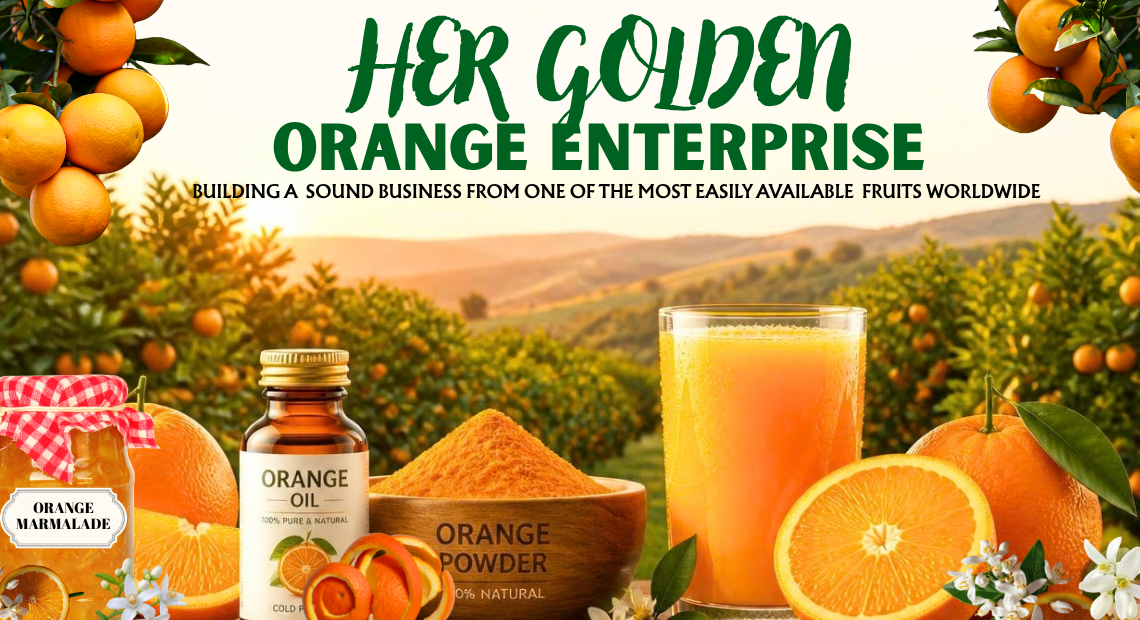
HER GOLDEN ORANGE ENTERPRISE
From Orchard to Fragrance, Beauty & Global Ingredients
There is something almost luxurious about an orange when you stop thinking of it as fruit.
Think instead of the moment a knife breaks through its bright skin. The fragrance escapes before the juice does. The peel curls away in a ribbon of orange, the white pith beneath it holding another possibility, while the fruit itself waits to become juice, preserve, powder, dessert, fragrance or something you have not yet imagined.
That is the business opportunity.
The orange is not one product.
It is a raw material with an entire value chain hidden inside it.
And for women in Africa, the Caribbean and the African diaspora, including African American women in the United States the opportunity is unusually interesting because oranges are already being grown, sold and consumed in all three regions.
Florida alone remains a major orange-producing state. USDA’s 2026 Florida agriculture overview reports 126,800 harvested acres of oranges and an estimated $228.5 million in orange value, including both processing and fresh-market production.
Across Africa, major citrus industries exist from North Africa through Southern Africa, while the Caribbean and Latin America have long-established citrus production and processing traditions. The result is not one market but a collection of regional orange economies that women can enter at different points from farming and aggregation to small-batch processing, hospitality supply, specialty foods and ingredients.
The question is no longer:
How much can I make selling oranges?
The better question is:
How much value can I create from every orange?
TANZANIA: THE ORANGE IS ALREADY THERE
This may be the most interesting part of the opportunity.
Tanzania does not need to build an orange industry from zero.
It already has one.
Tanga is particularly important.
Research on Muheza describes the district as a major orange-producing area, with more than 80% of Tanga’s oranges estimated to come from Muheza in the study period. Another recent study found that 40% of surveyed orange farmers in Muheza were women.
The 2019/20 agricultural census also recorded substantial orange acreage in Tanga, Pwani and Lindi, as well as significant production in Zanzibar.
Yet Tanzania’s international fresh-orange trade remains relatively small.
In 2024, Tanzania exported approximately 3.24 million kilograms of fresh or dried oranges worth US$117,070, with almost the entire recorded volume going to Kenya and Uganda.
Compare that with South Africa.
In the same year, South Africa exported approximately 1.13 billion kilograms of fresh or dried oranges worth approximately US$758.2 million.
The comparison does not mean Tanzania should attempt to copy South Africa’s citrus industry.
It demonstrates something simpler:
there is a considerable difference between having oranges and having an orange industry built around processing, logistics, quality systems and export markets.
That difference is where the business question lives.
THE TANZANIAN VALUE-CHAIN QUESTION
Tanzania’s orange problem is not simply production.
It is what happens between the farmer and the customer.
Research on Muheza has documented multiple layers of intermediaries, weak bargaining power, post-harvest losses and limited processing. A 2026 study found brokers and local markets still dominated sales channels among surveyed farmers, while only a small proportion sold through cooperatives or directly to exporters.
Earlier research also found that oranges were frequently transported and stored with limited preservation, resulting in significant losses from damage. Most oranges were still being sold as whole fruit rather than being processed into higher-value products.
That creates a very clear opportunity.
Do not only ask how to sell more oranges.
Ask:
How much of the orange currently being lost could become a product?
That could change the economics of the entire chain.
WOMEN IN THE ORANGE ECONOMY
The gender opportunity is particularly relevant.
Recent research in Muheza surveyed 150 smallholder orange farmers and found women represented 40% of respondents. The same research found constraints around land access, agricultural inputs, extension, finance and market channels.
Another 2025 study examining women in agricultural value addition in Muheza found women actively involved in activities such as sorting, drying and packaging of agricultural products, while facing limited access to training, finance and modern processing equipment.
That matters because these are exactly the stages where orange processing creates new enterprise opportunities.
A woman does not necessarily have to own a large orange plantation.
She could build a business around:
aggregation, sorting, drying, powder production, packaging,juice processing,peel collection,oil extraction
ingredient supply, branding or B2B distribution.
The objective is not simply to increase women’s participation in the orange economy.
It is to move more women toward the parts of the value chain where the product becomes more valuable.
THE OPPORTUNITY
For generations, agricultural businesses have often been built around getting the crop out of the field and into the market as quickly as possible.
That works; But it can leave enormous value on the table.
A fresh orange has a relatively short commercial life. It must be harvested, transported, stored and sold before quality deteriorates.
Processing changes the equation.
An orange can become juice. Its peel can become zest. The peel can be dried and milled into powder. Its aromatic compounds can become orange oil. The skin can become marmalade. The same orchard can supply a bakery, hotel, beverage company, cosmetics manufacturer, soap maker, candle company or fragrance business.
Suddenly, the business is no longer simply agriculture.
It becomes food manufacturing, ingredients, hospitality, beauty and fragrance.
That is where the Golden Orange Enterprise begins.
THE ORANGE OIL OPPORTUNITY
Orange oil is particularly attractive because it connects several industries.
FOOD & BEVERAGE
Orange oil can provide citrus flavor and aroma in food and beverage manufacturing.
FRAGRANCE & PERFUMERY
Sweet orange oil is a recognized citrus fragrance material.
COSMETICS & PERSONAL CARE
Citrus oils are used in a wide range of personal-care formulations.
HOME CARE
Orange-derived terpenes and D-limonene are used in cleaning and degreasing applications.
FAO notes that citrus oils and D-limonene have established markets beyond food, including industrial uses.
A recent market analysis also identifies flavoring, fragrance, personal care and cleaning as important end uses for orange oil, showing why the ingredient is not dependent on a single industry.
And the scale is significant.
One recent market estimate valued the global orange oil market at approximately US$846.6 million in 2024, projecting it to reach about US$1.2 billion by 2030. Another 2026 estimate places the 2025 market considerably higher, illustrating the uncertainty between commercial market-research methodologies.
The exact market-size number should therefore be treated as an estimate rather than a single definitive figure.
The direction, however, is clear:
orange oil is an established global ingredient market.
THE WOMAN IN FLORIDA
This opportunity is particularly interesting for African American women in the United States because the raw material does not have to be imported from Africa or the Caribbean.
Florida has an established citrus economy, and oranges remain an important agricultural commodity despite the enormous challenges the state’s citrus industry has faced from hurricanes and citrus greening disease. USDA’s 2024–25 data recorded 12.2 million boxes of Florida oranges utilized, while the 2026 state overview continues to show a substantial commercial orange industry.
That creates a different kind of opportunity for an entrepreneur.
She might not own an orange grove, She could instead build a relationship with growers.
She could buy cosmetically imperfect fruit suitable for processing. She could purchase certified organic oranges from a grower. She could create a small premium brand. She could develop orange peel powder for bakers. She could eventually explore orange oil or natural fragrance ingredients.
Florida already demonstrates that citrus and gift products can coexist commercially: Florida Citrus promotes citrus gift businesses offering fresh fruit alongside marmalades, candies, beverages and other specialty products.
That is exactly the kind of ecosystem a small woman-owned enterprise can learn from.
THE AFRICAN WOMAN
In Africa, the opportunity can look very different.
She may be closer to the farm.
She may be able to aggregate oranges from several growers, establish a small drying operation, supply hotels or supermarkets, or turn surplus fruit into shelf-stable products.
She might build around a particular regional identity:
South African Citrus Peel Oil.
Moroccan Orange Blossom & Citrus Products.
Ghanaian Orange Preserve.
Kenyan Orange Powder.
The point is not to copy another country’s orange industry.
It is to identify what grows locally, what is being wasted, what customers already buy and where processing can capture additional value.
Africa’s citrus story is already larger than many people realize. Major citrus production exists across North Africa and Southern Africa, while the broader African agricultural sector continues to present opportunities for local processing and value addition.
The entrepreneur’s advantage may be proximity to the raw material.
Her challenge is turning that proximity into a commercially consistent product.
THE CARIBBEAN WOMAN
The Caribbean brings another advantage: story.
Oranges fit naturally into a Caribbean food culture built around fruit, preserves, beverages, breakfast tables, baking, rum cakes, desserts, hospitality and gifting.
A woman in Jamaica, Trinidad and Tobago, Barbados, Guyana or another citrus-producing Caribbean market does not necessarily have to build a huge factory.
She could build a beautifully branded specialty-food business.
This is where women entrepreneurs have an opportunity to move from commodity agriculture into premium food branding.
THE SOLUTION
The Golden Orange Enterprise is a staged value-addition business built around one principle:
Use more of the orange. Waste less. Sell more.
The enterprise can begin with a very small processing operation and expand as customers reveal which products deserve greater investment.
The first objective should not be owning a factory.
It should be finding a buyer.
A woman could begin by purchasing small quantities of oranges and testing products with people who already have customers:
That first commercial relationship can tell her much more than a business plan written without a customer.
The business can therefore begin with relatively modest production quantities while the entrepreneur learns what customers are willing to pay.
| Product | What it is | Primary markets | Main value proposition | Processing level |
|---|---|---|---|---|
| 🍊 Fresh Orange | Whole harvested fruit | Retail, markets, hotels, restaurants, exporters | Simple, familiar product with immediate demand | Low |
| 🟠 Orange Powder | Dried and milled orange fruit/juice material | Bakery, beverages, confectionery, food manufacturers | Longer shelf life and easier transport | Medium |
| 🍊 Orange Peel Powder | Dried and milled orange peel | Food ingredients, bakery, seasonings, selected cosmetics | Converts a potential waste stream into a saleable ingredient | Medium |
| 🧴 Orange Oil | Aromatic oil extracted from orange peel | Food & beverage, fragrance, cosmetics, personal care, home care | Higher-value specialized ingredient | High |
| ⚗️ Citrus Ingredients | Pectin, D-limonene, terpenes and other extracted compounds | Food, industrial, personal care and manufacturing | Highest potential value capture, but greater technical complexity | Very high |
THE PEEL CHANGES THE BUSINESS
Now we arrive at one of the most interesting parts of the orange; The peel. For many businesses, the peel is waste. For a Golden Orange Enterprise, it can become an ingredient. Dried peel can be sold to food businesses.
Peel can be milled into powder. Zest can become a culinary ingredient. Peel can be used in candied products
And citrus peel is the source of aromatic compounds used in orange essential oil.
The FDA recognizes orange peel oils among substances used as flavoring agents or adjuvants in food.
This is where the orange begins to connect agriculture with the much larger ingredient economy.
BUT IF YOU WANT THE PEEL, BUY THE RIGHT ORANGE
This is where I would make the Golden Orange Enterprise different from a casual “use your orange peels” business.
If the business intends to use the skin, zest, peel or peel-derived oil, the sourcing decision becomes much more important.
The entrepreneur should strongly consider sourcing certified organic oranges or fruit from a supplier who can document the production and post-harvest treatment history.
USDA organic standards prohibit synthetic substances unless they are specifically allowed under the National List, and organic handlers must prevent contamination and commingling with prohibited substances. USDA also notes that organic certification involves verified production and handling practices—not simply an informal claim that a fruit is “natural.”
For an enterprise built around peel, this distinction is important.
WHAT SHOULD SHE AVOID?
The entrepreneur should not assume that washing a conventional orange makes its peel equivalent to organic peel.
Post-harvest citrus treatments can include fungicides and other treatments intended to protect fruit during storage and transportation.
For example, EPA documentation confirms that imazalil is used as a post-harvest fungicide on citrus. Research has also examined residues of imazalil, thiabendazole and 2-phenylphenol in citrus and found that residues can carry into marmalade; in that study, the behavior differed according to the chemical and cooking method.
Therefore, if the business is specifically producing:
orange zest
orange peel powder
orange peel tea
orange peel extract
orange essential oil
or marmalade made with the peel
the safest commercial strategy is to establish a controlled raw-material specification.
FROM ORANGE PEEL TO ORANGE OIL
Orange oil can take the business into a more sophisticated category.
Citrus-derived aromatic ingredients can be relevant to food flavoring, fragrance, soap, cosmetics, household products and other applications.
But this is also where the entrepreneur needs to become more technical.
An oil intended for food is not automatically interchangeable with an oil intended for cosmetics.
An essential oil being “natural” does not automatically mean it is safe for every application. FDA specifically notes that some citrus oils can cause problems when used on skin exposed to sunlight, and cosmetic products remain subject to applicable safety requirements regardless of whether their ingredients are natural or organic.
So the Golden Orange Enterprise should distinguish between:
food-grade ingredients, cosmetic ingredients and fragrance/industrial ingredients.
Each market has its own specifications.
That distinction becomes increasingly important as the business grows.
THE REVENUE MODEL
Here is where we simplify the entire business.
Instead of presenting ten unrelated products, think of the enterprise as five revenue layers.
THE FIRST LAYER: FRESH
The business buys, grows or aggregates oranges and sells them fresh.
This creates cash flow and establishes supplier relationships.
Customers: wholesalers, retailers, hotels, restaurants, markets and consumers.
This is generally the highest-volume, least processed part of the business.
THE SECOND LAYER: PRESERVED
The entrepreneur takes fruit that can no longer command the best fresh-market price and turns it into products with longer shelf life.
This is where marmalade becomes important.
Products: preserves, candied peel, syrups and selected beverages.
Customers: hotels, cafés, gift shops, specialty retailers, tourists and consumers.
This is the layer where a woman can begin with very small production quantities and learn the market.
THE THIRD LAYER: INGREDIENTS
Now the entrepreneur begins selling ingredients rather than finished consumer products.
Products: orange powder, dried peel, zest, extracts and other standardized ingredients.
Customers: bakeries, beverage companies, food manufacturers, tea companies and specialty food businesses.
This can shift the business toward recurring B2B sales.
THE FOURTH LAYER: AROMATICS
Now the business enters the higher-value world of citrus aromatic ingredients.
Products: orange peel oil and potentially other citrus-derived aromatic ingredients.
Customers: fragrance, cosmetics, soap, candle, personal-care and selected food businesses.
This is where quality control, extraction technology, testing and regulatory compliance become increasingly important.
THE FIFTH LAYER: THE BRAND
Eventually, the entrepreneur can stop selling only ingredients and begin selling a recognizable African, Caribbean or American citrus brand.
The value is no longer only in the orange.
It is in the brand, formulation, packaging, story and customer relationship.
THE GOLDEN ORANGE REVENUE LADDER
The model can therefore be understood very simply:
ORANGE
↓FRESH FRUIT
↓PRESERVES
↓DRIED PEEL & POWDER
↓EXTRACTS & OILS
↓FOOD, BEAUTY & FRAGRANCE INGREDIENTS
↓BRANDED FINISHED PRODUCTS
The entrepreneur can enter at any point.
She does not have to build the entire ladder on day one.
THE POTENTIAL
The most exciting part of this opportunity is not any single product.
It is the number of industries an orange can touch.
A single supply chain can connect the entrepreneur to agriculture, hospitality, food manufacturing, tourism, beauty, wellness and fragrance.
THE GLOBAL MARKET OPPORTUNITY
The orange is not entering one market.
It is entering a collection of global markets some enormous, some highly specialized, and some particularly attractive to a small woman-owned enterprise because they reward differentiation rather than sheer production volume.
The figures below are global market estimates for 2025, using the most recent market research available. Where a reliable orange-specific figure is available, it is used. Where it is not, the broader product category is identified so that the opportunity is not overstated.
| Orange Product / Opportunity | Global Market Value | What This Means for Her |
|---|---|---|
| Fresh Oranges | ~US$48.5 billion | The foundation market. Fresh fruit creates opportunities in farming, aggregation, wholesale, retail and export. |
| Orange Juice | ~US$6.9 billion | A major processing market serving beverages, hospitality, food service and consumer brands. |
| Orange Powder | ~US$496 million | A defined market covering orange powder products, including peel and juice powder, used in food, beverages, bakery, confectionery and personal care. |
| Citrus Powder | ~US$2.1 billion | A much larger ingredient market in which orange is the leading source segment in one recent 2025 estimate, accounting for about 38.7%. |
| Orange Essential Oil | ~US$1.9 billion | A specialized ingredient market spanning food & beverage, cosmetics, aromatherapy, cleaning and fragrance. |
| Orange Flavouring | ~US$2.8 billion | A global ingredient opportunity serving beverages, confectionery, bakery and other food manufacturers. |
| Candied & Semi-Candied Fruit | ~US$3.42 billion | A broader category rather than an orange-only market, but relevant to candied orange peel, bakery ingredients, confectionery and premium gifting. |
| Jam, Jelly & Preserves | ~US$9.82 billion | A much larger category containing marmalade and other fruit spreads, with opportunities across retail, hospitality, food service and specialty foods. |
Sources: Market Data Forecast estimates the global orange market at approximately US$48.54 billion in 2025. 6Wresearch estimates the global orange juice market at US$6.9 billion in 2025. The Insight Partners estimates the orange powder market at US$496.01 million in 2025. Data Bridge estimates the broader citrus powder market at US$2.10 billion in 2025 and reports orange as the largest source segment at 38.7%. 6Wresearch estimates orange essential oil at US$1.9 billion in 2025. DataIntelo estimates the orange flavour market at US$2.8 billion in 2025. Emergen Research estimates the broader candied and semi-candied fruit market at US$3.42 billion in 2025. Deep Market Insights estimates the global fruit jam, jelly and preserves category at US$9.82 billion in 2025.
WHAT THE NUMBERS REVEAL
These numbers should not be added together as though they represent one market the categories overlap.
But they reveal something important.
The orange can give a small enterprise multiple doors into global commerce.
A woman does not need to capture a meaningful percentage of a US$48 billion orange market to build a business.
The objective is not to conquer the market.
It is to find a profitable corner of it.
And that is precisely why value addition matters.
The same principle applies to orange powder, citrus ingredients, fragrance and essential oils.
Small production can serve a large market.
THE INVESTMENT
The beauty of this model is that the entrepreneur can choose her entry point.
These investment levels are illustrative business-development tiers, not promises of revenue or profit. Actual costs vary significantly by country, equipment, food regulations, packaging, raw-material prices, labor and scale.
$5,000 — THE GOLDEN PRESERVE START
This is the boutique beginning.
The entrepreneur focuses on:
- Small-batch preserves
- Basic food-processing equipment
- Jars and labels
- Product testing
- Branding
- Small initial orange purchases
- Sampling
- Direct sales
- Hotel and gift-shop development
The objective is not mass production.
It is to establish:
Can I make it?
Will people buy it?
Will a hotel reorder it?
$10,000 — THE ORANGE PANTRY
With a larger working budget, the entrepreneur can expand beyond one product.
She can develop:
- Multiple preserve varieties
- Dried orange peel
- Orange powder
- Candied peel
- Gift boxes
- Hotel breakfast products
- Improved packaging
- Small B2B contracts
This begins to transform a homegrown specialty product into a small processing enterprise.
$25,000+ — THE GOLDEN ORANGE INGREDIENT COMPANY
At this level, the entrepreneur can investigate more substantial processing capacity.
Investment may move toward:
- Commercial dehydration
- Milling
- Better packaging
- Quality-control systems
- Extraction technology
- Oil production
- Laboratory testing
- Certifications
- B2B ingredient development
- Larger supply contracts
- Export preparation
The goal is no longer simply to sell marmalade.
It is to become a value-added citrus company.
THE NEXT MOVE
The first move is not planting 100 acres. It is finding out what customers want. Start with the orange supply available in your own region. If you are in Florida, investigate local citrus growers and certified-organic suppliers.
If you are in Africa, investigate local orange-producing communities and aggregators. If you are in the Caribbean, look at farms, household production, hotels and tourism-linked food businesses.
Then ask a deceptively simple question:
What happens to the oranges nobody wants to buy fresh?
That answer could become the beginning of the business. Find a reliable source. Determine whether the fruit is organic and how it is treated after harvest.
If the peel will be used, establish a peel-specific sourcing standard and create one beautiful product.
Marmalade may be the easiest place to begin because it can be produced in small batches and positioned as a premium hospitality and gift product.
Approach a few hotels rather than trying to sell everywhere.
Offer samples.
Listen. Let the buyers tell you which flavors, package sizes and price points make sense. Then introduce a second product.
Only after the supply and market are proven should the entrepreneur consider more sophisticated extraction and oil production.
And as she grows, she should document everything:
where the oranges came from, how they were grown, how they were treated after harvest, when they were processed, how they were processed and where each finished product went.
That documentation can become part of her competitive advantage.
THE GOLDEN OPPORTUNITY
The orange may look ordinary because we have known it all our lives. That is precisely why it is easy to overlook.
It grows in Florida, It grows across Africa, It grows throughout parts of the Caribbean and wider Americas.
It appears on breakfast tables, in hotels, bakeries, supermarkets, restaurants and homes.
And hidden inside that familiar fruit is an entire collection of businesses.
The woman who sees only an orange sees a commodity.
The woman who sees the peel, the juice, the oil, the preserve, the powder, the fragrance, the hotel amenity and the gift box sees an enterprise.
And that is how she begins building Her Golden Orange Enterprise.
A NOTE FOR THE ENTREPRENEUR
Food, cosmetic and fragrance regulations vary by country and by intended use. A product that can legally be made and sold directly to consumers under a small-business or cottage-food framework may require additional licensing, processing controls or certification when sold wholesale, exported, or supplied as an ingredient to another manufacturer.
For Florida entrepreneurs in particular, the current cottage-food framework permits certain jams, jellies and preserves for direct-to-consumer sales but does not permit cottage-food products to be sold wholesale. Entrepreneurs intending to supply hotels, restaurants or gift shops should therefore investigate the applicable commercial-food requirements before entering those channels.
For peel, zest, oil and other products made from the orange skin, sourcing and post-harvest treatment deserve particular attention. Organic certification can provide a stronger controlled-sourcing framework, but entrepreneurs should still maintain supplier records and understand the requirements of the market into which the finished product will be sold.
READY TO EXPLORE THE OPPORTUNITY?
My name is Renae Bruce-Miller, and I am a professional consultant in African agro-processing, based in Dar es Salaam, Tanzania.
If this business opportunity has you thinking, “Could I actually do this?” — let’s talk.
I offer practical business and market-entry consultations for women who want to turn promising agricultural products and processing opportunities into viable businesses.
Together, we can examine the market, supply chain, investment level, regulatory considerations and potential route to market — and determine where to begin, what you need and what your next move should be.
Contact me for a consultation →