

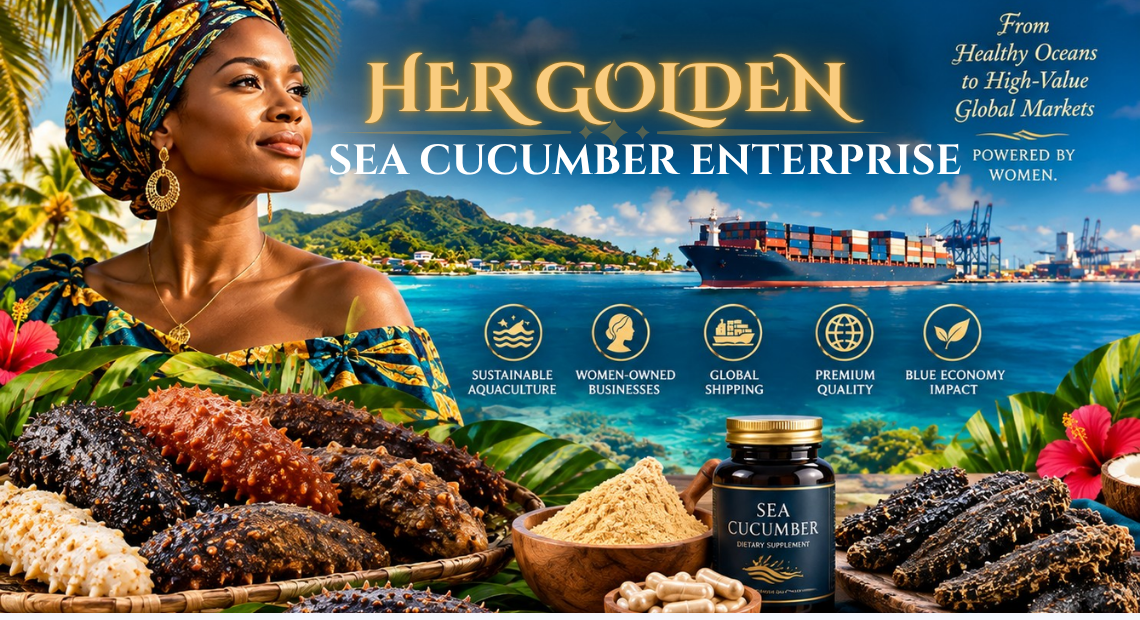
HER GOLDEN SEA CUCUMBER ENTERPRISE
The High-Value Ocean Crop Women Could Be Growing on Land, in Ponds and Along the Coast
There are agricultural opportunities that look ordinary until you follow the money.
Sea cucumber is one of them.
To many people, the sea cucumber looks like one of the least glamorous creatures in the ocean. But in the international seafood trade, particularly in East Asia, it can be a premium product worth hundreds of dollars per kilogram once processed and dried.
Known commercially as bêche-de-mer, trepang or dried sea cucumber, the product has been traded across Asia for centuries. Today, the opportunity is increasingly shifting from simply harvesting wild animals to farming them.
And this is where the story becomes particularly interesting for African and Caribbean women.
Africa is already in the trade. Madagascar, Tanzania, Mozambique and Seychelles have exported dried sea cucumber to Asian markets, while Jamaica and Belize demonstrate that Caribbean waters also contain commercially valuable species and established or emerging fisheries.
But the most important lesson may be this:
A woman does not necessarily have to own a fishing boat to enter the sea-cucumber business.
Some species can be cultured in controlled land-based tanks and ponds, while others are grown in protected coastal pens, lagoons or sea ranches. Research has demonstrated land-based nursery production of Holothuria scabra, while land-based aquaculture systems can also integrate sea cucumbers with other species as part of an integrated multi-trophic aquaculture system. (ScienceDirect)
The opportunity, therefore, is not simply catching sea cucumbers.
It is building a production, nursery, processing and export business around them.
THE OPPORTUNITY
The market is already there
The global market for dried sea cucumber is difficult to measure with one universally accepted figure because market researchers use different definitions, species and product categories.
One 2026 market estimate puts the global dried sea cucumber market at approximately US$2.55 billion in 2025, projecting growth to about US$3.84 billion by 2032.
Another 2026 industry estimate places the 2025 market at approximately US$1.18 billion, with a projected value of US$2.41 billion by 2035.
The difference is a reminder that these are commercial market estimates rather than a single official global statistic. What is consistent between the estimates is the existence of a substantial international market and continued growth expectations. (PW Consulting)
Asia-Pacific dominates the market, with China and Hong Kong functioning as particularly important commercial destinations.
And this is precisely why Africa and the Caribbean are interesting.
They are geographically positioned close to tropical sea-cucumber resources while sitting outside the world’s largest consumer market.
AFRICA IS ALREADY IN THE BUSINESS
Africa is not starting from zero.
A TRAFFIC assessment of African sea-cucumber trade found that 33 African countries were exporting sea-cucumber products by 2019. Between 2012 and 2019, Hong Kong reported importing approximately 3.8 million kilograms of dried sea cucumbers from Africa.
Madagascar was the largest African exporter during that period, accounting for approximately 40% of African exports, followed by Seychelles, Tanzania, Mozambique, Mauritania, Egypt and Kenya. (TRAFFIC)
The numbers also reveal something important.
Much of Africa’s historical production has depended on wild harvesting.
That is becoming increasingly problematic because sea-cucumber populations have been depleted in many areas through overfishing. UNECA identifies Tanzania, Seychelles, Mauritania, Madagascar and Mozambique among the leading African exporters to East Asia, while noting that production in many of these countries has historically been based on wild catches rather than farming. (Mucuruzi)
That creates the opening:
Move from extraction to aquaculture.
MADAGASCAR: AFRICA’S SEA-CUCUMBER LESSON
Madagascar provides perhaps the most developed African example.
Sea-cucumber farming began developing there in the late 1990s and early 2000s, with hatchery technology supporting village-level and commercial production.
By 2018, Madagascar had approximately 153 hectares of sea-cucumber pens, including village farms involving hundreds of households. Farmers could grow hatchery-reared Holothuria scabra to market size and sell their harvest to a commercial processing and export partner. (ScienceDirect)
There is also a significant gender story.
One Madagascar farming programme reported 162 farmers, 59% of them women, across more than 40 farms. (Blue Ventures)
Another documented community farm involved 20 farming teams, with women making up approximately 52% of participants. (Taylor & Francis Online)
This matters because it demonstrates that women do not have to remain at the bottom of the seafood value chain.
They can participate in production itself.
At the same time, Madagascar also provides an important warning: access to marine resources, land, community rights and the distribution of benefits must be designed carefully. Research has documented conflicts around enclosure and access in some sea-cucumber farming areas. Sustainable investment therefore requires community agreements, transparent ownership and clear benefit-sharing. (Taylor & Francis Online)
ZANZIBAR: THE WOMEN ARE ALREADY THERE
For Tanzania, this opportunity is particularly relevant.
Zanzibar has already experimented with sea-cucumber farming as an alternative livelihood for coastal communities.
FAO introduced sea-cucumber farming partly because the island’s predominantly female seaweed-farming population was facing declining productivity and income.
The women already possessed something valuable:
knowledge of the sea.
FAO reported that Holothuria scabra could earn farmers up to approximately US$100 per kilogram when dried, depending on quality, in the market conditions documented at the time. (Society for Conservation Biology)
More recently, the United Nations reported that sea-cucumber farming in Unguja Ukuu has developed into a community livelihood in which women participate directly in daily farm operations, including maintenance, harvesting and other activities. (The United Nations in Tanzania)
And Tanzania’s opportunity is not limited to Zanzibar.
A current blue-economy initiative in Pemba is developing an integrated sea-cucumber enterprise around hatchery production, nursery, community grow-out and processing. The project reports that 60% of its direct jobs are held by women. (Global Fund for Coral Reefs)
That is a very important signal.
The country already has:
species + coastline + market history + women with aquaculture experience + emerging commercial infrastructure.
What is missing is scale.
WHAT ABOUT THE CARIBBEAN?
The Caribbean should not be left out of this conversation.
The species and production systems are different from those of the Western Indian Ocean, but commercial sea cucumbers occur in the wider Caribbean and western Atlantic.
Jamaica
Jamaica announced a limited-entry commercial sea-cucumber fishery beginning in 2021 following an assessment of the resource.
The Jamaican Ministry of Agriculture and Fisheries estimated that the country could sustainably produce more than 30 tonnes of wet-weight sea cucumber annually, with potential export earnings estimated at approximately US$30 million under the assumptions used by the ministry.
At the time, the ministry reported dried sea cucumber prices reaching as much as US$385/kg. (Ministry of Agriculture and Fisheries)
That does not mean every farmer can obtain that price.
It demonstrates something more useful:
Jamaica has already identified sea cucumber as an exportable commercial resource.
Belize
Belize also has a documented sea-cucumber fishery.
Its fishery expanded rapidly between 2009 and 2016 before declining and being closed in 2017 because of management problems, including illegal fishing and difficulties establishing sustainable catch limits. (ScienceDirect)
The Caribbean is therefore not a blank slate.
It has species, fisheries knowledge, Asian-market connections and an opportunity to learn from the mistakes of unmanaged extraction.
And researchers are now examining aquaculture opportunities for Caribbean species such as Holothuria floridana, particularly in Panama, Mexico and Belize. (ScienceDirect)
For African-descended women with family, business or investment connections between Africa and the Caribbean, this creates an intriguing possibility:
two tropical regions, two production environments, one global luxury seafood market.
THE SOLUTION
Don’t catch the opportunity. Farm it.
The future of the industry cannot depend entirely on finding more wild sea cucumbers.
The more interesting business is controlled production.
The tropical sandfish, Holothuria scabra, is particularly important because it is one of the best-studied tropical commercial species and is currently the tropical species most extensively produced through hatchery technology. (ScienceDirect)
It can be produced through several systems:
Land-based nursery tanks
Juveniles can be raised in tanks under controlled conditions before being transferred to larger growing systems.
Earthen ponds
Research has demonstrated nursery production in pond-based systems, with water circulation playing an important role in growth and survival. (Wiley Online Library)
Coastal pens
Sea cucumbers can be grown in enclosed shallow-water areas.
Sea ranching
Juveniles can be released into managed marine areas where environmental conditions are appropriate.
Integrated aquaculture
Sea cucumbers can be incorporated into systems with other aquatic species because they feed on organic material in sediments and can help recycle nutrients. Researchers have specifically examined their role in land-based integrated multi-trophic aquaculture. (ScienceDirect)
So when we say “you can farm sea cucumber on land,” there is an important qualification:
This is not a freshwater farm.
A land-based commercial operation requires an appropriate seawater or marine-water system, suitable salinity and temperature, water exchange or recirculation, substrate and appropriate biosecurity.
But the animal does not necessarily have to spend its entire production cycle in the open ocean.
That distinction opens the door to entrepreneurs who own or lease suitable coastal land.
THE PRODUCT
The first commercial product to understand is bêche-de-mer.
Fresh sea cucumber is processed through stages that can include:
cleaning → gutting → boiling → drying → grading → packaging
The result is a highly concentrated dried product that can be shipped internationally.
And processing is where another business opportunity appears.
A woman does not necessarily have to operate a farm to participate.
She could own:
- a nursery;
- a grow-out operation;
- a drying facility;
- a grading and packaging business;
- a collection centre;
- a quality-control service;
- a cold-storage operation;
- an export company;
- a buyer-supplier aggregation business;
- or a combination of these.
THE POTENTIAL
Why the economics are interesting
Sea cucumber is unusual because the product becomes dramatically lighter during processing.
Research on Holothuria scabra has documented a strong relationship between wet and dry weight, while commercial processing studies show substantial reductions in weight during gutting, cooking and drying. (E-Journal Balitbang KKP)
That means the farmer is not selling the same kilogram that came out of the water.
The business model is about producing a high-value, low-volume export commodity.
Historical market research has found H. scabra selling at hundreds of dollars per kilogram dried, with premium large specimens reaching much higher prices in Hong Kong markets. A major review reported dried H. scabra values of approximately US$115–640/kg, with exceptional premium specimens reaching approximately US$1,670/kg in the data examined. (ScienceDirect)
A later review found that H. scabra had reached nearly US$2,000/kg dry weight in Hong Kong in 2016. (ScienceDirect)
These figures should not be used as a promise of what a new African or Caribbean farmer will receive.
Species, size, processing quality, moisture, grading, buyer, season and export channel all matter.
But they demonstrate why this is a serious high-value commodity rather than an ordinary seafood crop.
A simple way to see the opportunity
Suppose a small producer eventually develops a harvest equivalent to:
| Dried product sold | Illustrative selling price | Gross sales |
|---|---|---|
| 50 kg | $100/kg | $5,000 |
| 100 kg | $150/kg | $15,000 |
| 250 kg | $200/kg | $50,000 |
| 500 kg | $250/kg | $125,000 |
| 1,000 kg | $300/kg | $300,000 |
These are scenario illustrations, not guaranteed market prices.
The point is not that every farmer will sell at $300/kg.
The point is that once a producer reaches export-grade volume, even relatively small quantities of a premium dried commodity can represent meaningful revenue.
WHERE WOMEN FIT
This may be the most important part of the opportunity.
Women have historically been heavily involved in the lower-value portions of fisheries: gleaning, processing, drying, trading and selling.
Research on women in sea-cucumber fisheries and aquaculture notes that women frequently occupy lower-paid positions while men dominate more lucrative fishing activities. (ScienceDirect)
Aquaculture changes the equation.
Instead of waiting on someone else to bring the catch ashore, a woman can potentially own the production system itself.
Her Golden Sea Cucumber Enterprise could include:
THE FARMER
Owns ponds, pens or tanks and grows the animals.
THE NURSERY WOMAN
Produces juveniles for other farmers.
THE PROCESSOR
Purchases farmed animals and produces export-grade bêche-de-mer.
THE AGGREGATOR
Buys from multiple small farms and assembles commercial export lots.
THE QUALITY SPECIALIST
Controls grading, drying, moisture and packaging.
THE EXPORTER
Connects African or Caribbean production to Asian buyers.
THE AQUACULTURE CONSULTANT
Helps communities establish production systems.
THE WOMEN’S FARMING COOPERATIVE
Pools production, equipment, labour and bargaining power.
This is where the opportunity becomes bigger than a farm.
It becomes a value chain.
THE INVESTMENT
What is the minimum market entry?
This is where I would encourage a woman to think differently.
She does not need to begin by building a million-dollar hatchery.
The first question should be:
Which part of the value chain can I enter profitably?
TIER 1 — THE SEA CUCUMBER STARTER
Indicative entry: US$2,500–$7,500
A small pilot could involve:
- a small number of tanks or pond compartments;
- seawater intake/storage;
- filtration;
- pumps and aeration where required;
- substrate;
- fencing/netting;
- juvenile stock;
- basic monitoring equipment;
- simple handling equipment.
This is a pilot, not a commercial export farm.
The objective is to learn the biology and establish survival rates before committing serious capital.
TIER 2 — THE WOMAN’S COMMERCIAL FARM
Indicative entry: US$10,000–$30,000
This could support a larger pond, tank or coastal grow-out operation with:
- multiple production units;
- improved water management;
- juvenile stock;
- fencing/security;
- harvesting equipment;
- basic processing;
- drying infrastructure;
- storage;
- labour;
- permits and compliance.
The precise cost will vary enormously according to whether the operation uses existing ponds, new construction, coastal pens or a more sophisticated land-based system.
TIER 3 — THE GOLDEN SEA CUCUMBER PROCESSING HUB
Indicative entry: US$30,000–$75,000+
Now the business begins moving beyond farming.
The entrepreneur could aggregate production from several farmers and operate:
collection → cleaning → processing → drying → grading → packaging → storage
That creates an opportunity to earn not only from animals she personally grows but from the production of other women.
TIER 4 — THE INTEGRATED ENTERPRISE
US$100,000+
This is where the model can become truly industrial:
Hatchery + nursery + grow-out + processing + export
A commercial hatchery requires substantially greater technical expertise and capital.
For perspective, one current Sri Lankan commercial proposal describes a US$3.2 million integrated hatchery and sea-pen operation designed to produce up to two million juveniles annually. That is a useful illustration of what the upper end of the industry can look like—not a recommended starting point. (Globe Multi Traders)
The smarter entry for most entrepreneurs is to begin lower in the value chain and scale after proving survival, production and market access.
THE BIGGER AFRICAN OPPORTUNITY
Imagine linking several coastal communities.
A woman in Pemba produces.
Another in Zanzibar produces.
A cooperative in Madagascar produces.
A processor grades and dries.
A woman-owned trading company aggregates.
An international buyer purchases a consistent export lot.
Suddenly, the business is no longer:
“I have a pond full of sea cucumbers.”
It becomes:
“I operate a traceable African sea-cucumber supply chain.”
That is a much more valuable proposition.
And it is particularly relevant because the international market rewards consistency.
Buyers want:
- identifiable species;
- predictable size;
- proper processing;
- low moisture;
- clean product;
- traceability;
- reliable volumes;
- legal documentation;
- sustainable production.
THE CARIBBEAN CONNECTION
There is another opportunity here that deserves more attention.
African-descended women in Jamaica, Belize, the wider Caribbean and the United States do not necessarily have to compete with Asian producers.
They can develop tropical production networks closer to the communities where these species naturally occur.
Jamaica has already identified commercial sea-cucumber potential.
Belize has already experienced the boom-and-bust consequences of poorly controlled harvesting.
The lesson is clear:
The next Caribbean opportunity should be built around aquaculture, traceability and resource management—not simply another wild-capture rush.
For women with land, coastal access, seafood businesses, restaurants, export relationships or aquaculture experience, sea cucumber could become one component of a broader Caribbean blue-food enterprise.
THE RISK
There is a reason this commodity commands high prices.
It is not necessarily easy.
Sea cucumber farming requires:
good juveniles + appropriate water + correct stocking density + water quality + security + technical knowledge + processing discipline + a legitimate buyer.
And the biggest danger is assuming that a high international retail price automatically becomes the farmer’s price.
It doesn’t.
There are costs between the farm and the final consumer:
farmer → processor → aggregator → exporter → importer → wholesaler → retailer
There are also regulatory requirements concerning fisheries, aquaculture, export, food safety, protected species and—in some markets—wildlife trade controls.
For that reason, market access should be established before production is scaled.
THE NEXT MOVE
A woman interested in building a Her Golden Sea Cucumber Enterprise should begin with ten questions:
1. Which species is native to my location?
Do not import a species simply because it commands a high price somewhere else.
2. Is farming legally permitted?
Check fisheries, aquaculture, environmental and coastal regulations before construction.
3. Can I obtain legitimate hatchery-produced juveniles?
Seed supply is one of the most important constraints in commercial aquaculture.
4. Do I have access to suitable seawater?
For land-based production, water quality and reliable circulation are fundamental.
5. Which production system suits my property?
Tank, pond, coastal pen, sea ranch or integrated aquaculture?
6. Who will buy the product?
Find the buyer before building the farm.
7. What grade does the buyer want?
Size and processing quality can dramatically affect value.
8. Can I process to export quality?
Drying, moisture control, cleanliness and storage are part of the business—not an afterthought.
9. Can several women farm together?
Aggregation can solve the volume problem that defeats many small producers.
10. Can I start with a pilot?
A successful small farm is more valuable than an expensive farm that has never proved its production economics.
THE GOLDEN OPPORTUNITY
Sea cucumber is not a crop I would place in the category of “easy money.”
I would place it in another category:
high-value, technically demanding, export-oriented aquaculture.
And that distinction matters.
Madagascar has demonstrated that community farming can connect women and coastal households to commercial production.
Zanzibar has demonstrated that women can move from seaweed farming into sea-cucumber aquaculture.
Pemba is now developing a vertically integrated model that includes hatchery, nursery, grow-out and processing, with women holding a significant share of direct jobs.
Jamaica has already identified commercial export potential.
Belize has demonstrated both the opportunity and the consequences of over-exploiting the wild resource.
And scientific research has demonstrated that sea cucumbers can be incorporated into land-based and pond-based aquaculture systems under appropriate conditions. (The United Nations in Tanzania)
The opportunity, therefore, is not simply to catch more sea cucumbers.
It is to build a better industry around them.
Farm them.
Process them.
Aggregate them.
Export them.
And let women own more of the value chain.
MY GOLDEN ERA CONSULTATION
My name is Renae Bruce-Miller, I am a professional consultant in African Agro processing based in Dar es Salaam Tanzania.
Through Her Golden Era, I am interested in identifying practical agro-processing, aquaculture and blue-economy opportunities that can connect African and African-descended women to real markets.
Sea cucumber is one of those opportunities that deserves serious investigation—not because every woman should become a sea-cucumber farmer, but because the value chain raises a much bigger question:
What high-value products are already being produced around us, exported from Africa and the Caribbean, and purchased by the world—and why are women not capturing more of that value?
That is the question behind Her Golden Era.
Her world is happening now.
She is in it.
Are you?