


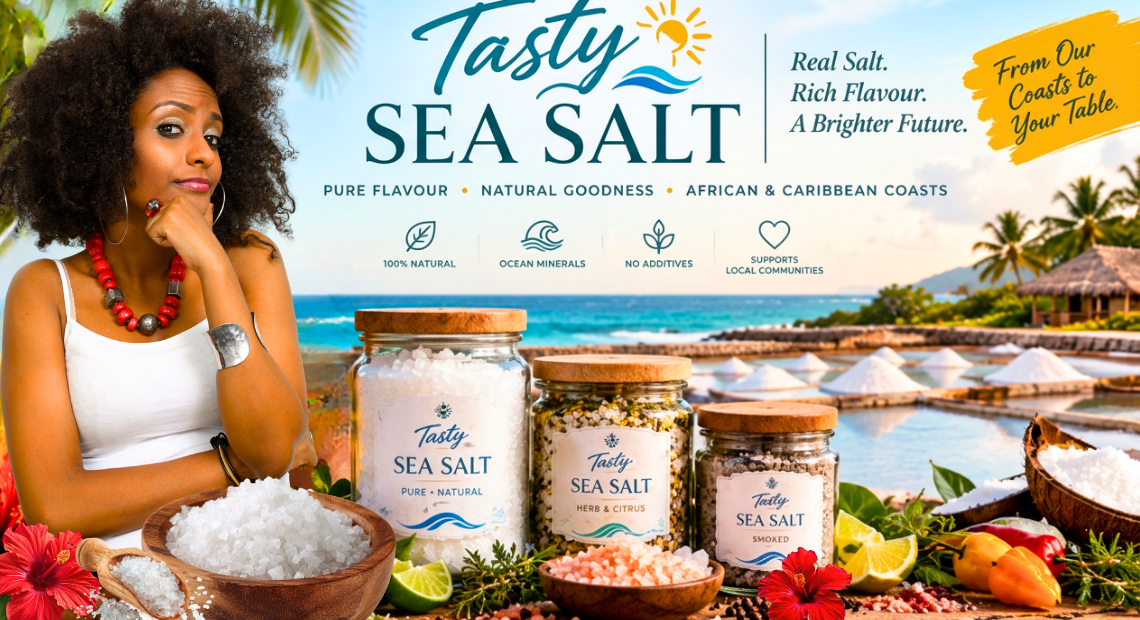
HER GOLDEN AFRICAN & CARIBBEAN SEA SALT ENTERPRISE
From Sea, Sun & Salt Pans to Global Shelves
Africa and the Caribbean possess something that can never be imported: an abundant coastline and tropical sunlight.
Salt can be produced from seawater through evaporation, then cleaned, dried, graded and packaged for food and other markets. The basic process is simple. The commercial opportunity lies in producing a consistent, clean product and moving it from a commodity into a branded ingredient.
The global salt market was estimated at approximately $26.9 billion in 2025, with projected growth to about $39.4 billion by 2034. Salt is consumed not only as a seasoning but across food processing, chemical manufacturing, water treatment, agriculture, animal feed, pharmaceuticals and other industries.
AFRICA’S SALT COAST
Salt production is spread across much of Africa.
| Region | Important salt-producing or commercially active countries |
|---|---|
| North Africa | Egypt, Morocco, Tunisia, Algeria, Libya |
| West Africa | Senegal, Ghana, Mauritania, The Gambia, Guinea, Guinea-Bissau, Sierra Leone, Côte d’Ivoire, Nigeria |
| East Africa | Tanzania, Kenya, Ethiopia, Eritrea, Djibouti, Somalia |
| Southern Africa | Namibia, South Africa, Mozambique, Angola, Botswana |
| Indian Ocean | Madagascar, Comoros, Mauritius, Seychelles |
Not all of these countries are major exporters, but together they demonstrate the geographic breadth of Africa’s salt resources.
The largest commercial exporters include Egypt, Kenya, Namibia, South Africa, Senegal, Tunisia and Morocco.
In 2024, Kenya exported approximately $52.5 million of salt and sodium chloride, Namibia $41.4 million, Egypt $72.9 million, Senegal $18.1 million, South Africa $18.1 million, Tunisia $32.6 million and Morocco $12.0 million.
Tanzania exported approximately $5.1 million, while its imports were considerably larger at $15.3 million.
That creates an interesting regional business question: why should a coastal African market import salt when the raw material is sitting beside the ocean?
TANZANIA REVEALS THE REGIONAL OPPORTUNITY
Tanzania’s 2024 exports of salt went primarily to Burundi, Malawi, the Democratic Republic of Congo, Rwanda and Uganda, generating about $5.1 million.
At the same time, Tanzania imported about $15.3 million of salt, primarily from Kenya and India.
Kenya exported nearly $52.5 million of salt in 2024, with Uganda, Tanzania, Rwanda, South Sudan and the DRC among its largest customers.
The trade pattern demonstrates something more useful than simply saying Africa has salt:
salt is already moving across East African borders as a regional commodity.
A small processor does not necessarily have to find a buyer in Europe. A reliable branded product can begin with hotels, supermarkets, restaurants, food manufacturers and neighbouring countries.
THE CARIBBEAN HAS ITS OWN SALT ECONOMY
The Caribbean has a particularly strong natural advantage for solar salt because of its warm climate, coastal geography and tourism economy.
Important salt-producing or commercially relevant markets include The Bahamas, Jamaica, Trinidad and Tobago, Barbados, Haiti, the Dominican Republic, Cuba, Guyana, Suriname, Belize, Grenada, Saint Lucia, Saint Vincent and the Grenadines and Antigua and Barbuda.
The Bahamas is already a significant salt exporter. In 2024 it recorded approximately $28 million of salt exports, with the United States receiving more than $14 million and Jamaica another $352,000.
Jamaica exported approximately $738,000 of salt in 2024, supplying Guyana, Trinidad and Tobago, Barbados, Saint Lucia, Grenada and other Caribbean markets.
Trinidad and Tobago exported approximately $1.87 million, with Guyana accounting for about $1.48 million.
The Caribbean therefore presents an unusual combination of local salt production, intra-Caribbean trade, tourism and premium food markets.
SALT IS MUCH MORE THAN TABLE SALT
The same basic mineral enters very different markets.
| Salt product/use | Customer |
|---|---|
| Fine culinary sea salt | Supermarkets, households, restaurants |
| Coarse sea salt | Chefs, food processors, grinders |
| Flavoured salts | Retail, gourmet food, gifting |
| Smoked or herb salt | Specialty food and restaurants |
| Salt blends | Meat, seafood, vegetable and snack producers |
| Pickling/preservation salt | Food processors and households |
| Bakery and food-processing salt | Commercial food manufacturers |
| Animal-feed salt | Livestock and agricultural markets |
| Bath and spa salt | Hotels, spas, wellness and cosmetics |
| Pharmaceutical-grade salt | Medical and pharmaceutical manufacturers |
| Industrial salt | Chemical processing, water treatment and manufacturing |
At industrial scale, salt is also a feedstock for producing chlorine and caustic soda, which in turn are used in products ranging from PVC to paper-processing chemicals.
That market is enormous, but it is not where a small woman-owned processor should begin.
THE PREMIUM OPPORTUNITY IS IN THE JAR
Commodity salt can sell for relatively little per kilogram.
Premium culinary salt can sell for dramatically more because the customer is purchasing presentation, purity, origin, texture and convenience, rather than simply sodium chloride.
An African coastal brand could develop products such as:
Mozambique Sea Salt
Zanzibar Sea Salt
Senegal Atlantic Salt
Namibian Desert Salt
Jamaican Sea Salt
Bahamas Sea Salt
The important point is authenticity. The origin should only be claimed when the salt is genuinely produced there and meets the relevant food standards.
Flavoured products can add another layer:
lime & sea salt, chilli salt, garlic salt, herb salt or smoked salt.
These are not new forms of salt; they are higher-value formulations built around salt.
THE LOW-IMPACT BUSINESS MODEL
The most appropriate small-enterprise model is a solar sea-salt micro-processing and packaging business.
Seawater is channelled into shallow evaporation ponds where the sun removes the water and leaves salt crystals. The harvested salt is then washed or otherwise cleaned according to the production method, dried, graded and packaged.
Where suitable land and environmental approvals exist, solar evaporation can keep energy requirements relatively low because the principal energy source is sunlight.
A woman investor could operate a modest production site near an established salt-producing community rather than attempting to develop a completely new salt field.
The business could buy or collect locally produced salt, perform the final cleaning, drying, grading and packaging, and sell under its own brand.
That is a much lower-impact entry point than building an industrial salt operation.
HER FIRST PRODUCTS
The initial product range should stay narrow.
Fine culinary sea salt can serve households and food manufacturers.
Coarse sea salt can target restaurants and chefs.
One or two African or Caribbean flavoured salts can provide the premium retail product.
A larger-format food-service bag can generate wholesale volume while the smaller jars generate the higher retail margin.
This gives the business two customers without creating an unnecessarily complicated factory.
A SMALL WOMAN-OWNED START-UP
An illustrative micro-processing and packaging operation could begin at approximately $12,000–$15,000, depending heavily on whether the entrepreneur is purchasing salt from existing producers or developing her own evaporation ponds.
| Start-up requirement | Illustrative investment |
|---|---|
| Small solar evaporation/collection setup or producer partnership | $3,000 |
| Washing, drying and grading equipment | $2,000 |
| Stainless work surfaces and food-grade containers | $1,000 |
| Scales, sealer and moisture/quality equipment | $1,000 |
| Jars, pouches, labels and initial packaging | $1,500 |
| Registration, testing and compliance | $1,000 |
| Initial salt inventory and ingredients | $1,000 |
| Working capital | $2,500 |
| Illustrative starting capital | $13,000 |
The model assumes the business starts with food-grade salt, not industrial chemical processing.
A SIMPLE FINANCIAL SNAPSHOT
Suppose the business reaches 1,000 kg of finished salt products per month.
If its blended realised selling price across retail jars, specialty blends and food-service packs averages $3 per kilogram, monthly sales would be approximately $3,000.
If the business retains an illustrative operating contribution of 30% after salt, packaging, labour, transport, utilities and other operating expenses, that would produce approximately $900 per month, or $10,800 annually.
| Planning snapshot | Illustration |
|---|---|
| Initial investment | $13,000 |
| Finished salt/month | 1,000 kg |
| Blended realised price | $3/kg |
| Monthly sales | $3,000 |
| Operating contribution at 30% | $900 |
| Annual operating contribution | $10,800 |
| Simple annual return | ~83% |
| Indicative capital payback | ~14–15 months |
These are planning assumptions, not a promised return. The biggest variables are packaging cost, local salt prices, retail versus wholesale sales, production volume and the premium customers are willing to pay for the finished product.
The business becomes more attractive when it sells a greater proportion through premium retail, restaurants, hotels and specialty food channels rather than competing solely in bulk commodity salt.
THE OPPORTUNITY IN THE MOMENT
For an African woman or woman from the diaspora, sea salt offers a rare kind of business opportunity: the raw material is abundant, the basic production technology is uncomplicated, and the market already exists across food, hospitality, agriculture and industry. Africa and the Caribbean are surrounded by salt-producing coastlines, yet substantial quantities of salt continue to cross regional borders. Tanzania’s 2024 trade alone shows the gap: about $5.1 million of exports against $15.3 million of imports. The opportunity is not to become another giant commodity producer. It is to build a small, clean, well-branded salt company that turns locally produced sea salt into premium culinary products, specialty blends and reliable food-service packs—and then grows into regional markets.
The ocean provides the raw material. Her business captures the value.
Research basis
The global market figure comes from a current 2026 industry analysis estimating the salt market at $26.92B in 2025, with a projection of $39.38B by 2034. (Fortune Business Insights)
The 2024 African export figures come from World Bank WITS/UN Comtrade. The data shows Egypt at $72.9M, Kenya at $52.5M, Namibia at $41.4M, Tunisia at $32.6M, Senegal at $18.1M, South Africa at $18.1M and Morocco at $12.0M in HS 250100 salt exports. (World Integrated Trade Solution)
For the East African angle, Tanzania’s 2024 salt exports were $5.14M, while its imports were $15.31M; Kenya exported $52.52M, with Tanzania as its second-largest destination at $11.40M. (World Integrated Trade Solution)
For the Caribbean, The Bahamas exported $28.0M of salt in 2024, Jamaica $738,000, and Trinidad and Tobago $1.87M. The Bahamas sent more than $14M to the United States, while Jamaica’s exports were heavily regional. (World Integrated Trade Solution)
The uses described in the article are consistent with USGS’s classification of salt as a food seasoning, chemical feedstock and input into products including chlorine, caustic soda, PVC and paper-processing chemicals. (usgs.gov)