


Mauritius: The Island Where the Holiday Could Become an Investment
There are beach holidays, and then there are places that quietly make you wonder whether you should have brought your financial adviser along. Mauritius is both. This sophisticated Indian Ocean island has the beaches, palm trees and impossibly blue water you came for, but it also has something rather more interesting for the woman thinking about her next chapter: a stable economy, an international financial centre, strong infrastructure and a government actively courting foreign investment. Mauritius positions itself as a gateway to Africa, with preferential market access, investment-protection agreements and a business environment designed to attract international companies and capital.

Your Golden Mauritius itinerary
DAY 1 — Port Louis: Meet the real Mauritius.
Start in the capital rather than immediately disappearing into a resort. Visit the Central Market, explore the waterfront and learn about Mauritius’s complicated and fascinating history at Aapravasi Ghat, the UNESCO World Heritage Site documenting the arrival of indentured labourers, and the nearby museums. Mauritius is a particularly interesting destination for Black travellers because the island’s history includes African enslavement, the Indian Ocean slave trade and the movement of African, Indian, Chinese and European peoples. At Le Morne, in the southwest, the landscape itself tells another chapter of that history: the mountain became a refuge for escaped enslaved people and is now a UNESCO World Heritage cultural landscape.
DAY 2 — Grand Baie & the north.
Head north to Grand Baie, where the mood becomes more glamorous: boutiques, restaurants, catamaran trips and beautiful beaches. Take a boat out to the northern islands or simply claim a table overlooking the water. For the woman who likes her holidays with a little retail therapy, this is the day for shopping, lunch and a leisurely afternoon rather than trying to conquer the entire island before dinner.
DAY 3 — Pamplemousses & the botanical side of Mauritius.
Visit the famous Sir Seewoosagur Ramgoolam Botanical Garden, then slow the pace down with a rum or sugar-cane experience, a long lunch and perhaps a wellness treatment. Mauritius does very well when you stop trying to make every hour productive.
DAY 4 — Le Morne & the southwest.
Make your way toward Le Morne Brabant, one of the island’s defining landscapes. You don’t have to climb the mountain to appreciate it; a guided cultural visit, beach day, lagoon excursion or wellness experience can be just as rewarding. The southwest is also excellent for women interested in wellness, nature and photography.
DAY 5 — Black River & the wild side.
Explore Black River Gorges National Park, where forest, waterfalls and endemic wildlife offer a welcome change from the beach. Choose an easy guided walk rather than turning the holiday into an endurance competition. Mauritius has plenty of accessible nature experiences, and the tourism authority actively promotes hiking, wellness, food, culture and nature alongside luxury travel.
DAY 6 — The investor’s Mauritius.
Now change the lens. Spend a day around Ebène Cybercity, Port Louis and Moka, where financial services, technology, business services and regional headquarters converge. If your visit coincides with an investment, trade, women-in-business or financial-services event, go. Mauritius hosts international business and investment gatherings and the Economic Development Board actively promotes sectors including financial services, ICT, healthcare, life sciences, renewable energy, manufacturing, agro-industry, blue economy and real estate.
Getting around
Mauritius is compact enough to explore but large enough that you’ll appreciate having a plan.
Buses are inexpensive and widely used, while taxis, private drivers and rental cars are the easiest options for a more comfortable itinerary. The tourism authority also lists cycling, metro, boat taxis and helicopter travel among the island’s transport options.
Buses can be frequent, although express services are less frequent and routes require a little planning.
For a first visit, I’d choose a private driver for one or two sightseeing days and use taxis or organised transfers for the rest. It costs more than the bus, but it means you can spend your day exploring without constantly checking the clock.
Mauritius becomes particularly interesting because You could spend the morning discussing an investment opportunity and the afternoon having lunch overlooking the Indian Ocean.
That combination—business without giving up beauty—is very Mauritius.
Mauritius: When to Go, What to Eat & What Not to Miss
Mauritius rewards the traveller who gives herself time to look beyond the resort. September to November is particularly lovely for warm weather without the intensity of the peak summer season, while December to March brings hotter, more humid weather and higher holiday prices.
If culture is your thing, time your trip around one of the island’s extraordinary celebrations. Holi falls around March, National Day is celebrated on March 12, Festival Culinaire Constance takes place in March, MAMA JAZ fills April with music, C-Kite Festival arrives in June, Festival Bouzé takes place in August, and Ganesh Chaturthi and the Festival de Chinatown bring September to life.
November is particularly meaningful: Diwali falls on November 8, 2026, while November 2 commemorates the arrival of indentured labourers—an important part of understanding Mauritius’s Indian Ocean history.
And if you can stretch the trip into December, look for the Kreol International Festival, celebrating Mauritian Creole music, dance, food and arts, and Porlwi by Light, which transforms Port Louis into an extraordinary open-air celebration of light, art and performance; the 2026 Porlwi festival is scheduled for December 2–4.

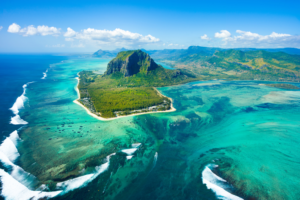
Mauritius is blessed with spectacular waterfalls tucked into its lush interior, from the dramatic Chamarel Waterfall to the cascading falls of Black River Gorges National Park. But perhaps the island’s most famous “waterfall” isn’t a waterfall at all. Off the coast of Le Morne, the extraordinary underwater waterfall is a breathtaking optical illusion created as sand and silt move over an underwater shelf, producing the appearance of water plunging into the depths of the Indian Ocean. Best appreciated from above on a scenic helicopter or seaplane flight, it is one of those rare natural spectacles that makes you look twice and then reach for your camera.
What will it cost?
Mauritius can be as affordable or as extravagant as you choose.
Current 2026 hotel pricing puts the average commonly viewed hotel at roughly US$170–$250 a night, depending on the month, with September around US$170 and December around US$252; luxury five-star properties can easily move into the US$400–$1,500+ per night territory.

Official Mauritius tourism statistics provide another useful benchmark: tourists staying in hotels spent an average of about MUR 11,700 per night in 2025, although that figure includes spending patterns across different hotel categories and does not mean that every hotel room costs that amount.
And then there is the food—which may be one of the best reasons to get out of the hotel.
Mauritian cuisine is a delicious meeting point of African, Indian, Chinese, French and Creole influences. Start with dholl puri, the island’s famous split-pea flatbread; try farata with curry, spicy gâteau piment, mine frit noodles and bol renversé, then make time for seafood, octopus curry, rougaille and grilled fish. A local restaurant meal can be surprisingly inexpensive, while a tourist restaurant generally costs considerably more and a gourmet hotel dinner can easily reach MUR 2,500–5,000 per person.
Don’t leave without seeing these
Le Morne Brabant is the obvious must-see, but don’t simply photograph it from a resort—the mountain carries a profound history connected to escaped enslaved people and is a UNESCO World Heritage site.
Aapravasi Ghat in Port Louis is another essential stop for understanding the indentured-labour history that helped shape modern Mauritius.
Then go completely in the opposite direction and spend an afternoon at Chamarel, visit the Seven Coloured Earth, explore Black River Gorges, wander through Sir Seewoosagur Ramgoolam Botanical Garden, take a catamaran to the northern islands, or simply spend an afternoon at Blue Bay or Flic en Flac doing absolutely nothing. For the Her Golden Era woman, I’d add one more experience: make time for a proper Mauritian cooking class or market tour. It is much easier to understand an island when you taste its history.
And if you’re travelling for more than the view…
Keep an eye on the Economic Development Board’s investment calendar. Mauritius regularly hosts business forums, investment-promotion events and sector meetings aimed at international investors, particularly in real estate, hospitality, financial services, technology and other sectors. The EDB’s 2026 Mauritius Europe Investment Promotion Roadshow, for example, specifically brought together investment forums, networking sessions and B2B meetings around real estate and hospitality opportunities.
You can come for the beach, discover the culture, fall in love with the food—and leave with a completely different idea about what an island holiday can mean.
Could you actually live here?
This is where the story gets interesting.
Mauritius permits non-citizens to acquire qualifying residential property through approved schemes including the Property Development Scheme (PDS), Integrated Resort Scheme (IRS), Real Estate Scheme (RES) and certain other approved routes. A non-citizen purchasing qualifying residential property at US$375,000 or more can be eligible for a residence permit, with the permit extending to qualifying dependants. The PDS route is specifically designed around high-end residences with amenities and property-management services.
There is also a Ground + 2 apartment route, allowing non-citizens to acquire qualifying apartments from MUR 6 million, although the residency rules and thresholds differ from the PDS/IRS/RES routes—so this is one area where buyers absolutely need professional advice rather than relying on a property agent’s Instagram reel.
And Mauritius has something else that makes it appealing to women planning for the longer term: retirement residency options. The government actively markets Mauritius as a place to work, live and retire, with routes including retirement residence permits, property-based residency and the Premium Visa.
What does property actually cost?
This is not a bargain-island story—and that is important to understand.
Current 2026 market data puts the average asking price for a Mauritius apartment at approximately US$441,000, while houses averaged around US$642,000 in 2025 asking-price data. But location makes an enormous difference: average apartment asking prices ranged from roughly US$183,000 in the central region to about US$640,000 in the east, while prime coastal houses can run well above US$1 million. Properties specifically available to foreign buyers averaged roughly US$740,000 in 2025, reflecting the premium attached to foreign-eligible developments. These are asking prices, not guaranteed transaction prices.
For the woman considering property as an investment rather than simply a holiday home, the numbers are worth examining carefully. The current national average gross residential rental yield is about 3.29%, with typical net yields lower after management, maintenance, taxes and other costs. In some short-term rental markets, gross returns can potentially reach 5–9%, but those figures depend heavily on location, occupancy, seasonality and professional management—they should never be presented as guaranteed returns.
So I would tell a reader: don’t buy in Mauritius simply because someone promises a 10% return. Buy the numbers, the location and the long-term proposition.
Why investors keep looking at Mauritius
The attraction is bigger than property.

Mauritius has deliberately built itself as an international financial and business centre, particularly for investors looking toward Africa. Its advantages include political and economic stability, sophisticated financial services, a network of double-taxation agreements and investment-protection agreements, modern telecommunications and a legal and regulatory environment designed to support international business.
The EDB describes Mauritius as having preferential market access covering a large share of the world’s population through its network of trade agreements.

For companies, the standard corporate income-tax rate is 15%, while certain qualifying international activities can benefit from an 80% partial exemption subject to substance and other requirements. Mauritius also has no general capital-gains tax, although this does not mean every property transaction or business sale is automatically tax-free; income arising from property dealing as a business can be taxable.
The country also has a sophisticated banking and international-financial-services sector. This is better understood as a regulated international financial centre, rather than the old-fashioned idea of a secret offshore bank account. Mauritius offers structures such as Global Business Companies, funds, trusts and foundations, and its financial-services sector includes wealth management, fund administration and cross-border investment services.
There are also extensive double-taxation agreements, although the precise benefit depends on the investor’s country of residence, the type of income and the relevant treaty. And if you become tax resident in Mauritius, don’t assume that “offshore” means “tax-free”: Mauritius taxes residents on income according to its tax rules, including relevant foreign income.
One important 2026 warning for property buyers
Mauritius has become more expensive for non-citizen property buyers. From 1 July 2026, registration duty on acquisitions by non-citizens under certain approved schemes increased from 5% to 10%, while land-transfer tax on relevant sales to non-citizens also moved to 10%. That makes professional financial and legal due diligence even more important before buying.
The Golden Era verdict
Mauritius is not simply another tropical island competing for your holiday budget. It is an African investment story wrapped in an Indian Ocean lifestyle.
Come for the beaches and the beautiful hotels. Come for the Creole food, the history, the music and the extraordinary mixture of cultures. Come for the wellness and the sunshine.
But if you’re a woman over 35 thinking about property, retirement, business expansion, wealth preservation or building an international life, give yourself a few extra days.
Have the spa treatment.
Attend the business event.
Tour the property.
Meet the women entrepreneurs.
Talk to the banker.
Ask the uncomfortable tax questions.
Then sit beside the lagoon with a glass of something cold and decide whether Mauritius is simply somewhere you enjoyed visiting—or somewhere your money, your work and your next chapter might belong.