

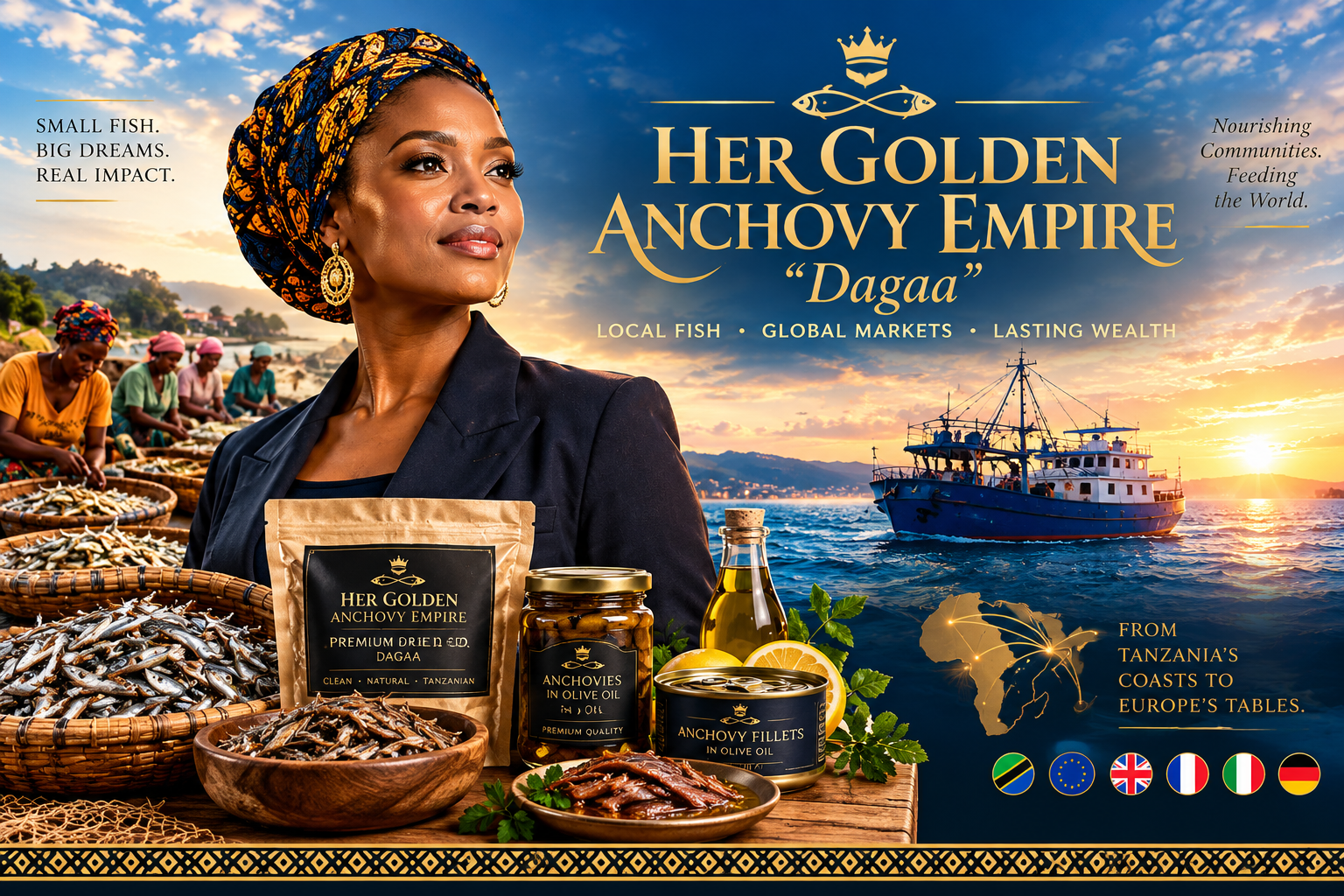
HER GOLDEN ANCHOVY (DAGAA) ENTERPRISE
From humble dagaa to a higher-value African seafood business
Wealth. Wellness. Joy.
There are foods that arrive on the global market wearing a luxury label — and then there are foods that quietly feed millions of people while someone else captures the value.
Anchovies belong in the second category.
Across Africa, small pelagic fish are already being caught, dried, salted, traded and eaten. In Tanzania, the small fish commonly known as dagaa are an important source of affordable protein and income. Women play a particularly important role in processing and trading the fish.
But there is a significant difference between selling fish and building a fish business.
The opportunity is in the gap between the catch and the customer: better handling, cleaner drying, grading, packaging, branding, food safety, regional distribution and eventually higher-value preserved products.
That is where an ordinary fish can become an enterprise.
THE OPPORTUNITY
Africa already has the raw material. The missing piece is value addition.
Tanzania’s fisheries sector is already a substantial export industry. In 2024, Tanzania exported approximately US$180.6 million of fish and fishery products, up from US$164 million in 2023, according to the country’s Economic Survey.
Yet much of the small-fish opportunity remains concentrated at the lower end of the value chain.
Research on Tanzania’s marine dagaa trade has found that the fish moves through domestic and regional markets, including the Democratic Republic of Congo, Zambia, Kenya, Rwanda, Burundi, Malawi and South Sudan. Much of this trade has historically been informal.
And there is a familiar problem:
The fish may travel farther than the value does.
Traditional drying can expose fish to contamination, weather, physical losses and inconsistent quality. Research on the Mafia Island dagaa supply chain estimated substantial cumulative losses before the fish reached consumers in the Democratic Republic of Congo.
This is exactly the kind of problem that creates an enterprise opportunity.
Instead of asking:
How can we catch more fish?
the better business question is:
How can we make the fish already being caught worth more?
THE MARKET
The international market demonstrates what happens when anchovies move up the value chain.
In 2024, global trade data recorded approximately US$250.9 million in imports of prepared or preserved anchovies under HS 160416, representing about 22.8 million kilograms.
The European Union alone accounted for approximately US$250.9 million of imports in this category, with Italy, Spain and France among the largest individual importing markets.
The United States imported another US$50.5 million, while the United Kingdom imported approximately US$21.8 million.
These are not markets for anonymous sacks of dried fish.
They are markets for processed food products.
The value ladder
| Product form | What the business is selling | Indicative trade picture |
|---|---|---|
| Fresh small fish | Raw catch | Lowest value / highly perishable |
| Sun-dried bulk fish | Basic preservation | Regional commodity market |
| Cleaned & graded dried fish | Consistent food product | Higher value |
| Salted / brined fish | Preserved ingredient | International market |
| Fillets | Prepared food ingredient | Higher value |
| Anchovies preserved in oil | Premium food product | Much higher value |
| Branded retail product | Consumer brand | Highest potential value |
The trade statistics make the progression visible.
For 2024, the global average import value recorded for prepared or preserved anchovies under HS 160416 was approximately US$11 per kilogram. Morocco, one of the world’s major anchovy-processing exporters, recorded exports of approximately US$155.2 million and 15.6 million kilograms in the same category — roughly US$10 per kilogram on an export-value basis.
That does not mean a Tanzanian processor can automatically sell at US$10/kg. Products, specifications, markets and processing costs differ considerably.
But it demonstrates something important:
There is a global market that pays for processing.
THE AFRICAN ADVANTAGE
Morocco provides perhaps the clearest African proof of concept.
In 2024, Morocco exported approximately:
US$155.2 million
of prepared or preserved anchovies.
Its major customers included:
- France
- Spain
- United States
- Italy
- Germany
Morocco also exported nearly US$19.9 million of anchovies salted or in brine.
The lesson is not that Tanzania should copy Morocco.
The lesson is that African anchovy processing can compete internationally when the product is transformed into something buyers can specify, trust, store and sell.
And Tanzania already has a domestic and regional market for dagaa.
That means the enterprise does not have to begin with Europe.
It can begin closer to home.
THE SOLUTION
Build the business around quality — not volume.
The simplest opportunity is a professionally processed dried anchovy/dagaa business.
The fish is purchased from licensed fishers or established landing-site suppliers, then:
sorted → cleaned → washed where appropriate → properly dried → graded → inspected → packed → labelled → distributed.
The difference may sound small.
Commercially, it is enormous.
A buyer purchasing a sack of inconsistently dried fish has to worry about:
- moisture
- contamination
- broken fish
- insects
- foreign material
- inconsistent size
- storage losses
- unreliable supply
A buyer purchasing a professionally processed product is buying consistency.
That consistency is what creates a brand.
THE PRODUCT COULD EVOLVE
The first product does not need to be complicated.
HER GOLDEN DAGAA
A cleaned, graded, hygienically dried small fish product for:
Tanzania → East Africa → DRC → Southern Africa → African diaspora markets
From there, the business can develop into several product lines.
1. Everyday dried dagaa
Affordable, cleaned and properly packaged.
The mass-market product.
2. Premium whole dried fish
Larger, carefully selected fish sold in smaller, higher-value packages.
3. Salted or brined anchovies
A different preservation format that can serve restaurants and food manufacturers.
4. Anchovy fillets
A much more labour-intensive product, but one that moves the business toward international foodservice and specialty markets.
5. Anchovies in oil
This is where the business begins entering the premium international pantry.
Small glass jars or cans.
Olive oil or another suitable edible oil.
Simple ingredients.
Strong packaging.
A distinctly African origin story.
6. Anchovy seasoning
A further value-added opportunity could be dried fish powder or seasoning for soups, sauces and savoury foods, subject to food-safety and product-standard requirements.
The point is not to launch all six.
The point is to build a ladder.
THE POTENTIAL
The regional market is already proving that people will buy dried small fish.
A recent study of the Tanzanian marine dagaa value chain found that approximately 81% of production was estimated to be destined for domestic use, while regional trade was also significant.
This is important.
The entrepreneur does not necessarily need to persuade consumers to eat a completely unfamiliar food.
She needs to make an existing food cleaner, easier to buy, easier to store and more attractive to different customers.
A simple enterprise model
Imagine a processor eventually handling:
10 tonnes of finished product per month.
At an illustrative wholesale selling price of:
US$2.50/kg
monthly sales would be:
US$25,000
At:
US$4/kg
the same volume would produce:
US$40,000
At:
US$6/kg
it becomes:
US$60,000
These are illustrative revenue scenarios, not forecasts. The actual price depends on species, size, moisture level, quality, processing yield, packaging, destination and buyer specifications.
The business case is therefore not:
“Anchovies are worth $6 a kilogram.”
It is:
“Every additional processing step must create enough additional value to justify its cost.”
That is the discipline behind the enterprise.
WHERE THE MONEY IS REALLY MADE
The most interesting part of this business may not be fishing.
It may be buying well and processing intelligently.
A processor can create value through:
Aggregation
Buying from multiple small suppliers and creating dependable commercial volumes.
Quality control
Rejecting poor-quality fish rather than allowing one bad batch to damage the entire product.
Drying
Moving from ground drying toward controlled drying racks or appropriate mechanical/solar drying systems.
Grading
Selling fish according to size and quality rather than treating everything as one commodity.
Packaging
Replacing anonymous sacks with food-grade commercial packaging.
Branding
Creating a recognizable African seafood product.
Market separation
Selling different grades to different customers instead of giving every customer the same product.
That last point matters.
A hotel does not necessarily want the same product as a wholesale trader.
A supermarket does not necessarily want the same product as a food manufacturer.
An African grocery store in London may want something entirely different from a buyer in Lubumbashi.
THE INVESTMENT
The enterprise can be built in stages.
| Model | Indicative investment | What it could include |
|---|---|---|
| Golden Starter | US$2,500–$7,500 | Small processing setup, drying racks, tables, scales, food-grade containers, basic packaging |
| Golden Commercial | US$10,000–$30,000 | Improved drying, washing/handling area, sealing equipment, storage, packaging and working capital |
| Golden Export | US$40,000–$100,000+ | Larger compliant facility, controlled processing, testing, packaging, cold/storage infrastructure and export working capital |
| Industrial Processing | US$150,000+ | Larger automated processing, advanced drying/filleting, sophisticated packaging and export-scale production |
These are planning ranges rather than equipment quotations. The actual investment should be built backwards from the product, volume and buyer specification.
And this is where the low-entry strategy becomes important.
A woman does not need to build a US$150,000 factory to discover whether she has a market.
She can begin with:
one product + one landing network + one processing site + one buyer segment.
Then scale.
THE EXPORT QUESTION
This is where the business becomes more interesting — and more demanding.
For regional trade, professionally dried and packaged dagaa may be the logical first export product.
For Europe, however, the bar is considerably higher.
The EU treats fishery products as products of animal origin. Fish entering the EU must come from an authorised country and, for products covered by the rules, an approved establishment. Tanzania’s current EU country listing permits wild-catch fishery products, while its aquaculture authorisation is separately restricted. The processing establishment itself must meet the applicable EU approval requirements.
That means an entrepreneur thinking about Germany, France or Italy should not start by printing labels and looking for a container.
Start with the compliance pathway.
The facility, sourcing records, hygiene system, traceability, testing, processing controls and export documentation must be designed around the destination market.
For a serious export business, HACCP-based food-safety controls and documented traceability become part of the product.
They are not paperwork added at the end.
They are part of the product itself.
THE AFRICAN MARKET MAY COME FIRST
There is another reason this opportunity is particularly interesting.
Tanzania’s regional dagaa trade already reaches markets across East and Central Africa.
Research identifies destinations including:
DRC • Zambia • Kenya • Rwanda • Burundi • Malawi • South Sudan
And recent research on the Mafia Island supply chain found significant value losses occurring along the regional journey.
That suggests a business opportunity that does not require crossing an ocean.
What if the first export company did something much simpler?
Buy better.
Process better.
Package better.
Transport better.
Document the product.
Sell directly to regional buyers.
That alone can move an entrepreneur from commodity trader to food processor.
THE WOMEN’S OPPORTUNITY
There is another reason this business belongs in Her Golden Era.
Across Tanzania’s dagaa value chain, women are heavily involved in processing and trading.
This means the opportunity is not necessarily about bringing women into a completely new industry.
They are already there.
The transformation is from informal or low-value participation toward ownership of:
- processing facilities
- aggregation businesses
- packaging companies
- distribution networks
- branded food products
- export companies
The woman who currently buys and resells fish could eventually own the facility that cleans, grades, packages and distributes it.
That is a very different position in the value chain.
THE NEXT MOVE
A 10-step route into the business
1. Identify the exact species.
Do not simply call every small fish an anchovy. Confirm the species and the appropriate trade classification.
2. Map three reliable landing sites.
Look for consistency of supply, size, seasonality and quality.
3. Build supplier records.
Know who supplied each batch and when it was landed.
4. Test the raw product.
Establish moisture, microbiological and other relevant food-safety parameters.
5. Create one premium dried product.
Do not begin with ten SKUs.
6. Upgrade the drying system.
Move away from uncontrolled ground drying toward hygienic, protected drying.
7. Package professionally.
Create a food-grade product with batch identification and traceability.
8. Sell regionally first.
Approach wholesalers, African grocery distributors, restaurants, hotels and food manufacturers.
9. Develop an export specification.
Once domestic and regional sales prove the product, build the testing and compliance file required for the chosen foreign market.
10. Move up the value ladder.
Dried fish → graded fish → salted/brined → fillets → preserved in oil → branded specialty seafood.
THE GOLDEN IDEA
The most powerful lesson in the anchovy opportunity is not that there is a giant global fish market.
There is.
The lesson is that Africa does not always need another raw-material export business.
Sometimes the opportunity is sitting directly in front of us, already being harvested, already being consumed and already moving across borders.
The money is in asking a better question:
What would this product be worth if we processed it for the customer instead of selling it for the next person to process?
Tanzania’s dagaa already feeds households and supports livelihoods.
The next chapter could be about building African-owned processing, packaging, distribution and brands around it.
That is how a little fish becomes a much bigger business.
HER GOLDEN ANCHOVY EMPIRE
Catch less of the value. Own more of it.
Research notes for the article
A few of the numbers are particularly strong and worth preserving in the published version:
- Tanzania’s total fish and fishery-product exports reached US$180.6 million in 2024, according to Tanzania’s Economic Survey. (Ministry of Finance)
- Global 2024 imports of prepared or preserved anchovies (HS 160416) were about US$250.9 million / 22.8 million kg; Italy, Spain, France, Germany, the UK and the US are significant markets. (World Integrated Trade Solution)
- Morocco exported US$155.2 million / 15.55 million kg of prepared or preserved anchovies in 2024, making it a particularly useful African proof-of-concept for the value-addition argument. (World Integrated Trade Solution)
- Tanzania recorded US$2.58k / 5,200 kg of exports under the specific HS 030563 category in 2024. That particular trade line is salted/brined anchovies and should not be treated as a complete measure of Tanzania’s dagaa trade, especially because classification of dagaa can vary. (World Integrated Trade Solution)
- Research on Tanzania’s marine dagaa value chain documents substantial regional trade and the dominant role of women in processing and trading. (ScienceDirect)
- For EU ambitions, this is not the same regulatory pathway as exporting fruit pulp: fishery products are animal-origin products and EU entry requires attention to country eligibility, approved establishments, official controls and certificates. The current EU regulation specifically lists Tanzania for authorised fishery-product entry, while aquaculture has separate restrictions. (eur-lex.europa.eu)