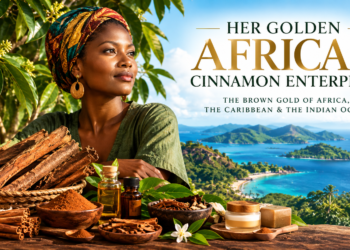


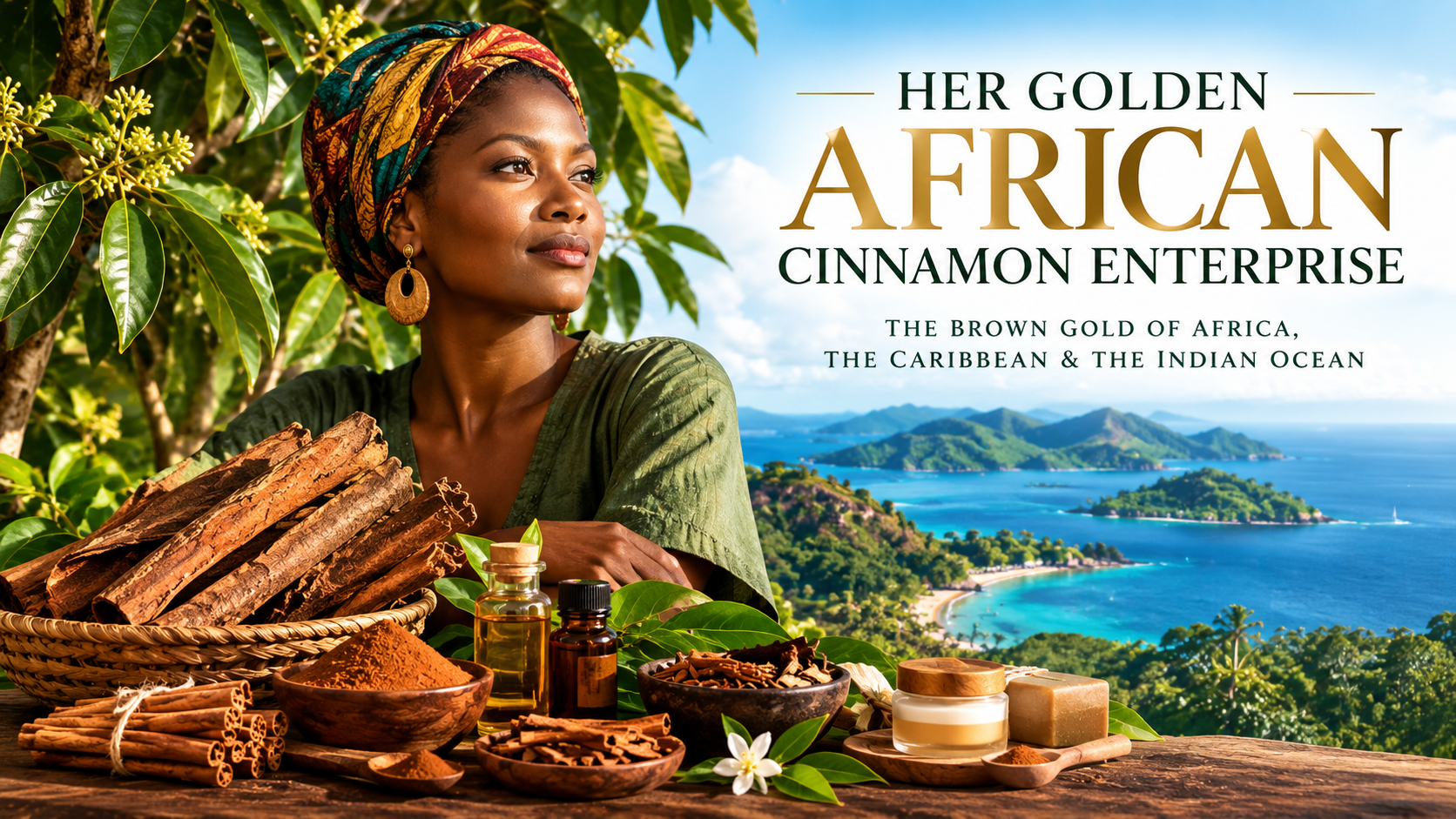
HER GOLDEN AFRICAN CINNAMON ENTERPRISE
BROWN GOLD: THE CINNAMON OPPORTUNITY AFRICA ALREADY HAS
There is something wonderfully luxurious about a good piece of cinnamon bark.
Not the dusty little bottle sitting forgotten in the back of the spice cabinet. I mean the real thing: thick, fragrant bark, rich brown in colour, releasing that warm, almost intoxicating aroma the moment you break it.
In Tanzania, cinnamon is already part of everyday trade. It appears in markets, spice shops, tea blends, pilau, baking, traditional preparations and increasingly in packaged food and beauty products.
But there is a much bigger business story hiding inside that humble piece of bark.
Cinnamon is not simply a spice.
It is an agricultural crop, a food ingredient, an essential-oil raw material, a fragrance ingredient, a wellness product, a hospitality product and a platform for dozens of value-added businesses.
And for African women — including women in the diaspora who may never plant a single cinnamon tree — the opportunity may be less about owning a farm and more about understanding where value is being lost between the farmer and the final customer.
That is where the golden opportunity begins.
FIRST, LET’S GET THE CINNAMON STORY RIGHT
Before we talk about the money, there is an important distinction every woman entering this business should understand.
The cinnamon generally known botanically as Cinnamomum verum is native to Sri Lanka. It is also known in botanical literature under the older name Cinnamomum zeylanicum.
This is the species associated with what the world knows as Ceylon Cinnamon or True Cinnamon.
And there is a very good reason the Sri Lankan product commands such respect.
Ceylon Cinnamon has a characteristic delicate fragrance, a sweeter and milder flavour than many cassia types, and exceptionally low levels of coumarin compared with common cassia cinnamons. Its bark is traditionally peeled and carefully processed into the distinctive layered quills for which Sri Lanka is famous.
That combination of botanical material, Sri Lankan terroir, processing skill, history, quality control and origin branding created something much more valuable than a commodity.
It created a premium product.
Sri Lanka has spent generations building that reputation. Its cinnamon industry supports a substantial agricultural and processing economy, and the country’s export strategy has deliberately turned cinnamon’s origin and quality characteristics into commercial differentiation.
And this is where the story becomes especially interesting for Africa.
Ceylon Cinnamon is not simply the name of a tree.
In 2022, the European Union registered “Ceylon Cinnamon” as a Protected Geographical Indication (PGI). The protected name identifies the Sri Lankan product and its geographical origin.
But the European regulation also makes an important distinction: botanical names such as Cinnamomum zeylanicum may be used to describe cinnamon produced from that botanical variety outside Sri Lanka, provided the outside country of origin is clearly identified and the labelling does not create an association with Sri Lanka.
That distinction matters.
Sri Lanka holds the protected geographical identity “Ceylon Cinnamon.” It does not own the botanical species itself.
And that species has travelled.
Kew’s Plants of the World Online records Cinnamomum verum as native to Sri Lanka but introduced into Tanzania, Seychelles, Comoros, Mauritius, the Caribbean’s Windward Islands and Leeward Islands, among other places.
So Africa and the Caribbean have access to the same botanical species.
The commercial question is not whether Africa can call its cinnamon “Ceylon Cinnamon.”
It cannot simply do that.
The question is whether African producers can take verified Cinnamomum verum, develop excellent cultivation and post-harvest practices, build traceable supply chains, create their own country-of-origin brands and capture more of the value.
That is a very different — and very interesting — proposition.
WHY THIS SPECIES IS SO COMMERCIALLY VALUABLE
The value of Cinnamomum verum lies in what happens after the tree is grown.
The bark can become whole cinnamon, quills, chips, powder and ingredients for food and beverage manufacturing. Cinnamon’s aromatic compounds also create opportunities in essential oils, fragrance, cosmetics and other formulations. Sri Lankan industry sources identify food, bakery products, tea, confectionery, chocolate, beverages and value-added oil and powder products among its markets.
This gives the crop something an investor should always look for:
multiple markets from one raw material.
The same harvest can potentially move into several different businesses depending on quality, processing and buyer requirements.
A farmer may sell bark.
A processor can sell cleaned and graded cinnamon.
Another company can grind it.
Another can formulate tea.
Another can manufacture spice blends.
Another can create bakery ingredients.
Another can develop fragrance products.
Another can extract oil.
The commercial ladder keeps going.
And that is precisely why cinnamon becomes interesting as an enterprise rather than simply an agricultural crop.
BUT WHAT ABOUT THAT THICK, DARK BROWN CINNAMON?
This deserves attention because it is something many consumers — including me — notice immediately.
The cinnamon commonly sold in East African markets can look very different from the delicate, thin, layered quills associated with premium Sri Lankan Ceylon Cinnamon.
Sri Lankan Ceylon quills are characteristically thin and layered, while other cinnamons, including cassia types, tend to be harder, thicker and darker.
So we should never identify the species from appearance alone.
A thick, rich brown piece of cinnamon bark in Tanzania may be a different Cinnamomum species or cassia rather than Cinnamomum verum. The scientific name, supplier documentation, origin and — where necessary — laboratory or botanical verification matter.
This is actually good news for business.
Because authentication itself becomes part of the opportunity.
A premium African cinnamon company should know exactly what it is selling.
The woman building a brand should be able to tell her customer:
species, country of origin, processing method, grade and intended use.
That is how a commodity begins becoming a premium ingredient.
AFRICA IS NOT STARTING FROM ZERO
Tanzania is already exporting cinnamon.
In 2024, Tanzania exported approximately 352 tonnes of whole or uncrushed cinnamon and cinnamon-tree flowers, valued at about US$760,680, according to UN Comtrade data reported through the World Bank’s WITS database. Major destinations included Germany, Italy, the United Kingdom, France and India.
Madagascar’s position is even more striking.
In 2024, Madagascar exported approximately 2,080 tonnes of whole or uncrushed cinnamon worth approximately US$5.12 million, with Germany, Spain, France and the Netherlands among its leading destinations.
And Madagascar also exported more than one million kilograms of crushed cinnamon that year, worth about US$1.73 million.
That tells us something important.
There is already an African cinnamon trade.
The question is how much more value can be captured before the product leaves the continent — and after it reaches the final consumer.
THE EXPORT VALUE STORY
The 2024 figures also reveal a useful commercial distinction.
Sri Lanka’s export value is vastly larger, but that comparison needs context: HS 090610 is a trade classification and does not tell us that every shipment from every country is Cinnamomum verum, nor does it measure quality, branding, processing or final retail value.
What it does show is the scale of the international cinnamon economy — and the much smaller position from which African producers are currently participating.
That is precisely where enterprise can enter.
THE AFRICAN VALUE GAP
There is another fascinating piece of the Tanzanian story.
Research on Tanzania’s spice value chains has found that cinnamon transactions remain heavily concentrated among local traders, while processors and wholesalers account for only a very small share of transactions. In one recent study covering Muheza and Morogoro, processors represented less than 1% of cinnamon transactions and wholesalers less than 1%.
That is not a reason to complain about middlemen.
It is a signal.
It suggests that processing, aggregation, quality control, packaging and direct market access remain relatively underdeveloped parts of the chain.
And that is exactly where entrepreneurial women can enter.
A woman does not necessarily need to become a cinnamon farmer.
She could build the company that buys correctly dried cinnamon from farmers, grades it, cleans it, tests it, packages it and sells it to a hotel chain.
Or she could create a retail brand.Or a tea company.Or a spice-blending company.Or supply cinnamon powder to bakeries.
Or sell bulk ingredients to manufacturers.Or create an African-origin fragrance line.Or become the diaspora importer connecting a verified African producer to customers abroad.
The farm is only the beginning of the value chain.
WOMEN ARE ALREADY IN THE VALUE-ADDITION STORY
This is not theoretical.
Research in Muheza District has documented women’s participation in spice value addition, particularly in activities such as sorting, drying and packaging — the very stages that influence product quality and market value. The study also identified barriers including limited access to finance, training, equipment and decision-making power.
A very practical example appeared in Tanzania in 2026.
CARE reported on Nitunze Spices, a women-led enterprise in which six women process locally grown spices including cinnamon, ginger, cardamom and lemongrass. They grind, package and sell finished products while creating a market for local farmers.
This is the kind of business model worth paying attention to.
It is not enormous.
It does not require owning thousands of hectares.
It begins with something ordinary and asks a better question:
What happens if we stop selling the raw material and start selling what the customer actually wants?
THE PRODUCTS ARE ALREADY WAITING
Cinnamon can travel through several levels of value addition.
At the simplest level, there is:
- cleaned whole bark.
- Then come chips and graded pieces.
- Then powder.
- Then retail spice.
- Then blended products — chai, masala, baking blends, hot chocolate mixes and specialty seasonings.
- Then beverages.
- Then bakery and confectionery ingredients.
- Then extracts and oils.
- Then fragrance, cosmetic and personal-care applications.
The commercial opportunity is therefore not necessarily “start a cinnamon plantation.”
It can be:
build a better cinnamon business.
And the African opportunity may be particularly interesting in the middle of that chain, where relatively modest investment can improve quality, presentation, traceability and market access.
THE POINT OF LEAST RESISTANCE
For the woman reading this article and thinking, I love this, but I don’t want to become a farmer, good.
You may not need to.
The point of least resistance is often closer to the customer than to the tree.
A diaspora entrepreneur in London, Toronto, Atlanta, New York, Dubai or Amsterdam could work with a verified African producer, import finished cinnamon, create a private-label brand and sell to specialty retailers, African grocery stores, restaurants, bakeries or consumers.
A woman in Africa could aggregate from several smallholders rather than cultivate the crop herself.
Another could establish a small processing and packaging operation.
Another could supply hotels and restaurants.
Another could specialize in African-origin ingredients for beauty and fragrance manufacturers.
And another could become the trade intermediary who understands both sides of the transaction.
The important thing is not to start by buying cinnamon.
Start by identifying who will buy it, in what form, at what specification and at what price.
Then work backward.
THE POTENTIAL
Cinnamon’s greatest strength is its ability to move up the value chain.
A sack of unprocessed bark is one product.
A certified, cleaned, graded, traceable cinnamon ingredient is another.
A beautifully packaged consumer product is another.
A formulated food, beverage, fragrance or cosmetic ingredient is another again.
This is why the headline export figures should not be mistaken for the ceiling of the opportunity.
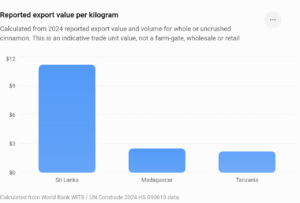
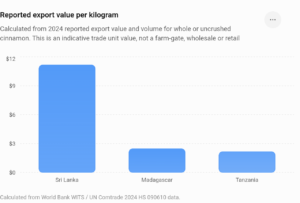
For example, Tanzania’s 2024 whole/uncrushed cinnamon exports averaged roughly US$2.16 per kilogram in reported export value, calculated from the WITS value and volume. Madagascar’s corresponding figure was approximately US$2.46 per kilogram. Sri Lanka’s was much higher at roughly US$11.16 per kilogram.
Those are not comparable retail prices, and they do not prove that one country produces a superior product. They simply demonstrate that the value realized per kilogram can differ enormously across origins, markets, specifications and supply chains.
That gap is worth investigating.
Not with fantasy projections. With better product.Better documentation.Better processing.Better packaging.
Better buyers.Better branding.
And better logistics.
THE INVESTMENT
This is where I would deliberately resist telling women that they need a fortune to enter the cinnamon industry.
You don’t.
The appropriate investment depends on where you enter the chain.
THE $5,000 ENTRY
At approximately US$5,000, a woman could explore a small aggregation, processing or private-label model: modest raw-material purchases, basic cleaning and drying equipment, packaging, initial testing, branding, registration, samples and customer acquisition.
The objective at this stage is not to build a factory.
It is to prove the buyer.
THE $10,000 BUILD
Around US$10,000 can begin to create a more serious small-scale operation — particularly one focused on grading, grinding, packaging and supplying hospitality or retail customers.
The business becomes less about buying and reselling cinnamon and more about creating a repeatable product.
THE $25,000 PLATFORM
At approximately US$25,000, an entrepreneur can begin considering a stronger aggregation and processing model, including better equipment, food-safety systems, packaging capability, working capital and larger buyer relationships.
This is where a woman could begin building a recognizable African-origin cinnamon brand or B2B ingredient business.
THE $50,000+ ENTERPRISE
At US$50,000 and above, the opportunity expands toward semi-industrial processing, larger aggregation networks, more sophisticated packaging, laboratory testing, export preparation, product development and institutional customers.
The capital should follow proven demand rather than precede it.
These are illustrative planning tiers, not supplier quotations or guaranteed returns. Actual investment requirements will vary according to country, equipment, regulatory requirements, product format and scale.
The smart investor starts small enough to learn — and grows when the market gives her permission.
THE GLOBAL WOMAN CAN ENTER WITHOUT LEAVING HOME
This is perhaps the part of the cinnamon story I like most.
A woman in the African diaspora does not have to own African farmland to participate in African agriculture.
- She can become the market.
- She can become the importer.
- She can become the distributor.
- She can become the brand.
- She can become the specialty food company.
- She can become the restaurant supplier.
- She can become the buyer connecting an African cooperative to a foreign market.
Or she can build the bridge between African producers and the enormous world of African-inspired food, beauty, wellness and hospitality.
The key is traceability.
- Know who produced the cinnamon.
- Know the botanical identity where relevant.
- Know the country of origin.
- Know how it was dried.
- Know how it was stored.
- Know what the buyer requires.
- Know the applicable food-safety and import rules.
And never borrow another country’s geographical reputation when you can build your own.
THE AFRICAN BRANDING OPPORTUNITY
Sri Lanka offers Africa a powerful lesson.
The lesson is not “copy Ceylon Cinnamon.”
The lesson is:
quality + origin + processing + consistency + storytelling + market protection = commercial value.
Sri Lanka did not simply grow cinnamon.
It developed a recognizable origin story around it.
Africa can do the same.
Imagine Tanzanian cinnamon that is properly identified, consistently graded, carefully dried, beautifully packaged and sold as a premium Tanzanian spice.
Imagine Madagascar building further on the cinnamon supply chain it already exports at scale.
Imagine Zanzibar and other Indian Ocean producers developing origin-specific cinnamon stories.
Imagine Caribbean producers and entrepreneurs revisiting Cinnamomum verum where the species is suitable and commercially viable, while respecting the distinction between their own origin and Sri Lanka’s protected geographical identity.
The future product does not have to say:
“We are the next Sri Lanka.”
It can say:
“This is African cinnamon. This is where it comes from. This is how it was produced. And this is why it belongs in your kitchen, your hotel, your bakery, your tea, your fragrance line or your product.”
That is a much stronger story.
THE NEXT MOVE
The first move is not planting.
It is identification.
Find out exactly what cinnamon is available in your target producing region and establish the botanical identity, because appearance alone is not enough.
Then find the producers.
Then understand how they harvest, dry, grade and store the bark.
Then identify the weakest point in the chain.
Perhaps it is drying.
Perhaps it is aggregation.
Perhaps farmers cannot reach serious buyers.
Perhaps the product is being sold in large sacks when buyers want standardized packs.
Perhaps the cinnamon is good but the documentation is poor.
Perhaps nobody has built the brand.
That weakness becomes your entry point.
From there, secure a small quantity and test the market before committing serious capital.
Put samples in the hands of bakers, chefs, tea companies, restaurants, spice manufacturers, retailers and diaspora buyers.
Ask what they actually want.
- Whole bark?
- Quills?
- Powder?
- Organic certification?
- Bulk sacks?
- Private label?
- Small retail packs?
- A specific moisture level?
- A particular grind?
Once the answer becomes clear, build backward toward the supply.
And if you are working across borders, build the logistics and compliance into the business from the beginning rather than treating export as an afterthought.
Because the real cinnamon enterprise is not simply about growing more trees.
It is about building a chain in which more of the final value remains with the people producing, processing, branding and selling the product.
That is where the opportunity becomes interesting.
HER GOLDEN TAKEAWAY
Cinnamon looks small.
The business around it is not.
The world already knows that Cinnamomum verum can command a premium when its qualities, processing and origin are properly understood. Sri Lanka has demonstrated what happens when a country turns a botanical resource into a protected, recognizable and carefully managed origin product.
Africa does not need to pretend its cinnamon is Sri Lankan.
It needs to know what it has.
It needs to process it better.
It needs to identify the right markets.
And it needs entrepreneurs — especially women — willing to move beyond the raw commodity.
Because sometimes the next African export empire is not hiding inside a giant industrial project.
Sometimes it is sitting quietly in a bag of cinnamon bark.
READY TO EXPLORE THE OPPORTUNITY?
My name is Renae Bruce-Miller, and I am a professional consultant in African agro-processing, based in Dar es Salaam, Tanzania.
If this business opportunity has you thinking, “Could I actually do this?” — let’s talk.
I offer practical business and market-entry consultations for women who want to turn promising agricultural products and processing opportunities into viable businesses.
Together, we can examine the market, supply chain, investment level, regulatory considerations and potential route to market — and determine where to begin, what you need and what your next move should be.
Contact me for a consultation →