

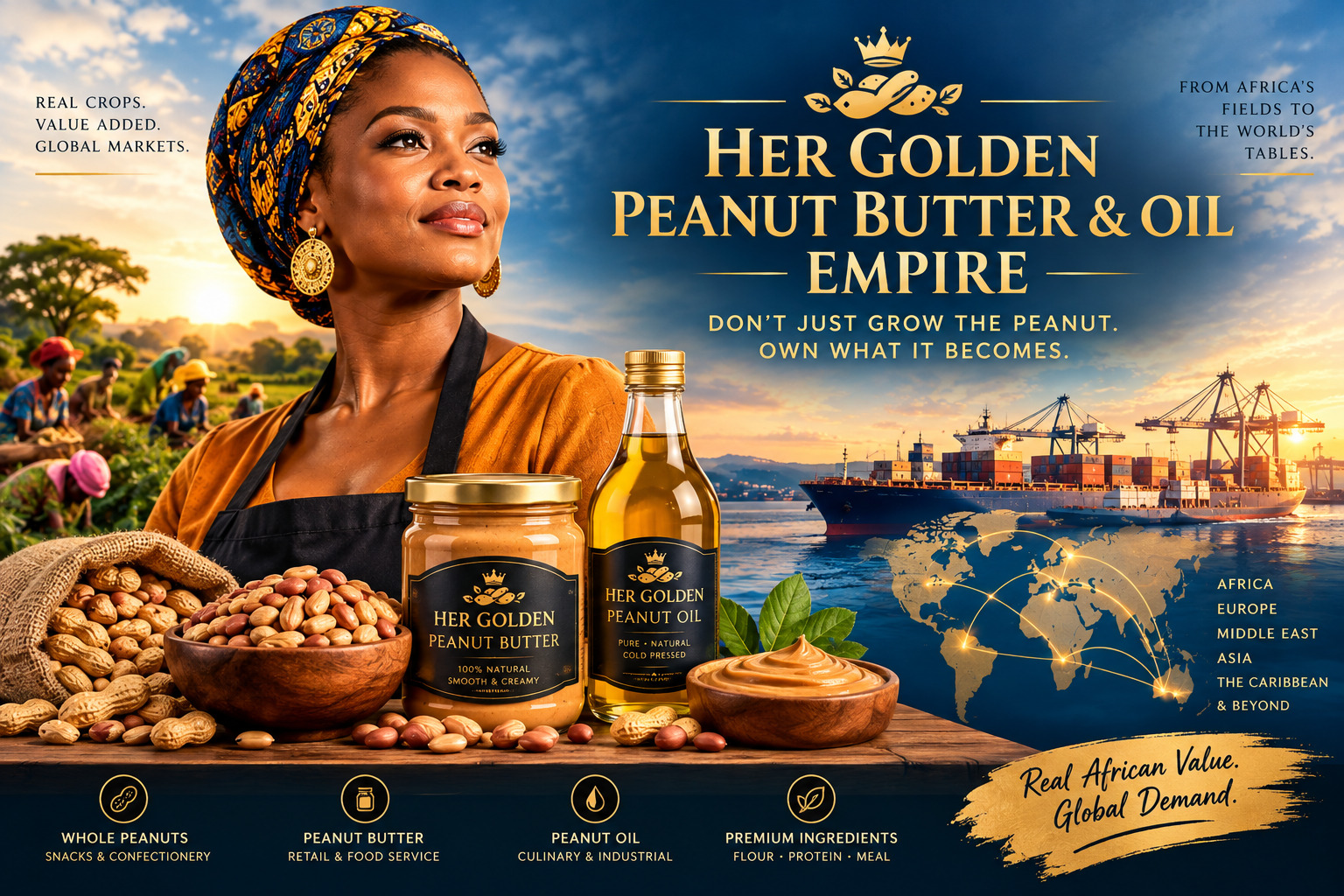
HER GOLDEN PEANUT BUTTER & OIL EMPIRE
Don’t just grow the peanut. Own what it becomes.
The peanut may be one of Africa’s most underestimated business opportunities.
It is already being grown, traded, processed, roasted, crushed, cooked and sold by women across the continent. The question is not whether African women belong in the peanut industry.
They are already in it.
The bigger question is whether more of that activity can move from informal processing and raw commodity sales into businesses that capture more value: prepared peanuts, peanut butter, peanut flour, peanut oil and industrial ingredients.
And the international market is already there.
THE GLOBAL PEANUT SNAPSHOT
Africa is a major peanut-producing region, but production does not automatically translate into processing wealth.
Nigeria is Africa’s largest producer, with recent USDA estimates around 4.3 million tonnes annually. Senegal is another major producer, at roughly 1.8 million tonnes. Tanzania is a significant East African producer, although it is better described as a substantial producer than as Africa’s “peanut powerhouse.”
The global trade picture tells the more interesting story.
In 2024, exporters shipped approximately:
| Peanut product | What the trade shows |
|---|---|
| Shelled peanuts | Argentina $893M; India $823M; US $419M; Brazil $360M |
| Preserved/prepared peanuts | China $705M; Netherlands $379M; US $254M; India $114M |
| Crude peanut oil | India $339M; Brazil $88.7M; Nicaragua $29.1M; Senegal $11.3M |
| Other/refined peanut oil | Belgium $22.6M; China $19.8M; Brazil $18.3M; US $11.0M |
(World Integrated Trade Solution)
These are different businesses.
The opportunity is choosing where to enter the chain.
THE WOMEN ARE ALREADY IN THE BUSINESS
FAO research has described peanuts as a women’s crop in smallholder production systems, with women involved in production, seed selection, drying, grading, sorting, shelling, processing and selling. (FAOHome)
And more recent African research gives us concrete examples.
In Chemba District, Tanzania, researchers studied 137 female groundnut farmers and found women participating in cleaning, drying, grading, sorting, processing, packing, storage and marketing. Their work also included managing aflatoxin risk—one of the critical quality issues in the international peanut trade. (AGRIS)
In Kano State, Nigeria, a study of 298 women groundnut processors examined businesses producing groundnut cake and oil. Access to markets, cooperative membership and the way the enterprise was organized were among the factors associated with profitability. Lack of capital and high raw-material costs were major constraints. (AGRIS)
Another study found that groundnut processing contributed approximately 94% of the total income of the women surveyed, with an average reported return on investment of 26% in that particular study population. (AGRIS)
And research in northern Ghana involving 829 women engaged in the groundnut value chain found that access to processing infrastructure such as shelling, roasting and grinding equipment was associated with higher productivity, income from groundnut activities and greater control of income among women. (ScienceDirect)
So the opportunity isn’t:
“Let’s get African women into the peanut industry.”
They are already there.
It is:
“Let’s help more women move up the peanut value chain.”
THE OPPORTUNITY
There is a considerable difference between selling a bag of raw groundnuts and selling what that groundnut becomes.
A simplified value chain looks like this:
Groundnut farmer → trader → cleaned/shelled peanut → roasted product → peanut butter → flour/ingredient → oil → branded or industrial product
Every additional processing step requires more knowledge, equipment, quality control and market access—but it can also create another commercial opportunity.
And the international markets demonstrate that buyers exist at several points along this chain.
The European Union imported approximately US$126 million of unshelled peanuts in 2024, including significant quantities from Egypt, the United States, China, Israel and Togo. (World Integrated Trade Solution)
For shelled peanuts, the trade is substantially larger. China supplied the EU with approximately US$115.8 million of shelled peanuts in 2024, while Indonesia imported US$65.9 million from China and the Philippines US$44.7 million. (World Integrated Trade Solution)
This creates opportunities even before we reach peanut butter or oil.
PREPARED PEANUTS: THE FIRST VALUE-ADDED STEP
Roasted, salted, seasoned and otherwise prepared peanuts have a substantial international market.
In 2024, the largest importers of preserved/prepared groundnuts included:
| Market | 2024 imports |
|---|---|
| France | US$172.3M |
| United States | US$160.3M |
| Germany | US$143.9M |
| Japan | US$102.7M |
| South Korea | US$96.4M |
| United Kingdom | US$90.0M |
(World Integrated Trade Solution)
This is an important caveat: HS 200811 covers preserved/prepared groundnuts broadly; it does not isolate peanut butter.
That market can include roasted, salted and other prepared peanut products.
For an African woman entrepreneur, that means the first commercial opportunity doesn’t have to be a sophisticated international peanut-butter brand.
It could be cleaned, roasted, seasoned and packaged peanuts sold to supermarkets, hotels, airlines, cafés, wholesalers or food distributors.
PEANUT BUTTER: WHERE THE CROP BECOMES A BRAND
Peanut butter takes the business another step.
The process can be relatively straightforward:
quality peanuts → sorting → roasting → blanching → grinding → formulation → filling → packaging
But commercial peanut butter is a food-manufacturing business. Consistent taste, texture, moisture, shelf life, packaging, labeling and food safety all matter.
And Tanzania already has evidence that the value chain is worth developing.
A 2024 study involving Tanzanian farmers, processors, traders and seed producers found that farmers were often paid the same price for groundnuts regardless of size, colour or variety. Researchers concluded that improving the peanut-butter value chain could help create a stronger incentive for farmers to produce quality peanuts. (AGRIS)
That is a fascinating business connection:
Better processing can create demand for better raw material.
The processor and the farmer can therefore grow together.
PEANUT OIL: THE INDUSTRIAL OPPORTUNITY
Then we reach the part of the peanut that is barely developed in some African markets.
Oil.
In 2024, India exported approximately US$339 million of crude peanut oil, while Brazil exported US$88.7 million. Senegal exported another US$11.3 million, putting it among the world’s notable crude peanut-oil exporters. (World Integrated Trade Solution)
Brazil is particularly instructive.
Its 2024 crude peanut oil exports went to markets including China, Italy, the Netherlands and the United States. China alone purchased approximately US$42.4 million from Brazil. (World Integrated Trade Solution)
This is not simply a cooking-oil story.
Peanut oil can serve food, culinary and industrial ingredient markets, depending on its specifications and processing.
And the peanut does not necessarily end with the oil. The remaining peanut cake or meal can also have value, subject to its quality and intended use.
That creates the possibility of a more integrated business:
peanut → oil + meal/cake + food ingredients
rather than simply selling the crop.
TANZANIA: A VERY INTERESTING GAP
Tanzania already exports peanuts in several forms.
In 2024, Tanzania exported approximately US$10.3 million / 16.9 million kg of preserved/prepared groundnuts, principally to Indonesia and India. (World Integrated Trade Solution)
It also exported shelled groundnuts to regional and international destinations including Rwanda, Kenya, Zambia, South Africa, the UK, UAE, Vietnam, Egypt, the Philippines and Cambodia. (World Integrated Trade Solution)
But the peanut-oil trade is dramatically smaller.
Tanzania’s 2024 crude peanut-oil exports were only approximately US$53,900 / 181,000 kg. (World Integrated Trade Solution)
And Tanzania imported about US$19,000 of peanut oil from India in 2024. (World Integrated Trade Solution)
That contrast is worth investigating.
The country is already growing and exporting peanuts. Yet peanut oil remains a very small commercial category.
That doesn’t automatically mean an oil mill will be profitable. It does mean there is a processing gap worth testing.
LOOK AT THE CARIBBEAN
Trinidad & Tobago has developed a regional prepared-peanut business.
In 2024, it exported approximately US$9.76 million / 2.09 million kg of preserved/prepared groundnuts.
Its largest customer was Jamaica, which received approximately US$5.87 million, followed by Barbados, Guyana and Grenada. (World Integrated Trade Solution)
And Jamaica’s imports show the other side of the relationship: Trinidad & Tobago was its largest supplier of preserved/prepared groundnuts in 2024. (World Integrated Trade Solution)
This is not an enormous global corporation.
It is a regional value chain.
That matters because an African woman doesn’t necessarily need to conquer Europe on day one.
She could build:
farm → processor → national market → neighbouring countries → regional market
and expand from there.
BRAZIL AND MEXICO SHOW TWO DIFFERENT MODELS
Brazil shows the processing-and-export model.
Mexico shows what happens when a food industry combines domestic production with imported raw material and then exports processed products.
Mexico exported approximately US$76.7 million of preserved/prepared groundnuts in 2024, with more than US$75.4 million going to the United States. (World Integrated Trade Solution)
The lesson is simple:
A country does not have to grow every peanut it processes.
What matters is controlling a commercially valuable part of the chain.
For African entrepreneurs, that opens another possibility: a processor can sometimes source from several producing regions, provided quality, traceability, food-safety and commercial requirements can be controlled.
THE MARKET MAP
The peanut opportunity therefore looks different in each region.
AFRICA
Raw material, primary processing and growing consumer markets.
EUROPE
Prepared peanuts, food ingredients and premium food products. France and Germany are particularly significant import markets. (World Integrated Trade Solution)
ASIA
Huge processing and consumption markets. Japan and South Korea are major importers of prepared groundnuts, while China is simultaneously a major producer, processor and exporter. (World Integrated Trade Solution)
MIDDLE EAST
Food-import and distribution markets, with opportunities for prepared products, ingredients and specialty foods.
CARIBBEAN
A compelling example of regional processing and intra-Caribbean trade.
NORTH AMERICA
Large food and snack markets, with Mexico demonstrating how imported raw material can feed a substantial processed-food export business.
THE WOMAN’S OPPORTUNITY IS UP THE VALUE CHAIN
A woman does not have to own 500 acres of groundnuts to participate in this industry. She might begin by purchasing quality peanuts from farmers. Or she might organize farmers into a supply network. She might operate a roasting and packaging business. She might produce peanut butter. She might supply 5–20 kg food-service packs to bakeries and hotels. She might develop peanut flour for food manufacturers. She might eventually invest in an oil press. Or she might build the brand and outsource production to an approved processor.
The research from Tanzania, Nigeria and Ghana shows that women are already performing many of the activities required for these businesses. The missing pieces are often capital, equipment, market access, quality systems and the ability to move from informal processing into commercially controlled production. (AGRIS)
That is an opportunity.
THE INVESTMENT: START WHERE YOU ARE
STARTER | approximately $1,500–$5,000
Begin with peanut butter or prepared peanuts.
Test the product locally. Sell directly to consumers, cafés, bakeries, hotels and small retailers.
At this level, the objective is not international export.
It is proving the product and the customer.
BRAND / B2B | approximately $5,000–$15,000
Develop a more professional food operation or use an approved co-packer.
The business can supply:
peanut butter + roasted peanuts + food-service packs
This is also where an entrepreneur can begin developing consistent packaging, labeling and quality controls.
COMMERCIAL PROCESSING | approximately $15,000–$40,000
Move into larger production of peanut butter, roasted products, ground peanut and potentially peanut flour.
The customer base can expand from households into:
bakeries + hotels + restaurants + food manufacturers + distributors.
OIL PROCESSING | approximately $25,000–$75,000+
This is the next industrial step.
A small oil-press operation requires more equipment, quality control, storage and working capital, but it creates a potentially broader product portfolio around oil and peanut cake/meal.
Larger integrated processing plants require substantially more capital.
These figures are illustrative planning ranges, not equipment quotations.
THE QUALITY QUESTION: AFLATOXIN
There is one issue that can make or break an export peanut business:
Aflatoxin.
The international peanut business begins with the quality of the crop—not the label on the jar.
European rules set maximum aflatoxin levels for peanuts intended for direct human consumption or use as a food ingredient, including 2.0 μg/kg for aflatoxin B1 and 4.0 μg/kg for total aflatoxins under the applicable category.
That makes proper drying, storage, sorting, testing, traceability and handling essential.
And this is another place where women already have an important role: the Tanzanian Chemba study specifically documented women’s involvement in post-harvest activities related to aflatoxin management. (AGRIS)
Quality control is not an export afterthought. It is part of the business model.
THE POTENTIAL
The peanut opportunity is not one giant business.
It is a ladder.
RAW PEANUT ↓
CLEANED / GRADED↓
SHELLED↓
ROASTED / PREPARED↓
PEANUT BUTTER↓
PEANUT FLOUR / INGREDIENTS↓
PEANUT OIL↓
INDUSTRIAL PROCESSING
The further an entrepreneur can move while maintaining quality and finding a buyer, the more of the value chain she potentially controls.
And that is why I would not tell a woman reading this article that she needs to build a factory.
I would tell her to ask:
Which part of this value chain can I enter profitably with the resources I have today?
THE NEXT MOVE
Start with the crop and the market not the machinery.
Find the producing farmers. Understand their varieties and quality. Test the raw material. Identify the customer before buying equipment. Decide whether your first product should be roasted peanuts, peanut butter, ground peanut, flour or oil.
If capital is limited, co-processing or contract manufacturing can allow you to test the market before building your own facility.
And if the business works, move one step higher.
That is how an ordinary agricultural crop becomes a serious enterprise.
Don’t just grow the peanut. Own what it becomes.
READY TO EXPLORE THE OPPORTUNITY?
My name is Renae Bruce-Miller, and I am a professional consultant in African agro-processing, based in Dar es Salaam, Tanzania.
If this business opportunity has you thinking, “Could I actually do this?” — let’s talk.
I offer practical business and market-entry consultations for women who want to turn promising agricultural products and processing opportunities into viable businesses. Together, we can examine the market, supply chain, investment level, regulatory considerations and potential route to market and determine where to begin, what you need and what your next move should be.
CLICK HERE FOR OUR CONSULTANCY PAGE lets connect today
Her world is happening now.
She is in it.
Are you?
Trade statistics are primarily 2024 international trade data. HS 200811 covers preserved/prepared groundnuts broadly and does not isolate peanut butter. Investment figures are illustrative planning ranges rather than supplier quotations. Market opportunity should always be validated against current regulations, buyer specifications, raw-material quality and actual operating costs before investment.