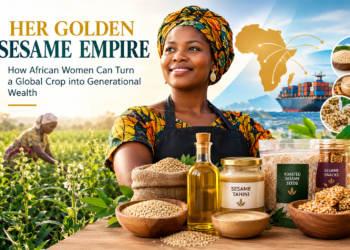



HER GOLDEN SESAME EMPIRE
Africa’s women are already in the sesame business. The opportunity is to move up the value chain.
Sesame is one of those African crops that can be easy to overlook precisely because it is already such a successful business.
The seed is small. The industry is not.
In 2024, Tanzania exported approximately $268 million of sesame seed, while Nigeria exported about $414 million and Mozambique about $223 million. Africa is already supplying some of the world’s largest sesame markets, including China, Japan, Turkey and India.
But there is another story inside those export figures.
African women are already participating in the sesame economy.
The question is whether they can capture more of the value created between the farm and the final customer.
THE WOMEN ARE ALREADY THERE
A 2026 study of the Malawi–Tanzania sesame value chain provides unusually clear evidence of women’s participation. Among the producers surveyed, 57.46% were women. Yet the same research found that men represented 68.75% of the traders, illustrating a familiar pattern in agricultural value chains: women may be heavily involved in production while men remain more visible in the commercial activities that determine how the crop reaches the market.
The researchers identified limited access to working capital, market information, infrastructure and formal markets as some of the constraints affecting the value chain. The study also identified cross-border demand from Tanzania as an important commercial connection for Malawian sesame producers.
The picture is similar in Ethiopia, although the evidence comes from an earlier study. Research commissioned by Oxfam in Benishangul-Gumuz found women actively involved in ploughing, planting, weeding and harvesting sesame, accounting for an estimated 20–40% of field labor across the business models examined. Yet women were largely excluded from the sales process. The research specifically identified cleaning, quality control and other value-added activities as potential areas for greater women’s participation.
Then Nigeria.
A study of the sesame value chain in Jigawa found a striking gender division. The farmers, traders and exporters in the study were male, but all of the sesame processors surveyed were women, undertaking artisanal processing. The evidence is important because it shows that women are not simply agricultural laborers within the sesame economy; they are already participating in transformation and processing.
The evidence can be summarized simply:
| Market | Evidence of women’s participation | Where the gap appears |
|---|---|---|
| Malawi–Tanzania | Women represented 57.46% of producers in the 2026 study sample | Men represented 68.75% of traders |
| Ethiopia | Women performed an estimated 20–40% of sesame field labor in the study | Women had limited participation in sales |
| Jigawa, Nigeria | Women accounted for all processors in the study sample | Farming, trading and exporting were male-dominated |
The opportunity for African women is not simply to become sesame farmers.
They are already farmers, processors and participants in the value chain.
The bigger opportunity is to move from participation toward greater ownership of the businesses, products, markets and brands built around sesame.
THE GLOBAL MARKET IS ALREADY BUYING
There is no need to invent demand for sesame.
The global sesame seed market is substantial, and international trade is already well established. In 2022, more than 2 million tonnes of unprocessed sesame seed, valued at roughly $3 billion, were traded internationally. Tanzania, Nigeria, Sudan, Ethiopia, Burkina Faso and Chad are among Africa’s significant producers and exporters.
China is particularly important. In 2023, it imported approximately $1.53 billion worth of sesame seed, making it by far the largest import market in the World Bank’s HS 120740 trade data. Turkey, Japan, the European Union, India and South Korea also represent substantial markets. (World Integrated Trade Solution)
Where the world’s sesame demand is concentrated

The scale of these markets is significant, but the trade routes are even more revealing.
China imported approximately $239.8 million of sesame from Tanzania alone in 2023, representing about 130,370 tonnes. It also imported approximately $153 million from Mozambique and $170 million from Sudan. (World Integrated Trade Solution)
Japan imported approximately $102.8 million from Nigeria, $50.6 million from Burkina Faso, $42.5 million from Mozambique and $33.1 million from Tanzania in the same year. (World Integrated Trade Solution)
The European Union imported approximately $50.3 million from Nigeria and $14.1 million from Sudan, while Uganda supplied approximately $13.7 million. (World Integrated Trade Solution)
Africa is therefore not standing outside the global sesame economy looking for an entry point.
It is already inside it.
For an African entrepreneur, this is encouraging because the market already exists at both ends of the value chain.
Africa produces sesame.
The world buys sesame.
The commercial question becomes much more interesting:
What can African entrepreneurs build between those two points?
FROM SEED TO SHELF
Sesame does not have to remain a sack of agricultural commodity.
The same seed can become a cleaned retail product, roasted sesame, sesame flour, tahini, sesame oil, confectionery, sauces, spreads and other food ingredients. Sesame oil can also serve culinary and personal-care markets, while sesame meal creates another potential stream from the pressing process.
This is where value addition becomes important.
The entrepreneur who sells raw sesame participates in one market.
The entrepreneur who cleans and packages sesame reaches another.
The entrepreneur who turns it into tahini has created an ingredient business.
The entrepreneur who develops a recognizable consumer brand has created something different again.
The crop has not changed.
The business model has.
THE SESAME VALUE LADDER
The ladder is not suggesting that the highest level automatically produces the highest return.

It shows something more useful: each additional layer creates another possible business.
A woman can enter at the level that matches her capital, skills, market access and regulatory capacity, then move further into the value chain as the business develops.
TAHINI: AN EXAMPLE OF THE VALUE-ADDITION GAP
Tahini offers a useful illustration.
The global tahini market was estimated at roughly $1.8 billion in 2025 by Fortune Business Insights, with projected growth over the following decade. Grand View Research also estimates a substantial global market and identifies the Middle East and Africa as an important regional market for tahini.
This is not an unfamiliar food in Africa. Sesame is already part of food traditions across the continent and the Middle East.
That means an African entrepreneur does not necessarily need to teach consumers what sesame is.
She can concentrate on producing a consistent product, developing attractive packaging, meeting food-safety requirements and getting the product into the hands of customers.
A jar of African sesame tahini can be sold to households, restaurants, hotels, bakeries and food manufacturers.
The business has moved from selling a crop to supplying an ingredient.
THE AFRICAN MARKET MATTERS TOO
It is tempting to look at sesame and immediately think about China, Japan or Europe.
But the first customer may be much closer.
Africa’s growing supermarket sector, hospitality industry, bakeries, restaurants and food manufacturers all create demand for reliable ingredients. A sesame business can therefore begin with domestic or regional customers before it ever becomes an export business.
A producer in Tanzania could supply hotels and restaurants in Dar es Salaam or Zanzibar. A processor in Nigeria could supply bakeries and food manufacturers. A Malawian producer could aggregate with other farmers and serve regional buyers. An Ethiopian entrepreneur could build a branded sesame product around an established production base.
The path does not have to begin with a shipping container.
In many cases, it is safer to begin by discovering who already wants the product.
THE WOMAN WHO WANTS TO START SMALL
A woman does not need to purchase farmland or construct a factory to participate in this opportunity.
She could begin by sourcing properly cleaned sesame and developing a small retail or food-service brand. Roasted sesame, packaged seed, sesame seasoning or other simple products can provide a way to learn the market without immediately taking on the capital requirements of industrial processing.
The critical work at this stage is sourcing, food safety, packaging, pricing, customer discovery and distribution.
Once customers begin buying consistently, the business has something much more valuable than an attractive business plan.
It has evidence.
MOVING INTO PROCESSING
The next step could be roasting, grinding or producing sesame paste.
This is where the business begins to move further away from commodity trading and toward food manufacturing.
A properly designed small processing operation could potentially serve several customer groups at once. Retail customers might buy jars of tahini, restaurants could purchase larger containers, and food manufacturers could buy sesame paste or other ingredients in bulk.
The same supply chain can therefore support several revenue channels.
That matters because the entrepreneur is no longer dependent upon one type of customer.
SESAME OIL CREATES ANOTHER BUSINESS
Oil offers another route into value addition.
Instead of selling sesame only as a seed, a processor can press it for oil and develop a separate product around the resulting oil.
The remaining sesame meal also has potential uses, meaning that the economics of the operation should be considered around the whole seed, rather than only the primary product.
The principle is straightforward: buy the raw material once and look for several legitimate markets for what comes out of the processing operation.
That is how an agricultural commodity begins to become an industrial business.
AND THEN THERE IS AFRICAN CONFECTIONERY
Sesame already has a long history in confectionery, particularly through products such as halva.
That creates room for African entrepreneurs to approach the ingredient from another direction.
Sesame could be combined with honey, coconut, cocoa, dates or peanuts to create premium snacks and confectionery products designed for African consumers and international African-food markets.
The opportunity is not necessarily to reproduce an imported product.
It is to ask what a modern African sesame product could look and taste like.
That is where branding, food culture and product development become part of the value chain.
THE REAL GAP: COMMERCIAL CONTROL
The evidence from across Africa points toward an important pattern.
Women are already participating in sesame production.
Women are already processing sesame in parts of Nigeria.
Women are working in sesame fields in Ethiopia.
Women are significant producers in the Malawi–Tanzania value chain.
Yet commercial control does not always follow participation.
The 2026 Malawi–Tanzania study found women strongly represented among producers while men dominated trading. The Ethiopian research similarly found substantial female participation in farm labor but little participation in sales. In Jigawa, women dominated the small sample of processors while men dominated other downstream roles.
That gap is where entrepreneurship becomes particularly interesting.
There is room for women to move into aggregation, cooperative marketing, quality control, packaging, processing, wholesale supply, food manufacturing and branded products.
The opportunity is not to replace the women already working in sesame.
It is to give more of them a pathway to own the commercial layer of the business.
THE GOLDEN SESAME VALUE CHAIN
A woman entering the industry can participate at several points along the chain, from working directly with farmers and aggregating sesame for commercial buyers through to establishing cleaning and grading operations, creating packaged sesame products, roasting and seasoning the seed, manufacturing tahini, pressing sesame oil, developing confectionery or supplying sesame ingredients to hotels, restaurants and food manufacturers.
A larger company could eventually connect several of these activities, creating a vertically integrated sesame business.
The important point is that she does not have to start at the top.
She can move up.
AFRICA ALREADY HAS THE RAW MATERIAL
The scale of African production makes this particularly compelling.
Tanzania, Nigeria, Sudan, Ethiopia, Mozambique, Burkina Faso and Chad are all significant sesame-producing or exporting countries. FAO-linked data compiled in a recent food-safety review placed Tanzania among the world’s major sesame producers, with approximately 700,000 tonnes of production recorded for 2022 and more than 120,000 tonnes exported that year. Nigeria and Ethiopia were also major producers and exporters.
Tanzania also has an established sesame value chain extending through farmers, traders, commission agents and exporters. Research from Masasi District in Mtwara found that traders captured a higher gross margin per kilogram than farmers in the study sample and specifically recommended stronger market information, farmer training and value addition.
That finding is worth paying attention to.
The opportunity is not simply producing more sesame.
It is finding ways to capture more value from the sesame that Africa is already producing.
THE PATH OF LEAST RESISTANCE
For many entrepreneurs, the most sensible starting point is not an enormous processing plant.
It is a customer.
The bakery that needs sesame, the hotel that buys tahini, the restaurant that wants reliable sesame oil, the supermarket looking for locally produced packaged ingredients and the food manufacturer that needs a dependable sesame supplier all represent potential entry points.
From there, the entrepreneur can work backwards.
Where is the sesame coming from? Can the supply be consistent? What quality does the buyer require? What processing is necessary? What packaging is required? What licenses and food-safety standards apply? What quantity can realistically be sold?
The answers determine the size of the business.
This approach creates a natural progression from small enterprise to larger processing rather than requiring an entrepreneur to make a large capital commitment before she knows whether customers will buy.
THE BIGGER POSSIBILITY
The most interesting sesame company may ultimately not be a farm at all.
It could be an African food company built around the seed.
It could source from networks of farmers, provide quality specifications, aggregate production, process the crop and develop a portfolio of products.
Its shelves could eventually carry sesame seeds, tahini, sesame oil, roasted sesame, sesame-based snacks and confectionery.
Its factory could also manufacture for other African brands.
Its customers could include households, hotels, restaurants, supermarkets and food manufacturers.
And its export business could develop only after the domestic and regional business has proven itself.
That is how a commodity becomes an enterprise.
THE NEXT MOVE
The first question for a woman considering sesame is not, “How much money do I need?”
It is:
“Which part of this value chain has a gap that I can fill?”
If farmers need reliable buyers, there may be an aggregation opportunity. If manufacturers need consistent ingredients, there may be a supply opportunity. If consumers are buying imported tahini, there may be a local manufacturing opportunity. If hotels are importing sesame oil, there may be a processing opportunity. If retailers have sesame on their shelves but no compelling African brand, there may be a branding opportunity.
And if women are already doing the production and processing work but are missing from the commercial side, there may be an even bigger opportunity: building businesses that allow women to capture more of the value they are already helping to create.
THE GOLDEN OPPORTUNITY
Africa does not need another conversation about whether its agricultural commodities have potential.
Sesame already has a global market.
Africa already produces it.
African women are already working in the value chain.
The opportunity is to connect those three facts.
The next sesame entrepreneur does not necessarily need to plant a single seed.
She may be the woman who turns those seeds into a product, a supply company, a processing business, a food brand or an export-ready enterprise.
The seed is already golden.
The opportunity is to build more businesses around it—and to make sure more of that value remains in African hands.
WANT TO EXPLORE THE OPPORTUNITY?
If you are considering entering the sesame business and want to understand where you could realistically enter the value chain, what products may offer the most accessible starting point, how to identify suppliers and customers, and what would be required to move from an idea to a viable African agribusiness, professional consultation can help you turn the opportunity into a practical pathway.
Renae Bruce-Miller is a professional consultant in African agro-processing based in Dar es Salaam, Tanzania. Through Her Golden Era, she examines practical opportunities across African agriculture, processing, trade and value addition, with a particular interest in helping entrepreneurs identify commercially viable entry points.
Interested in exploring your own sesame opportunity? Contact Renae Bruce-Miller for a consultation.