

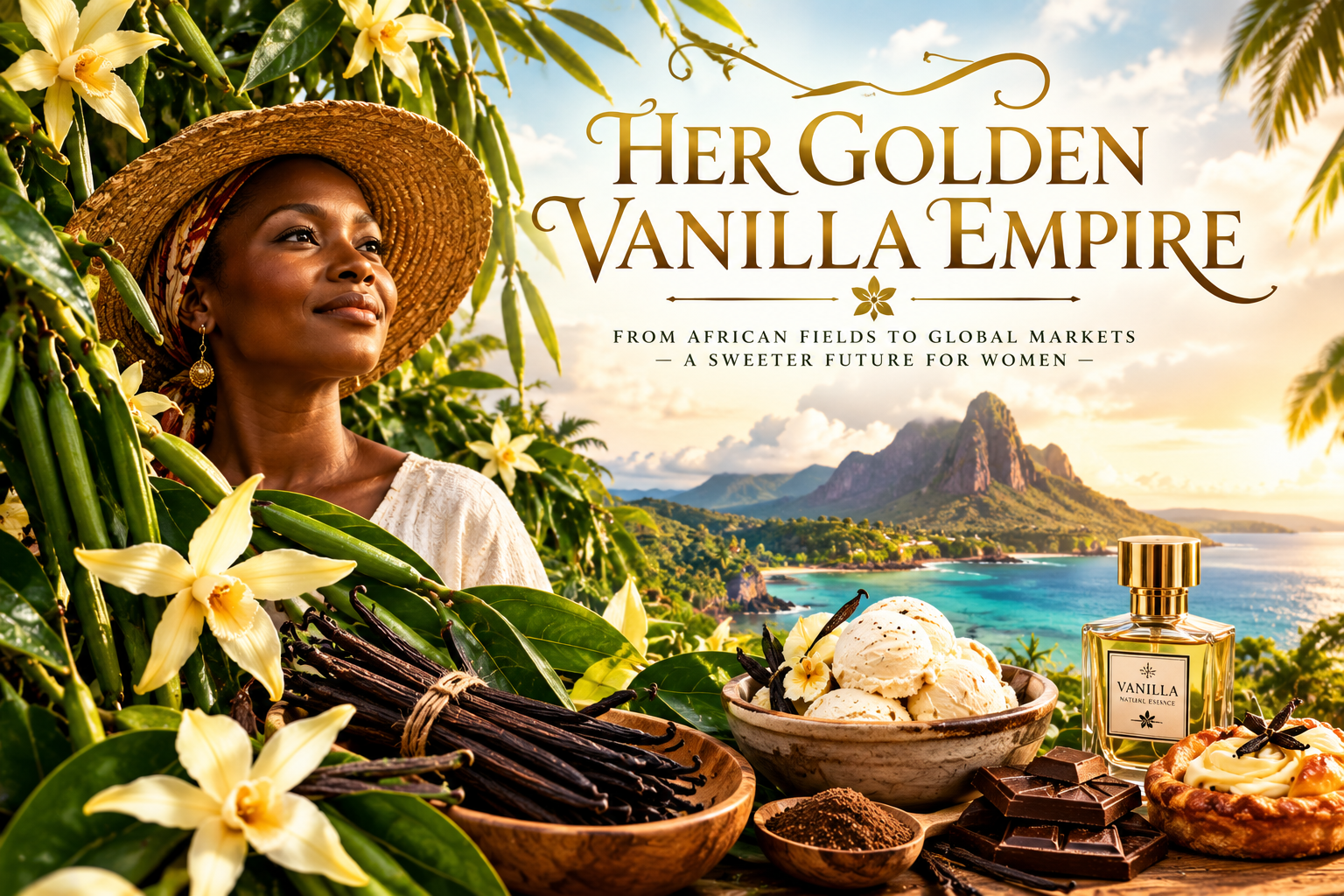
HER GOLDEN VANILLA EMPIRE
From the women pollinating tiny orchid flowers in African fields to the global companies turning vanilla into food, fragrance and beauty — the next vanilla story may belong to her.
There is something almost extraordinary about vanilla.
One of the world’s most recognizable luxury flavors begins with a tiny orchid flower that opens for only a short window. Someone has to notice it, pollinate it by hand, wait months for the pod to mature, then harvest, cure, dry, condition and grade it.
By the time that green pod becomes the dark, fragrant vanilla bean sold around the world, an enormous amount of human skill has gone into it.
And increasingly, that someone is a woman.
Across Africa, women are already growing vanilla, hand-pollinating flowers, harvesting pods, sorting beans, learning quality control, marketing their crops and teaching other farmers. They are not waiting for permission to enter the vanilla economy.
They are already there.
The bigger question is what happens when women begin to capture more of the value created after the vanilla leaves the vine.
THE OPPORTUNITY
Vanilla is one of those agricultural products where the distance between farmer and final customer can be enormous.
A farmer may sell a cured bean. Somewhere else, that bean may become vanilla extract for a bakery, an ingredient for chocolate or ice cream, a flavor for a beverage, or an aromatic material used in fragrance and beauty.
The crop has not changed.
The customer has.
And that is where the opportunity lives.
Africa already has a place in this international business. In 2023, Madagascar exported approximately $271.7 million worth of vanilla, Uganda approximately $25.6 million, and Tanzania approximately $594,000.
Madagascar’s scale is enormous compared with Tanzania’s, but all three demonstrate the same basic fact: African vanilla already has international buyers.
The United States imported approximately $151.2 million of vanilla from Madagascar and $16.9 million from Uganda in 2023. The European Union imported approximately $174.1 million from Madagascar and almost $10 million from Uganda.
The market does not need to be invented.
The question is who captures more of the value along the way.
The world’s major vanilla markets in 2023
| Market | Vanilla imports |
|---|---|
| European Union | $205.1 million |
| United States | $194.4 million |
| France | $133.3 million |
| Germany | $50.2 million |
| Netherlands | $42.1 million |
| Canada | $24.4 million |
| United Kingdom | $14.6 million |
| Switzerland | $13.4 million |
THE WOMEN ARE ALREADY IN THE VANILLA BUSINESS
Madagascar dominates the African vanilla story, particularly the SAVA region in the northeast. But behind those enormous export numbers are thousands of people whose hands make the industry possible.
Consider Razafinosy Payette, a 44-year-old mother of three and vanilla farmer in SAVA. A member of the SAVASOA Cooperative, she has participated in training covering regenerative vanilla cultivation, income diversification, poultry, sewing and leadership, while applying regenerative practices on one of her vanilla plots.
Her story matters because women in agricultural statistics can easily disappear into the word farmers.
But Payette has a name.
So does the work she is doing.
And that is how we should begin thinking about African women in agriculture — not simply as labor within a value chain, but as producers whose knowledge and businesses can become part of the commercial infrastructure around the crop.
Vanilla makes that particularly visible because the flower must be pollinated by hand and the timing matters. A farmer cannot simply return whenever convenient. The person who understands the plant and knows how to pollinate it correctly possesses valuable technical knowledge.
Pingo Jolly in Uganda demonstrates how that knowledge can become an enterprise of its own.
Jolly farms vanilla on 1.5 acres and also hosts a farmer-learning center, working with other vanilla farmers in her community. After abandoning an earlier attempt at vanilla production, she returned to the crop following technical training and eventually planted approximately 500 plants. In one season, she delivered 269 pounds of vanilla without bean rejects.
Her story is bigger than one farm.
It shows how agricultural knowledge can increase production, improve quality and become something a woman can teach, sell and build a reputation around.
Uganda has also begun publicly recognizing women in the crop. Florence Nabukalu was named Uganda’s Best Female Vanilla Grower in 2025, following previous winner Fridah Birekeraho.
These women do not represent every vanilla farmer.
They make something important visible:
women are already part of the commercial vanilla story.
AND THEN THERE IS ZANZIBAR
This is where the story becomes especially interesting.
Zanzibar is famous around the world as the Spice Islands. Cloves may dominate its agricultural identity, but vanilla has also been cultivated within the islands’ spice economy.
Research has documented vanilla cultivation in Unguja, including Mkunazini and Donge, while Zanzibar’s tourism industry already presents vanilla as one of the spices encountered on its spice farms.
But Pemba gives us a particularly compelling women’s story.
Bimajo Masoud Juma transformed a small piece of land into a diversified spice forest where vanilla grows alongside cardamom, black pepper, cinnamon and cloves.
In 2023, she harvested almost two kilograms of vanilla pods.
Then she did something that caught my attention even more.
She began selling vanilla vines to people who wanted to become farmers themselves.
Her farm was therefore producing more than a crop. It was producing planting material, knowledge and an entry point for other entrepreneurs.
That is the beginning of an enterprise.
And it is why Zanzibar should not be treated as a decorative paragraph in an African vanilla story.
Zanzibar has a vanilla story of its own.
Its opportunity may not be to compete with Madagascar on volume. It may be to build value around origin, tourism, quality and identity.
Imagine beautifully packaged Zanzibar vanilla beans sold through hotels and specialty retailers. Vanilla powder. Vanilla-infused sugar. Culinary gift sets combining vanilla with coffee or chocolate. A woman-owned company aggregating production from several small growers and selling a traceable Zanzibar-origin product to chefs and specialty buyers.
The agricultural volume may be modest.
The commercial story does not have to be.
That is often the difference between selling a crop and building a brand.
TANZANIA’S MAINLAND WOMEN ARE THERE TOO
The opportunity is not limited to the islands.
Research on women vanilla farmers in Hai District, Tanzania, found women involved in field preparation, planting, hand pollination, harvesting, sorting and marketing. The research also identified challenges involving structured markets, reliable buyers, advisory services and finance.
A separate 2026 study examined women smallholder farmers in Bukoba Rural District, including their participation in global vanilla value chains and technology adoption.
Tanzania’s vanilla exports remain small compared with Madagascar and Uganda, but Tanzania already has international customers. In 2023, the country exported approximately $594,000 of vanilla, including roughly $422,600 to the United States and $114,700 to France.
That is not yet a giant industry.
It is something more useful for an entrepreneur:
evidence that a market connection already exists.
YOU DO NOT HAVE TO OWN A VANILLA FARM
This is where vanilla becomes particularly interesting for the woman who wants to enter African agriculture but does not want to become a farmer.
The value chain extends through aggregation, curing, grading, quality control, packaging, logistics, exporting, processing, branding and distribution.
A woman in Dar es Salaam may understand hospitality.
A woman in Zanzibar may understand tourism.
A woman in London, Atlanta or Toronto may understand specialty food buyers.
Another may own a bakery, restaurant, gourmet shop, natural beauty company or fragrance business.
None of them needs to own hundreds of acres of vanilla.
One may build a business connecting farmers to buyers.
Another may specialize in curing and grading.
Another may aggregate production.
Another may develop a premium origin brand.
Another may process beans into powder or extract.
Another may become the ingredient supplier behind somebody else’s food or beauty brand.
The woman who understands the customer may be just as important to the value chain as the woman who grows the crop.
FROM BEAN TO INGREDIENT
This is where the economics of vanilla begin to change.
Whole cured beans are valuable, but processing can create products designed specifically for commercial customers.
Vanilla can become powder, extract, paste and other specialized ingredients. A bakery may want an easy-to-use ingredient rather than thousands of individual beans. A manufacturer needs consistency. A beverage company needs predictable specifications.
The entrepreneur is therefore no longer simply selling vanilla.
She is selling consistency, convenience, quality and functionality.
And that changes the commercial question from:
“Who wants to buy my vanilla beans?”
to:
“Which manufacturers need the vanilla ingredient I can reliably supply?”
That is a much larger conversation.
THEN VANILLA WALKS INTO CHOCOLATE, FOOD AND PERFUME
Vanilla is also interesting because it connects naturally with other African industries.
Africa already grows cocoa. It produces sugar, coffee, fruit and other agricultural ingredients. As food manufacturing expands, vanilla can become an ingredient inside African chocolate, confectionery, beverages and desserts rather than simply another commodity exported out of the continent.
And then there is fragrance.
Vanilla is an important aromatic material, and major international flavor and fragrance companies operate across food, beauty and perfumery.
That means an African vanilla entrepreneur does not necessarily have to sell to a spice importer.
Her customer could be a food manufacturer, cosmetic company, fragrance house, natural-perfumery business or ingredient distributor.
This is the power of agro-processing.
A crop begins in an agricultural field and ends up in an entirely different industry.
AFRICA DOES NOT HAVE TO EXPORT ONLY THE BEAN
The international industry itself is moving closer to origin.
In May 2026, IFF opened a Vanilla Innovation Center in Madagascar, bringing laboratory analysis, extraction, scent and flavor creation and application development closer to the country’s vanilla-growing and post-harvest regions.
That is a significant signal.
The future of African vanilla does not have to stop at harvesting and exporting cured beans.
There is room to ask bigger questions:
What if more extraction happened in Africa?
What if more quality testing happened near the farmer?
What if African companies developed natural vanilla ingredients for manufacturers?
What if African entrepreneurs became experts in traceability, specifications and consistency?
And what if women owned some of those businesses?
That is where vanilla begins to move from agriculture into industry.
THE INVESTMENT: WHERE COULD SHE ENTER?
There is no single price of entry into the vanilla business. The right investment depends on whether you want to farm, aggregate, cure, process, manufacture or build a consumer brand.
THE $5,000 ENTRY — PROVE THE BUSINESS
Around $5,000 can create a starting point for a small value-chain business rather than a factory.
A woman could work with a small group of farmers, purchase or aggregate properly handled beans, establish basic storage and packaging, develop a small premium product line or begin building a buyer network.
In Zanzibar or Pemba, this could mean creating a small origin-focused business connected to existing growers rather than trying to establish a large plantation.
At this level, the goal is simple: prove that someone will pay for the product.
THE $10,000 ENTRY — BUILD A SMALL COMMERCIAL OPERATION
At approximately $10,000, the entrepreneur can begin moving from experimentation into a more structured commercial operation.
That could mean working with a larger farmer network, strengthening aggregation and quality control, improving curing and storage, developing traceability and investing in professional packaging and market development.
The business begins to have a clearer proposition:
We source, cure, grade and market quality vanilla from this origin.
THE $25,000 ENTRY — BUILD A BUSINESS AROUND THE BEAN
At approximately $25,000, the entrepreneur can begin building a more substantial small-scale processing and aggregation business.
Capital could support post-harvest infrastructure, farmer purchasing, storage, quality systems, packaging, traceability and, depending on the product and regulations, early development of vanilla powder or carefully formulated extracts.
This is where the entrepreneur is no longer simply trading a crop.
She is building a system around it.
THE $50,000–$100,000 RANGE — MOVE TOWARD SERIOUS PROCESSING
At $50,000 to $100,000, a business could begin considering more sophisticated processing, potentially including powder, extracts or other ingredients.
But this is where discipline becomes critical.
The entrepreneur needs to understand food safety, laboratory testing, equipment, utilities, packaging, licensing, technical expertise and export requirements — and, most importantly, have a clear customer before spending heavily on equipment.
A beautiful processing facility without buyers is still an expensive building.
$100,000+ — BUILD AN INGREDIENT BUSINESS
Above $100,000, the opportunity becomes more industrial.
The business could develop greater processing capacity, stronger quality-control systems, laboratory capability, traceability and the ability to supply professional food, beverage, fragrance or cosmetic customers.
At this level, the company is not simply selling vanilla.
It is competing on specification, consistency, reliability, technical performance and service.
These are indicative entry points, not fixed project budgets. Land, labor, equipment, energy, certification, laboratory testing, packaging, transport and regulatory requirements vary considerably by location and product.
The smartest investment is not automatically the largest one.
A $5,000 business with a real customer can teach an entrepreneur more than a $100,000 factory built before the market has been tested.
THE GOLDEN OPPORTUNITY
Vanilla is not simply a spice.
It is an international ingredient business hiding inside a tiny orchid flower.
And women are already doing the difficult work.
They are planting, pollinating, harvesting, curing, sorting, teaching and building relationships.
From Madagascar to Uganda, from Tanzania’s mainland farmers to the women growing vanilla in Zanzibar and Pemba, the story is already underway.
The next step is not to convince women that they belong in vanilla.
They already do.
The opportunity is to help more women move from participation to ownership.
A woman may begin with a small plot in Pemba.
She may become known for the quality of her beans.
Another woman may build a curing operation.
Another may aggregate from farmers.
Another may export.
Another may produce extract.
Another may build a food or beauty brand in the Diaspora.
Another may become the supplier of a natural vanilla ingredient to a manufacturer.
The value chain has room for all of them.
Africa does not have to stop at the vanilla bean.
And neither does she.
THE NEXT MOVE
Before investing heavily, understand the vanilla already being produced.
Meet the farmers. Learn how the crop is cultivated and cured. Understand grading and quality specifications. Find out what buyers reject and why. Speak to traders and exporters.
Then speak to the buyers.
Would they purchase Tanzanian vanilla?
Would they purchase Zanzibar vanilla?
What grade do they require? What volume? Whole beans or extract? What specifications, documentation, packaging, certifications and delivery terms?
Those questions turn vanilla from an attractive agricultural story into a commercial investigation.
And if you are a woman in the Diaspora, ask one more question:
Who is already buying vanilla where I live?
Your greatest asset may not be farmland.
It may be market access.
That is where a crop becomes a business.
And that is where her golden vanilla empire can begin.
WANT TO EXPLORE THE OPPORTUNITY?
If you are considering entering the vanilla business and want to understand where you could realistically enter the value chain, what products may offer the most accessible starting point, how to identify suppliers and customers, and what would be required to move from an idea to a viable African agribusiness, professional consultation can help you turn the opportunity into a practical pathway.
Renae Bruce-Miller is a professional consultant in African agro-processing based in Dar es Salaam, Tanzania. Through Her Golden Era, she examines practical opportunities across African agriculture, processing, trade and value addition, with a particular interest in helping entrepreneurs identify commercially viable entry points.
Interested in exploring your own vanilla opportunity?
Contact Renae Bruce-Miller for a consultation.