


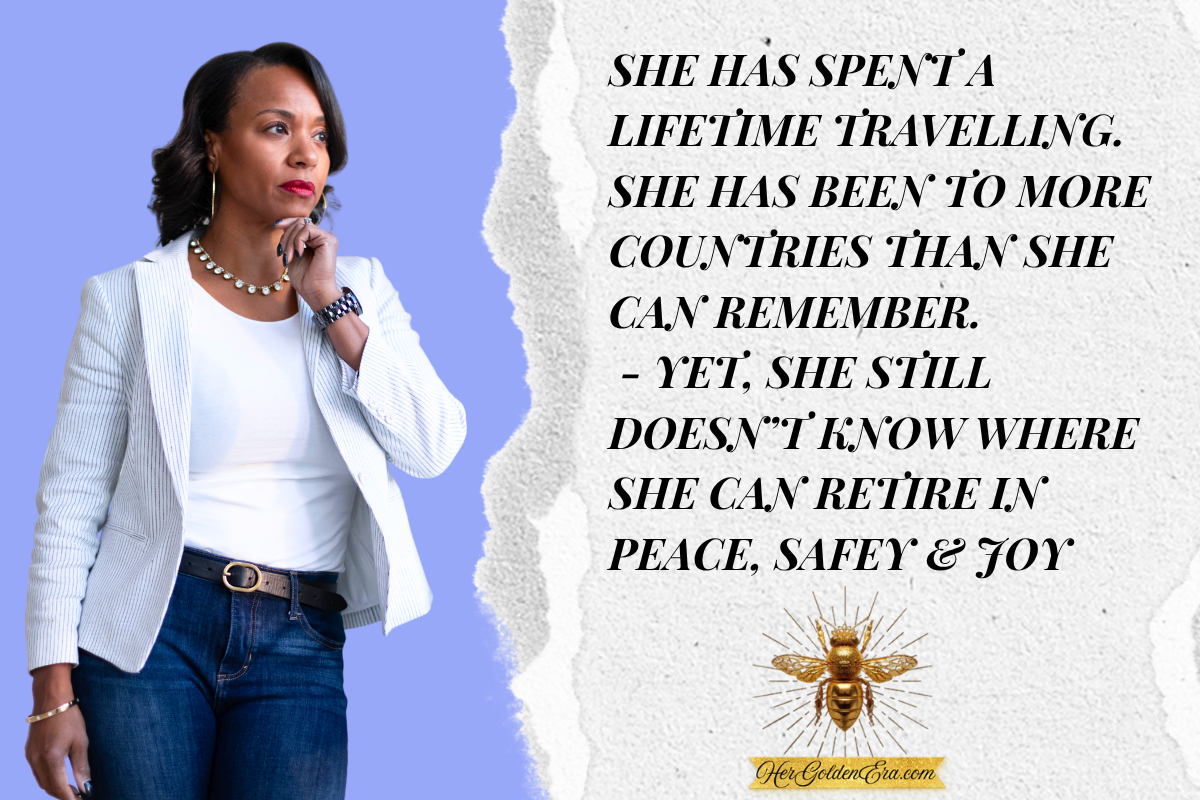
Her New Retirement Map
Where in the World Can a Black Woman Build Her Second Life?
There is a moment in a woman’s life when the question of retirement changes.
It is no longer, Where can I afford to survive?
It becomes:
Where could I actually live?
Perhaps she is 48 and tired of commuting through traffic. Perhaps she is 57 and newly divorced. Perhaps she is 63, her children have left home, and the house that once felt wonderfully full now feels strangely quiet. Perhaps she has spent four decades working, raising children, supporting relatives, paying mortgages and being the dependable one.
And perhaps, for the first time, she is asking a deliciously selfish question:
What if the next chapter belonged to me?
For Black women, that question has an additional dimension. We are not simply looking for somewhere inexpensive. We are looking for places where a mature Black woman can arrive without having to explain her hair, her skin, her accent, her ambition, her age or the fact that she is perfectly happy traveling alone.
The good news is that the retirement map has changed.
Mexico, Thailand, Costa Rica and Portugal are now established favorites among international residents. Mauritius is quietly emerging as an Indian Ocean alternative. Jamaica offers something money cannot manufacture: cultural familiarity. Italy remains the great romantic fantasy, although its residency requirements demand serious financial planning. Egypt offers astonishing value and history but requires more careful navigation of residency and healthcare. Tanzania offers something entirely different—the possibility of retiring not simply near Africa, but inside Africa.
And there is no single winner.
There is only the place that fits your life.
First, Forget the Old Definition of Retirement
Retirement used to mean staying put. A house. A garden. Grandchildren. Perhaps a cruise once a year.
The new retirement is more mobile.
International expat research increasingly reflects that shift.
InterNations’ 2026 survey places Mexico second and Thailand third overall among 31 destinations, with Portugal eighth.
Thailand ranks exceptionally well for affordability, while Mexico scores highly for personal finances and ease of settling in. (InterNations

And the economics are persuasive.
Numbeo’s 2026 country index places the United States at 68.8 for cost of living, compared with 42.6 for Mexico, 38.0 for Thailand, 52.9 for Costa Rica, 48.8 for Portugal, 61.4 for Italy, 54.5 for Jamaica, 38.3 for Mauritius, and substantially lower levels in Tanzania. These are index measures, not personal monthly budgets, but they demonstrate the broad difference in price environments. (Numbeo)
For a woman living on pension income, Social Security, investment income or a combination of the three, that difference can determine whether retirement feels constrained—or expansive.
But cheap is not enough.
A beautiful retirement requires four things:
Money. Healthcare. Safety. Belonging.
And then there is a fifth:
Joy.
Mexico: The Great Reinvention

Mexico may be the easiest place on this list to imagine as a second life.
It has the infrastructure of a major international destination, excellent private healthcare in many cities, enormous cultural depth and an established foreign-resident population.
San Miguel de Allende offers colonial architecture, restaurants and an arts scene. Mérida offers Yucatán culture and a slower rhythm. Lake Chapala has long attracted retirees. Mexico City offers something entirely different: museums, fashion, restaurants, galleries and the energy of a global capital.
For Black women, Mexico also has an advantage that shouldn’t be underestimated: proximity to the United States.
You can have your Mexican life and still reach family in America without crossing an ocean.
InterNations ranked Mexico first for ease of settling in among its 2026 destinations. Seventy-three percent of expats surveyed said making local friends was easy. At the same time, Mexico ranked only 25th in its Safety & Security subcategory, illustrating an important truth: loving Mexico does not mean ignoring security. Neighborhood selection matters enormously. (InterNations)
The money
A comfortable single-person retirement can often be planned around roughly $1,400–$2,000 a month, depending heavily on city, housing and lifestyle. Recent 2026 estimates put a single budget around $1,400 in some Mexican retirement centers. (Retire Destinations)
Residency
Mexico does not have a single age-based “retirement visa.” Temporary residency can be obtained by demonstrating financial solvency. One current Mexican consular example allows qualification through income, investments or property, with thresholds varying by consulate and exchange rates. One consulate currently lists either approximately $4,400 in monthly income or $75,000 in average savings/investments as examples. (consulmex.sre.gob.mx)
Best for: the woman who wants culture, proximity, excellent food, a mature expat community and the possibility of reinventing herself without completely disconnecting from America.
Thailand: The Retirement Darling

Thailand is the destination that keeps appearing whenever retirees talk about value.
And there is a reason.
The country combines inexpensive everyday living with extraordinary food, beaches, temples, wellness culture and a sophisticated tourism infrastructure.
Bangkok is cosmopolitan and intense. Chiang Mai is calmer and famously popular with international residents. Phuket offers beaches and an established foreign community. Hua Hin has long had a retirement following.
InterNations ranked Thailand the most affordable destination for expats in 2026, with 85% of respondents rating the cost of living positively. Forty percent of expats surveyed in Thailand were already retired, and 22% said retirement was a reason for moving there. (InterNations)
A comfortable single lifestyle can often be built around $1,100–$1,700 a month, depending on location and expectations. (Retire Destinations)

The visa
Thailand is refreshingly clear about age for traditional retirement routes.
The Non-Immigrant O-A retirement visa requires applicants to be 50 or older. Financial requirements commonly include 800,000 baht in a Thai bank account, 65,000 baht monthly income, or a qualifying combination. (กระทรวงการต่างประเทศ)
Thailand’s Long-Term Resident “Wealthy Pensioner” route is more demanding: applicants must be at least 50 and generally show $80,000 in annual passive income, or $40,000–$80,000 with an additional $250,000 investment. (ltr.boi.go.th)
There is a catch.
The 2026 Global Peace Index places Thailand at 101st globally, and InterNations notes concerns including air quality in some areas. (Global Peace Index)
Best for: the woman who wants her retirement to feel like an adventure rather than a withdrawal from life.
Costa Rica: The Gentle Landing

Costa Rica has been attracting retirees for decades, and its appeal is wonderfully straightforward.
Nature.
Warm weather.
Healthcare.
Political stability.
And a retirement residency system that doesn’t require millionaire status.
Its Pensionado category requires a permanent monthly pension of at least $1,000. The country’s legal framework also provides a Rentista category for people with qualifying stable income of at least $2,500 per month. (pgrweb.go.cr)
The cost of living is higher than Thailand or Mexico, with Numbeo’s 2026 cost index at 52.9. Comfortable single budgets are commonly estimated around $1,700–$2,000 monthly, depending on location and housing. (Numbeo)
Safety is one of Costa Rica’s stronger arguments. The 2026 Global Peace Index ranks it 54th, substantially ahead of Mexico and Jamaica. (Global Peace Index)
The Central Valley around San José is particularly attractive for women who prioritize access to healthcare and services.
Best for: the woman who wants nature, healthcare and stability more than nightlife.
Jamaica: When Retirement Feels Like Coming Home
There are countries you move to.
And then there are countries you return to.
For Jamaican women in the diaspora, Jamaica belongs in a different category altogether.
You understand the language. The food. The music. The humor. The rhythm of conversation. You know what mango season means. You understand why a Sunday afternoon can stretch for hours.
And Jamaica is actively encouraging its diaspora to come home.
The Jamaican government says its Returning Residents program is designed to encourage nationals abroad to return to live, work, raise families, do business, invest and retire. Citizens who have lived overseas for at least three consecutive years and return permanently can qualify for specified customs concessions. (MFAFT Jamaica)
Foreign nationals can also apply for Jamaican permanent residence under a retirement category; PICA requires evidence of financial means, pension or bank statements, health documentation and other supporting records. (PICA)
The cost of living is not as low as Thailand. Numbeo’s 2026 index places Jamaica at 54.5, but rent remains substantially below U.S. levels in many markets. (Numbeo)
Safety requires realism. Jamaica ranks 93rd in the 2025 Global Peace Index and security conditions vary considerably by parish and neighborhood. (Institute for Economics & Peace)
Best for: the woman whose retirement is less about becoming an expat and more about reconnecting with home.
Portugal: Europe’s Soft Landing
Portugal is perhaps the most seductive European option for a woman who wants sunshine, history, healthcare and access to the wider European continent.
Lisbon is sophisticated and increasingly expensive. Porto offers a cooler, more intimate urban experience. The Algarve remains popular with retirees looking for beaches and slower living.
Portugal ranked eighth overall in InterNations’ 2026 Expat Insider survey and fourth in its Personal Finance Index. Expats particularly praised its value and quality of life. (InterNations)
The 2026 Global Peace Index ranks Portugal seventh in the world, making it one of the strongest destinations on this list for national peace and stability. (Vision of Humanity)
The visa
Portugal offers a residence visa for retirees and people living from their own income. Applicants must demonstrate accommodation, insurance, criminal-record documentation and sufficient means of subsistence. (Gov.pt)
There is no minimum retirement age for the D7-style passive-income route.
The Portuguese reference framework uses the national minimum wage to calculate means of subsistence; AIMA currently lists €870 as the 2025 reference minimum, although applicants should confirm the applicable figure for the year and visa category when applying. (Aima)
A realistic comfortable single budget is approximately $1,800–$2,500+ per month, with Lisbon substantially more expensive than smaller cities and towns. (Retire Destinations)
Best for: the cultured woman who wants Europe without the frantic pace of Europe’s biggest capitals.
Italy: The Dream Has Paperwork
Italy is where retirement becomes cinematic.
A morning espresso, A market, A village square, A train to Florence, An afternoon beside the sea, A long lunch that refuses to end.
But Italy is not Thailand.
It is not inexpensive, and its retirement residency route is designed for people with genuine independent financial means.
The Elective Residence Visa requires substantial, stable income that does not depend on working in Italy.
Italian consulates cite pensions, annuities, property income and financial assets as appropriate sources. One current consular source identifies approximately €31,000 annually as a starting reference, while emphasizing that the consulate evaluates whether the applicant has genuinely substantial resources. (consfrancoforte.esteri.it)
There is no specific retirement age.
You simply need to demonstrate that you can support yourself.
Italy ranks 33rd in the 2026 Global Peace Index, still within the more peaceful group globally. (Vision of Humanity)
The cost of living varies wildly. A small-town Italian retirement can be surprisingly reasonable; Milan, Rome and prime coastal locations are another matter. Numbeo places Italy’s 2026 cost-of-living index at 61.4. (Numbeo)
Best for: the woman with reliable passive income who wants beauty, culture, food and history—and doesn’t mind bureaucracy.
Mauritius: The Indian Ocean Wild Card
Mauritius deserves far more attention.
For Black women looking toward Africa but wanting the infrastructure of a sophisticated island economy, Mauritius offers an unusual combination: African identity, Indian Ocean culture, political stability, international tourism and a relatively developed financial and property market.
The 2025 Global Peace Index ranked Mauritius 26th globally, ahead of Italy, Portugal’s neighbors and virtually every African destination except a small handful. (Vision of Humanity)
Its 2026 cost-of-living index is 38.3, significantly below the United States. (Numbeo)
The visa
Mauritius is unusually explicit about age.
Foreign nationals over 50 can retire under the Retired Non-Citizen Residence Permit. The permit can be issued for up to ten years and renewed under established criteria. (Passport Mauritius)
A retired resident can also work toward a 20-year residence permit after three years if qualifying transfers total at least $54,000 over three years. (Passport Mauritius)
There is another route for property buyers: acquiring qualifying residential property at a minimum value of $500,000 can provide eligibility for residence. (DHA Mauritius)
Best for: the woman who wants Africa, an island, relatively strong stability and the possibility of combining retirement with investment.
Egypt: History at a Different Price
Egypt is not the obvious retirement choice.
That is precisely why it deserves consideration.
Imagine spending your sixties within reach of the pyramids, the Red Sea, Alexandria and Cairo’s extraordinary cultural life.
Egypt is one of the least expensive countries on this list. Numbeo’s 2026 data place it substantially below Europe and North America. (Numbeo)
But Egypt is not currently offering the clean, straightforward equivalent of Thailand’s 50+ retirement visa or Costa Rica’s Pensionado program.
Foreign residents have access to several temporary-residency categories, including three- and five-year residence services, but the route depends on the basis for residence rather than simply reaching retirement age. Egyptian government services explicitly provide three- and five-year temporary residence options. (Public Services Management)
Safety also requires a closer look. Egypt ranked 113th in the 2026 Global Peace Index. (Global Peace Index)
Healthcare, traffic, bureaucracy, heat and city infrastructure deserve careful consideration.
Best for: the adventurous, culturally curious woman willing to spend time researching the practicalities before making a commitment.
Tanzania: What If Retirement Meant Africa?
And then we arrive at the destination I think deserves a completely different conversation.
Tanzania.
Not because it is perfect.
Because it offers something that retirement brochures rarely discuss:
proximity to an African future.
Dar es Salaam offers the Indian Ocean, international hotels, restaurants and a growing business community. Arusha places you beside some of the world’s great safari destinations. Zanzibar offers beaches, history and an increasingly international property and tourism economy.
And Tanzania has something unusually concrete for foreign retirees.
Its Immigration Department provides a Class C residence permit specifically for retired persons.
The minimum age is 55.
Applicants must have assured income sufficient to sustain themselves and dependents, and the published fee for the retired-person category is $500, with a $50 re-entry pass per applicant or dependent. (Immigration Service Department)
Tanzania’s 2026 Global Peace Index ranking is 98th, while the 2026 Numbeo cost index places it far below the United States. (Global Peace Index)
But here is the important part:
Tanzania is not necessarily a retirement destination for someone who wants to reproduce American life at half the price.
It is a destination for the woman who wants something else.
A garden.
A coastal house.
A small hospitality business.
A farm.
A wellness retreat.
A creative studio.
A life that is less about accumulating things and more about constructing an environment.
For a Black woman from the diaspora, it can also represent something psychologically powerful:
You are not an outsider to Blackness here.
You may still be a foreigner.
You may still need to navigate immigration, property rules, taxation, healthcare and bureaucracy.
But you are walking into a continent where your appearance is not automatically the most interesting thing about you.
That can be liberating.
So Where Should She Go?
The answer depends on what she wants her second life to feel like.
If she wants affordability and adventure, Thailand is difficult to beat.
If she wants proximity to America and a mature expat ecosystem, Mexico is compelling.
If she wants stability and nature, Costa Rica deserves serious consideration.
If she wants Europe, Portugal is arguably the most accessible starting point, while Italy is the more demanding romantic choice.
If she wants the Caribbean, Jamaica offers something no foreign country can manufacture: cultural belonging.
If she wants island life with strong stability and African proximity, Mauritius is the intriguing wildcard.
If she wants history and extraordinary value, Egypt is fascinating—but requires more homework.
And if she wants to ask the most radical question—
“What if I built my second life in Africa?”
—Tanzania belongs on the map.
The Retirement Test Nobody Talks About
There is one final calculation a woman should make before buying the one-way ticket.
Don’t ask only:
“Can I afford to live there?”
Ask:
- “Can I afford to live there well?”
- Can I afford private healthcare if I need it?
- Can I fly home twice a year?
- Can I maintain health insurance?
- Can I afford an emergency flight?
- Can I afford the neighborhood where I actually feel comfortable?
- Can I afford air conditioning?
- Can I afford imported foods if I need them?
- Can I afford a car or reliable transportation?
- Can I afford to travel?
- Can I afford to entertain friends?
- Can I afford to help family without destroying my retirement?
And perhaps the most important question:
Can I afford to change my mind?
Because retirement abroad should not become another obligation. The woman who spent her first sixty years fulfilling obligations deserves a second life with some elasticity. Try the country before committing.
Rent before buying. Spend three months before spending your savings. Learn the healthcare system.
Understand the tax consequences. Talk to women already living there. Investigate residency yourself through the official immigration authorities. And never confuse an Instagram apartment tour with a retirement plan.
The World Is Bigger Than the Life We Were Sold
There is something wonderfully defiant about a mature woman looking at a map and realizing she has options.
- She can wake up in Lisbon.
- Swim in Mauritius.
- Have lunch in Jamaica.
- Spend winter in Mexico.
- Learn Thai cooking in Chiang Mai.
- Walk through an Italian village.
- Watch the sunset over the Indian Ocean.
- Visit the pyramids.
- Go on safari.
- Return to Jamaica for Christmas.
- And still fly home when she wants to.
Retirement no longer has to mean disappearing into a familiar suburb and waiting for life to become smaller.

It can mean becoming more selective about where life happens.
And perhaps that is the real revolution.
Women spent decades being told where they belonged.
The family home, The office,The children’s school, The kitchen, The community, The church, The neighborhood.
Now she gets to look at the entire world and ask a very different question:
Where does the life I want belong?
For the Black woman entering her Golden Era, the answer may not be one country. It may be a passport full of possibilities.
And perhaps the greatest luxury of all is not retiring from work.
It is finally having the freedom to choose where the next chapter takes place.
THE GOLDEN PASSPORT: A QUICK 2026 RETIREMENT CHECK
| Destination | Approx. comfortable single budget* | Retirement/residency pathway | Age requirement | 2026 peace picture |
|---|---|---|---|---|
| Mexico | ~$1,400–$2,000/mo | Temporary residence based on financial solvency | No specific retirement age | More security-sensitive; 2026 GPI ranking 140s |
| Thailand | ~$1,100–$1,700/mo | Non-O retirement / LTR | 50+ | GPI 101 |
| Costa Rica | ~$1,700–$2,000/mo | Pensionado | No specific age | GPI 54 |
| Jamaica | ~$1,500–$2,500+ | Retirement PR route / Returning Resident for eligible Jamaicans | No published retirement age for PR | GPI 95 |
| Portugal | ~$1,800–$2,500+ | Passive-income/retirement residence | No specific age | GPI 7 |
| Italy | ~$2,000–$3,000+ | Elective Residence | No specific age | GPI 33 |
| Mauritius | ~$1,300–$2,000+ | Retired Non-Citizen Residence Permit | 50+ | GPI 25 |
| Egypt | ~$900–$1,500+ | Various temporary residence routes | No dedicated retirement age | GPI 113 |
| Tanzania | ~$1,000–$1,800+ | Class C Retired Person | 55+ | GPI 98 |
*These are planning ranges rather than official government cost-of-living figures. Housing, city, healthcare, insurance, travel, lifestyle and exchange rates can dramatically change the final number. Numbeo’s 2026 country indices are useful for comparing relative price levels, while current retirement-budget sources provide practical lifestyle estimates. (Numbeo)
One last rule: visa and immigration requirements change. Before making a financial commitment, confirm the current rules with the country’s official immigration authority or consulate. The figures above are a research snapshot for August 2026, not legal or immigration advice.