


WHAT BLACK WOMEN NEED TO KNOW ABOUT MENOPAUSE
For generations, many Black women entered the major biological transitions of womanhood with surprisingly little preparation.
A 2007 qualitative study of African American women found that conversations about menstruation were often avoided or framed negatively, leaving participants with few sources of reliable information from schools, mothers, or other women; the researchers found that this limited learning contributed to confusion and negative attitudes toward menstruation, menopause and menstrual-related health conditions.
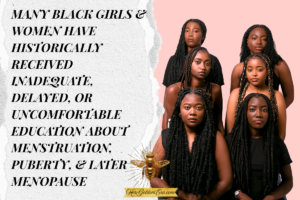
(PubMed) More recently, a 2026 UK-wide survey of 377 Black women aged 40 to 70 found that 88.3 percent had received no menopause education at school, while 58.1 percent said they had not felt informed about menopause before the age of 40.
Most of the women said menopause should be discussed earlier, at school or with healthcare professionals, rather than waiting until symptoms became difficult to manage.
(PubMed) And the problem does not necessarily end when a woman finally reaches the doctor’s office: a 2024 focus-group study involving African American women found that many participants had unmet needs for menopause information from clinicians, with some saying they felt ignored or dismissed when they attempted to raise the subject themselves.
(ScienceDirect) The picture that emerges is not that Black women lack resilience we have an almost legendary supply of that but that resilience has sometimes been asked to substitute for information.
We learned how to endure the period, the pregnancy, the childbirth, the sleepless nights and the caregiving; we were not always taught what was happening to our bodies along the way.
Perhaps the next generation deserves something better: not whispered warnings, not “you’ll know when it happens,” and certainly not a woman standing in her kitchen at 48 wondering why she is suddenly sweating through her blouse.
She deserves the facts before the symptoms arrive, a doctor willing to listen, and the confidence to understand that menopause is not a medical failure or the end of womanhood.
It is a life stage and women deserve to enter it informed.
The body is changing. The woman is not disappearing.
There is a joke women make about menopause that is funny because it is true.
One minute you’re sitting peacefully at your desk. The next, your body decides that it has been personally insulted by the existence of clothing.
The heat arrives. You fan yourself. You remove the cardigan. You open the window. Someone asks if you’re all right.
You say, “I’m fine.” You are not fine.
You are approximately three seconds away from standing in the refrigerator.
Then, just as suddenly, the heat disappears and you are sitting there wondering what, exactly, happened.
Welcome to menopause.
Or, more accurately, welcome to a biological transition that medicine has spent an astonishing amount of time treating as though it were an embarrassing inconvenience rather than a major stage of women’s lives.
For Black women, there is another layer to the story.
We have often been told to tolerate discomfort. Work through it. Raise the children. Go to work. Take care of Mama. Show up. Don’t complain.
And because generations of Black women have developed extraordinary reputations for resilience, there is a peculiar danger in being very good at enduring things.
You can become so accustomed to discomfort that you don’t realize you are allowed to ask for help.
Menopause is one of those moments when we should.
Because this isn’t simply about periods stopping.
It is about what happens when the hormonal system that has accompanied a woman through puberty, pregnancy, childbirth and much of adulthood begins changing its terms.
And the first thing every woman should know is this:
You are not imagining it.
But Why Doesn’t Anyone Really Know What’s Happening?
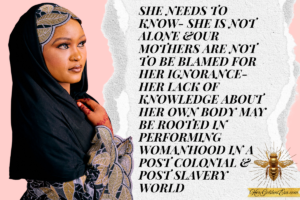
Studies Prove-Many Black women around the world are womb illiterate about puberty /menstruation and menopause.
A particularly relevant qualitative study, published in Journal of Women’s Health in 2007, interviewed 17 low-income African American women about communication surrounding menstruation.
The researchers found a recurring pattern of avoidance and negative discussion of menstrual events throughout their lives.
Participants described having few sources of information and limited menstrual education from schools, mothers, and other women. The researchers concluded that this contributed to confusion, inaccurate beliefs and negative attitudes not only toward menstruation, but also toward menopause and menstrual-related health conditions.
The women weren’t simply uninformed about one event. Black/African women are not provided with basic knowledge at the most critical times-yet somehow we should magically know what happens in menopause?
For Black Women- Cultural silence could follow us from adolescence into midlife.
On the Continent, There is also contemporary evidence from Tanzania.
A study of 8,012 adolescent schoolgirls found that the majority had inadequate menstrual-health knowledge, and only 21% of schools had an instructor trained in menstrual-health education. About 30% of girls reported that they had not heard about menstruation before menarche.
A separate study of adolescents in Kibaha found that only about 34% felt well informed about puberty and 31% about menstruation, with very few reporting that they received information before puberty.
Menopause itself is defined retrospectively: twelve consecutive months without a menstrual period, assuming there is no other medical explanation.
The years leading up to it are called perimenopause.
This transition often begins in the 40s, and hormone levels can fluctuate considerably before eventually declining. The average age of natural menopause is around 51, although individual women can arrive there considerably earlier or later. (ACOG)
Which explains why a woman can feel perfectly normal one month and then, six months later, wonder whether somebody has secretly replaced her body with a rental.
The ovaries gradually produce less estrogen.
That change affects considerably more than reproduction.
Estrogen receptors exist throughout the body, and the menopause transition can be associated with changes involving sleep, mood, cognition, sexual and vaginal health, cardiovascular and metabolic health, bone density and physical function. (PubMed Central (PMC))
This is why the old description of menopause as “hot flashes and mood swings” is so inadequate.
It is like describing a hurricane as “a bit of weather.”
The Performance of Womanhood

Perhaps the gap in Black women’s knowledge about their own bodies is not simply an educational failure. Perhaps it is also the residue of a much older performance of womanhood—one shaped by slavery, colonial medicine and the expectations placed upon Black women to be useful, resilient and endlessly capable.
Under American slavery, Black women’s reproductive capacity was economically exploited, while physicians simultaneously used enslaved women as subjects for invasive gynecological experimentation and dismissed or appropriated the reproductive knowledge held by Black midwives and healers.
Historians and public-health researchers have documented how this history helped produce a complicated relationship between Black women and medical institutions that continues to influence trust and reproductive healthcare today.

In the British Caribbean in countries like Jamaica and Barbados, recent historical scholarship similarly describes enslaved Black women as being treated primarily as laborers and reproducers rather than as patients whose suffering and medical knowledge deserved recognition.
And yet the story is not simply one of Black women being passive victims.
African American women developed and transmitted their own systems of reproductive knowledge, particularly through mothers, grandmothers and midwives; research on menopause has found that intergenerational knowledge could be an important source of power and preparation.
The problem, perhaps, is what happened when that knowledge met a culture that rewarded Black women for being strong enough not to need anything.
We learned to perform competence: to work through pain, care for everybody else, keep our bodies presentable, remain sexually desirable, bear children, raise them, age gracefully and somehow complain as little as possible.
Menopause exposes the absurdity of that bargain.
A woman can perform strength beautifully and still have no idea why she is awake at three in the morning, sweating through her pajamas, unable to concentrate, experiencing painful sex or suddenly feeling unlike herself.
And contemporary research tells us that this information gap is not imaginary: in a recent survey of 377 Black women, 88.3 percent reported receiving no menopause education at school, while 58.1 percent said they did not feel informed about menopause before age forty.
Perhaps the revolution, then, is not teaching Black women to become stronger. We have had quite enough lessons in strength. It is teaching her that she is entitled to knowledge, curiosity, pleasure, medical attention and authority over her own body.
She does not have to perform womanhood. She is allowed to understand it.
Black women possessed enormous bodies of knowledge about reproduction, childbirth, herbs, healing and women’s health—but much of that knowledge was marginalized, appropriated, excluded from formal medicine, or transmitted privately rather than institutionally.
Research on African American women and menopause even found that some women raised in the segregated South remembered their mothers as giving them considerable knowledge and practical power around menopause
COLONIALISM IN AFRICA ALSO DISRUPED AFRICAN WOMEN’S REPRODUCIVE KNOWLEDGE
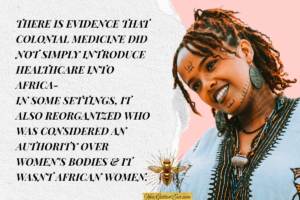
The story does not belong only to Black women in the Americas and Europe.
Across parts of Africa, colonial medicine also changed the relationship between women, their bodies and the people considered qualified to explain those bodies.
In colonial Swaziland, for example, historians have documented how European missionary medicine entered women’s reproductive lives with the stated purpose of improving maternal and infant health, but also with an explicit project of transforming African women’s sexual and reproductive beliefs and practices.
Swazi women were not passive recipients: some resisted hospital confinement and rejected practices that interfered with their established ways of caring for mothers and newborns.
South Africa offers another revealing example.
Historical research describes the displacement of Black midwives and the professionalization of obstetrics as a predominantly white, male medical domain, while Indigenous reproductive knowledge was increasingly dismissed as backward or unscientific.
Yet the knowledge did not simply disappear.
Contemporary South African scholarship documents Indigenous understandings of menopause that have been passed between generations through language, food practices, proverbs, physical activity, herbal knowledge, family responsibilities and community traditions and researchers warn that failing to document this knowledge risks losing it altogether.
The consequences of this complicated history can still be seen in modern healthcare.
A South African study of 150 women found that while 92 percent had heard of menopause, only 39 percent demonstrated adequate knowledge about menopause and 38 percent about hormone replacement therapy, leading researchers to call for substantially better education so women could participate meaningfully in decisions about their own health.
More recent research involving women in Zimbabwe and South Africa found something equally revealing:
some women described shock and confusion when menopause arrived, difficulty distinguishing menopausal symptoms from illness, and an absence of information about how symptoms could be managed; yet some South African women also described menopause positively
—as a transition into respected elderhood and freedom from menstruation and childbirth.
Much of that knowledge survived in families, communities and Indigenous practices, even as formal medical systems elevated other forms of authority.
The post-colonial challenge, therefore, may not be to choose between Western medicine and African tradition, but to give women the freedom to draw from both:
evidence-based medicine when it is needed, Indigenous knowledge where it has meaning and value, and above all the authority to ask questions about their own bodies without being made to feel ignorant for doing so.
African women had knowledge. Colonialism disrupted whose knowledge counted. Modern medicine added extraordinary tools, but sometimes forgot that patients themselves possess knowledge about their bodies. The post-colonial woman should not have to choose between heritage and science. She deserves both—and the right to ask questions.
And this is why Black Women Have Their Own Menopause Story
A recent survey specifically examining Black women’s knowledge and attitudes toward menopause found that among 377 respondents, 88.3% had received no menopause education at school, while 58.1% said they had not felt informed at all about menopause before age 40.
Most wanted menopause education earlier and commonly sought information only after symptoms had already begun.
Another survey of 334 African American women found that 87% did not feel supported during their menopause transition, while 85% wanted more support from healthcare providers. Sixty-four percent reported experiencing discrimination because of menopause, and 77% believed younger women should be educated about menopause.
And there is an older study that is particularly important because it identified a racial disparity in access to information: African American women in the study had approximately twice the risk of having no source of menopause information, with education level also playing a significant role.
Even more interestingly, research on Black women in the menopausal transition identified themes of “being strong,” accepting aging, silence and lack of knowledge. Participants often downplayed symptoms while simultaneously emphasizing how important menopause education was
One of the most important contributions of the Study of Women’s Health Across the Nation—SWAN—is that it followed women from different racial and ethnic groups through midlife rather than relying solely on studies of predominantly White women.
The results have repeatedly shown that Black women experience vasomotor symptoms—hot flashes and night sweats—more frequently, more severely and for longer periods than women in several other racial and ethnic groups. (PubMed Central (PMC))

One SWAN analysis found that women with frequent and persistent vasomotor symptoms had substantially higher risks of later cardiovascular events. Frequent symptoms were associated with approximately a 50 percent higher risk, while persistent symptoms were associated with an even greater increase. (PubMed Central (PMC))
That does not mean that a hot flash causes a heart attack.
It means persistent vasomotor symptoms such as sudden heat, flushing and sweating caused by blood vessel changes= may be a signal worth taking seriously in the broader context of a woman’s cardiovascular health.
Which is why “just deal with it” is not particularly sophisticated medical advice.
There May Be More Than Hormones at Work
Here is where the Black women’s menopause conversation becomes especially important.
Why do Black women experience a heavier burden of vasomotor symptoms?
Hormones are certainly part of the story.
But researchers are increasingly examining the effects of stress and social conditions.
A recent SWAN analysis specifically investigated whether everyday discrimination could help explain the disproportionate burden of vasomotor symptoms among Black women. The researchers found associations between experiences of discrimination and vasomotor symptoms, although the relationship is complex and does not prove that discrimination alone causes hot flashes. (PubMed Central (PMC))
Another study examining menopause timing found that, after accounting for selection biases that had obscured earlier results, Black women experienced natural menopause about 1.2 years earlier on average than White women in the analyzed data. (PubMed)
That is not a gigantic difference.
But for a woman whose symptoms begin earlier, those years matter.
And it reminds us of something important:
Race is not simply biology.
The lived experience of being a Black woman—stress, socioeconomic conditions, discrimination, access to healthcare, neighborhood environment, nutrition, sleep and cumulative life experiences—can interact with biology.
The body keeps receipts.