

MATURE WOMEN AND THE LAW:
KNOWING YOUR RIGHTS, PROTECTING YOUR INTERESTS AND SECURING YOUR LEGACY
Turning 40 is not merely reaching another age. For many women, it is a stage of greater maturity, responsibility and influence.
By this time, a woman may be raising children, managing a business, building a career, acquiring property, supporting extended family, caring for ageing parents, or beginning to think seriously about retirement and her legacy.
Yet, while women often become increasingly responsible for the welfare of others, they may overlook an equally important responsibility: protecting themselves legally.
The law is not only relevant when there is a dispute.
It can be a powerful tool for prevention, protection, planning and empowerment.
Mature women therefore need to understand their legal rights and responsibilities and, more importantly, take deliberate steps to protect their interests.
1. Know What You Own
Property is one of the most significant areas in which women should be legally informed.
A woman who has worked for years, invested in a business, contributed to the acquisition of a home or inherited property should know exactly what she owns and the legal basis of that ownership.
Women should ensure that property transactions are properly documented and that ownership records are maintained. Where property is acquired jointly, the nature of the joint ownership and each person’s interest should be clearly understood.
One should not assume that because she contributed financially or worked within a family, her legal interest will automatically be recognized in every circumstance. The law may take contributions into account, but the circumstances and evidence matter.

2. Understand Your Rights in Marriage
Marriage is both a personal relationship and a legal relationship.
Mature women should understand the legal consequences of marriage, particularly concerning property, financial contributions, maintenance, children and succession.
A woman should not be afraid to seek independent legal advice before signing significant documents involving property, loans, guarantees, business interests or matrimonial arrangements.
Where a marriage is experiencing serious difficulties, obtaining legal advice early can help a woman understand her options before matters become a crisis.
Legal advice does not necessarily mean preparing for divorce. Sometimes, understanding one’s legal position can help parties resolve problems more responsibly and preserve their interests.
3. Do Not Confuse Trust With the Absence of Documentation
Many family disputes begin with statements such as:
“But we agreed.”
“He promised me.”
“She knows that this belongs to me.”
“We are family; why should we put it in writing?”

A mature woman should be particularly cautious when lending substantial amounts of money, entering partnerships, investing in property, guaranteeing another person’s obligations or contributing significant funds to a business.
Documentation does not mean that you distrust people. It means that you are protecting everyone from future misunderstanding.
4. Make a Will
One of the most important legal documents a mature woman can consider is a valid will.
Many people postpone making a will because they associate it with death. However, a will is not an invitation to death; it is an instrument of responsible planning.
A woman may have children, property, savings, investments, a business and personal belongings. Without appropriate succession planning, disagreements can arise among family members concerning how her estate should be administered.
A woman should consider who will administer her estate, how her property should be dealt with, and any other matters that can lawfully be addressed through appropriate estate planning.
A will should also be reviewed when circumstances change, including marriage, divorce, the birth of children, acquisition of substantial property or changes in intended beneficiaries.
Do not wait until a crisis to organize your affairs.
5. Protect Your Business
Many women over 40 are entrepreneurs, professionals, investors and employers. Business success brings legal responsibilities.
A mature businesswoman should ensure that her business is appropriately registered and that contracts, employment arrangements, partnerships, loans and other important transactions are properly documented.
Personal and business finances should also be appropriately separated.
Where a business is owned with another person, the parties should clearly understand their respective interests, responsibilities and what happens if one partner dies, withdraws or becomes unable to continue.
Women should also think about succession. Building a successful business is one achievement; ensuring that it can survive beyond you is another.
6. Be Careful About Guarantees and Financial Commitments
Women sometimes become guarantors for spouses, children, relatives, friends or business associates because they want to help.
Helping others is commendable, but signing a guarantee or accepting a financial obligation can have serious legal consequences.
Before signing any document, understand:
●What exactly am I agreeing to?
●What happens if the principal debtor fails to pay?
●What property or income may be exposed?
●Can I withdraw from the arrangement?
●What are my legal obligations?
Never sign a legal document simply because someone says, “It is only a formality.”
If you do not understand a document, obtain independent legal advice.
7. Think About Retirement and Your Future
At 40 and beyond, retirement may appear distant, but responsible planning should begin long before retirement arrives.
Women should understand their employment benefits, pension arrangements, insurance policies, investments and other financial resources.
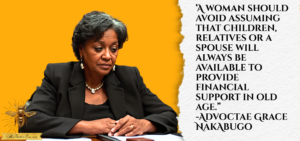
Planning for your future is not selfish. It is responsible.
8. Protect Yourself From Abuse and Exploitation
Age does not make a woman immune from domestic, financial or other forms of abuse.

A woman should understand that abuse is not limited to physical violence. Economic control, threats, coercion and other forms of harmful conduct may have legal consequences.
Where a woman feels unsafe or believes her rights are being violated, she should seek appropriate legal and professional assistance rather than suffering silently.
9. Keep Your Important Documents Safe
Every mature woman should know where her important documents are and maintain secure copies where appropriate.
These may include:
●Identification documents;
●Property documents;
●Marriage-related documents;
●Business registration documents;
●Bank and investment records;
●Insurance documents;
●Pension information;
●Important contracts;
●Wills and estate-planning documents.
Trusted family members should know how to locate essential documents in an emergency, while sensitive information should remain appropriately protected.
10. Do Not Be Afraid to Ask a Lawyer
One of the greatest legal mistakes a person can make is seeking legal advice only after a problem has become a dispute.
Lawyers can also help prevent disputes.
A mature woman should consider obtaining legal advice before buying significant property, entering a business partnership, signing major agreements, providing a guarantee, restructuring a business, dealing with matrimonial property or making important succession arrangements.
The cost of preventive legal advice may be considerably less than the financial and emotional cost of litigation.
Conclusion: Protect Yourself While Building Your Legacy
The mature woman has already travelled a significant distance in life.She has acquired experience, relationships, responsibilities and, in many cases, considerable assets.
Know what you own. Understand your rights. Document important transactions. Protect your business. Plan your estate. Prepare for retirement. Seek advice before signing significant documents. And do not be embarrassed to ask questions about the law.
Most importantly, remember that legal preparedness is not an expression of mistrust or fear. It is an expression of wisdom.
A woman who spends her life protecting and building others should also remember to protect herself.
At 40 and beyond, the question is no longer only, “What am I building?” It is also:
“How am I protecting what I have built, and what legacy am I leaving
behind?”
Contact information: