

GOLDEN ERA ICONS
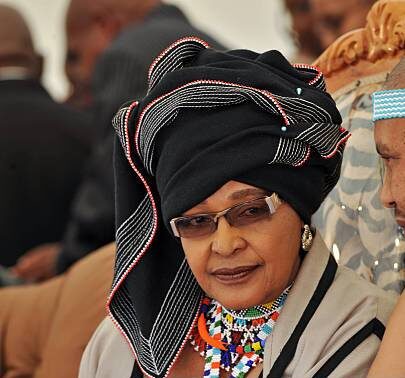
Winnie Madikizela-Mandela: The Golden Mother of Free South Africa
There is a particular kind of courage required of a woman whose life is permanently altered by the choices of the man she loves.
Winnie Madikizela-Mandela did not begin her adult life imagining that she would become one of the most controversial and consequential women in modern African history. Before the photographs, the headlines, the prison cells and the political speeches, she was Nomzamo Winifred Zanyiwe Madikizela—a young Black South African woman who had trained as a social worker and wanted, like so many young women, to build a life.
She was born in 1936 in Bizana in what was then Transkei, to teachers Columbus and Gertrude Madikizela. Her mother died when Winnie was only nine. She eventually moved to Johannesburg, where she became the first qualified Black medical social worker at Baragwanath Hospital. Her work brought her into direct contact with the devastating social consequences of apartheid, including infant mortality and the poverty imposed upon Black communities.
It was there, in the world of ordinary people struggling under an extraordinary system, that her political consciousness deepened.
Then she met Nelson Mandela.
They married on 14 June 1958. Winnie was 21. Mandela was already a prominent political activist and lawyer, and their marriage was never going to be an entirely ordinary one. Yet they were still a young couple. They had two daughters, Zenani and Zindziswa, and, for a time, there was a family to build.
But apartheid had already begun making decisions about their lives.
Mandela was increasingly targeted by the state. In 1961 he went underground. In August 1962 he was arrested. In November that year he was sentenced to five years in prison. After the Rivonia Trial, he and seven other defendants were sentenced to life imprisonment in June 1964.
He would spend more than 27 years behind bars.
Winnie would spend those decades outside them—but that distinction can be deeply misleading.
The prison was not only Robben Island
When history tells the story of Nelson Mandela’s imprisonment, we rightly remember Robben Island.
But Winnie Madikizela-Mandela discovered that apartheid had another kind of prison for women.
It was called banning.
It was house arrest.
It was surveillance.
It was interrogation.
It was detention without trial.
It was separation from children.
It was the constant knowledge that the police could arrive at any moment.
From 1962 onward, Winnie was subjected to a succession of banning orders that restricted where she could go, whom she could meet and what she could do. In 1969 she was detained under the Terrorism Act and spent 17 months in solitary confinement. She later documented that experience in 491 Days: Prisoner Number 1323/69. In 1970 she was placed under house arrest.
The woman who had once worked as a social worker caring for vulnerable people was now being treated by the state as a political threat.
And she was raising two daughters.
This is the part of Winnie’s story that can disappear beneath the enormous shadow of her husband’s name.
Nelson Mandela became the world’s most famous political prisoner.
Winnie became the woman who had to live with the consequences.
Nelson was imprisoned, but Winnie had to keep going.
She had children to raise. She had to endure police harassment. She had to maintain relationships with a husband she could only see under prison restrictions. She became an important link between Mandela and the outside world and increasingly became a public symbol of resistance herself.
Nelson Mandela himself later acknowledged this.
In a statement concerning their relationship, he wrote that Winnie had been an indispensable pillar of support during his imprisonment and had become an international focus of the campaign for South African political prisoners. He also acknowledged that the government repeatedly harassed, persecuted, arrested, detained and charged her.
That is an extraordinary thing to remember.
The wife of the world’s most famous political prisoner was herself being persecuted because of her connection to him—and because she had become a political actor in her own right.
She refused to disappear
In 1977, Winnie was banished to Brandfort in the Free State.
Banishment was not simply being told to move house. It was an instrument of apartheid designed to isolate political opponents from their communities and networks.
Yet Winnie continued to organise.
Following the 1976 Soweto uprising, she helped establish the Black Women’s Federation and the Black Parents’ Association. Her activism increasingly connected the political struggle against apartheid with the everyday struggles of Black families, women and children.
This matters because Winnie was not merely waiting for Nelson Mandela to come home.
She was becoming a political figure herself.
By the 1980s, her public profile had become enormous. She represented resistance to many South Africans who were tired of waiting for apartheid to voluntarily dismantle itself.
And this is where her story becomes difficult.
Because Winnie Madikizela-Mandela was not a saint.
She made mistakes.
She became associated with rhetoric and actions that were deeply controversial. The 1989 kidnapping and assault of Stompie Seipei became one of the darkest episodes associated with her public life, and the Truth and Reconciliation Commission later heard testimony concerning the violence surrounding the Mandela United Football Club. Winnie was subsequently convicted of kidnapping and sentenced to prison, although the sentence was reduced on appeal.- She has since been found innocent of these charges.
Her political career and personal reputation were further damaged by controversy.
What happens when a woman is expected to survive the impossible?
This is the question Winnie Madikizela-Mandela forces us to ask.
What happens to a woman who spends decades being watched, followed, detained, threatened and isolated?
What happens to a mother whose husband is absent for most of her children’s childhood?
What happens to someone who is repeatedly told that she is dangerous because she refuses to become invisible?
And what happens when the world eventually expects that same woman to emerge from all of this perfectly composed, perfectly forgiving and perfectly respectable?
The Nelson Mandela Foundation has itself acknowledged the psychological and physical toll of Winnie’s imprisonment and persecution. It noted that, unlike Nelson Mandela, she was subjected to torture while imprisoned and carried the damage of that experience for the rest of her life.
That does not excuse wrongdoing.
But understanding is not the same thing as excusing.
And perhaps that distinction is particularly important when we tell the stories of women.
Men who participate in liberation movements are often remembered as complicated political actors—strategists, revolutionaries, negotiators, fathers, husbands, heroes and flawed human beings.
Women are too often required to be something else.
Perfect mothers.
Perfect wives.
Perfect victims.
Perfect revolutionaries.
Winnie was none of these things perfectly.
She was human.
The woman standing beside Nelson Mandela
On 11 February 1990, Nelson Mandela walked out of Victor Verster Prison after more than 27 years of incarceration.
And there she was.
Winnie.
Standing beside him.
Her fist raised.
The photograph became one of the defining images of the twentieth century.
But look at that photograph differently.
Do not see only the wife greeting her famous husband.
See the woman who had spent nearly three decades carrying the burden of his absence.
See the mother who had raised their daughters through a system determined to destroy their family.
See the woman who had herself been imprisoned.
See the woman who had been banned, watched, isolated and vilified.
See the woman who had become an international symbol while the man she loved was behind bars.
And understand that when Mandela emerged from prison, he was returning to a country that had changed—and to a wife who had changed too.
Their marriage could not simply return to 1958.
Too much had happened.
Within two years they were separated. Their divorce became official in 1996.
The end of their marriage does not diminish what they once meant to each other. Nor does it diminish Winnie’s contribution to the liberation struggle.
Indeed, perhaps it tells us something important about the cost of political freedom.
Countries celebrate liberation.
Families often pay the bill.
Beyond the mythology
Winnie Madikizela-Mandela remained politically active after apartheid. She served as president of the ANC Women’s League, became a Member of Parliament and briefly served as Deputy Minister of Arts, Culture, Science and Technology after the democratic transition.
But her legacy remained contested.
Some regarded her as the mother of the nation.
Others regarded her as a symbol of the excesses and violence that accompanied the struggle.
Both perceptions exist.
The responsibility of history is not to choose the most comfortable one.
It is to hold the whole woman. That means remembering the social worker. The young mother. The political prisoner. The banned woman. The organiser. The mother separated from her children. The wife separated from her husband. The woman who became a symbol of resistance. The woman who made mistakes. The woman who was condemned.
The woman who survived.
And the woman who continued to demand that South Africa confront the inequalities left behind by apartheid.
Why Winnie belongs in the Golden Era
Winnie Madikizela-Mandela died on 2 April 2018 at the age of 81.
By then, South Africa was a democracy.
Nelson Mandela had become its first democratically elected president.
The African National Congress had moved from a banned liberation movement to the governing party.
Apartheid had been dismantled.
Black South Africans could vote.
And the country had become one of the world’s most powerful symbols of the possibility of democratic transformation.
South Africa’s democracy was built by millions of people men and women, workers, students, activists, political prisoners, religious leaders, trade unionists, journalists, families and communities who resisted apartheid in countless ways.
But Winnie Madikizela-Mandela was undeniably one of the women who carried that struggle when carrying it was dangerous.
Her contribution cannot be reduced to being Nelson Mandela’s wife.
She became part of the struggle herself.
And perhaps that is why she belongs in a magazine celebrating women in their Golden Era.
Because the Golden Era is not about pretending that a woman’s life was flawless.
It is about recognizing what she survived.
It is about understanding that strength can coexist with contradiction.
It is about giving mature women permission to own the entirety of their stories—the beautiful parts, the painful parts, the mistakes, the victories and the chapters that other people would rather forget.
Winnie Madikizela-Mandela lived through a political system designed to make Black South Africans powerless.
It tried to silence her.
It imprisoned her.
It separated her from her husband.
It interfered with her ability to work.
It disrupted her family.
It watched her.
It frightened her.
It vilified her.
And still, she remained standing.
That is not perfection.
That is resilience.
And resilience is worthy of remembrance.
Winnie Madikizela-Mandela is a Golden Era Icon not because she was without flaws, but because history demanded an extraordinary amount from her—and she refused to disappear.
That is the legacy worth remembering.