



Generational wealth begins with a simple shift in thinking: stop asking only how much money you can make and start asking what you can own that will still have value tomorrow.
For a woman over 45, this can be one of the most important financial transitions of her life.
Income pays today’s bills; assets can continue working after the paycheque stops.
Assets may include land and property, a business, shares and other investments, retirement accounts, intellectual property, royalties, cash reserves and other income-producing holdings available in your country.
The objective is not to accumulate possessions for their own sake, but to repeatedly convert a portion of your income into things that can appreciate, produce income or provide financial security.
Research from the Federal Reserve shows that household wealth is held across both financial assets—such as stocks, bonds and retirement accounts—and non-financial assets such as homes, businesses and other real estate. (stlouisfed.org)
Every time you reinvest profits into an asset instead of consuming all of the money, you are potentially moving your family one step further from living entirely on earned income and one step closer to owning wealth.
Generational wealth is also about what you teach, not only what you leave behind.
A woman can leave her daughter a house and still leave her financially unprepared if she never teaches her how the property is titled, how taxes and insurance work, how to maintain it, how to recognize a fraudulent transaction, or how to generate income from an asset.
The same applies to a family business, investment account or piece of land.
A family trust can allow a woman to place selected assets under professional or trusted trustee management for the benefit of children and future generations, with the trust deed determining how those assets and their income may be used.
The settlor creates the trust, trustees legally administer the trust property, and beneficiaries receive benefits according to the trust terms. (GOV.UK)
The important distinction is that a trust does not magically create wealth; its power is in helping you preserve, control, manage and transfer wealth while potentially preventing a valuable asset from being fragmented or immediately consumed by the next generation.
Depending on the jurisdiction and trust structure, a family trust might hold investment portfolios, rental property, shares in a family company, intellectual property or other assets.
Tax treatment varies enormously, so the trust should be designed with a qualified lawyer and tax professional in the jurisdiction concerned. (GOV.UK)
How to establish and fund a family trust
1. Define the purpose.
Decide what you want the trust to accomplish: preserve property, hold investments, fund children’s education, own shares in a family business, provide income for family members, protect assets, or create a multigenerational investment pool.
2. Choose the type of trust.
There are several structures; including discretionary, fixed/interest-in-possession, revocable and irrevocable trusts and the appropriate choice depends heavily on your country’s law, tax system and objectives. Don’t choose one from an internet template simply because it sounds protective.
3. Identify the people involved.
You are generally the settlor/grantor—the person establishing and contributing property. You appoint trustees, who administer the assets according to the trust deed. You identify the beneficiaries, such as your children, grandchildren or a defined family group. (GOV.UK)
4. Have a proper trust deed prepared.
This is the document that establishes the rules. It should specify the beneficiaries, trustee powers and responsibilities, how investments may be made, when distributions can occur, what happens if a trustee dies or becomes incapable, how trustees can be replaced, and what happens to the trust when circumstances change.
5. Choose trustees extremely carefully.
This is one of the most important decisions. Trustees control and administer the trust property and have fiduciary responsibilities. (IRS) Consider whether you need an independent professional trustee, a bank/trust company, family members, or a combination. Don’t automatically put one relative in control of everything.
6. Establish the trust legally.
Sign the trust deed according to local requirements, obtain any required registration, tax identification or regulatory approvals, and establish the trust’s bank or investment accounts. The formalities differ substantially between jurisdictions.
7. Fund it—this is the part people often misunderstand.
A trust is not a wealth strategy until assets actually enter it. You might initially contribute cash, then transfer investments, shares in a company, rental property, land, intellectual property or other appropriate assets. In some cases, assets can be purchased directly by the trust. Every transfer must be checked for stamp duty, capital-gains tax, transfer taxes, land-registration requirements, creditor issues and other consequences. For example, tax authorities in different jurisdictions can treat transfers into trusts as taxable events. (GOV.UK)
8. Build the assets inside the trust.
This is where your wealth-creation philosophy comes in. Instead of distributing every dollar of income to family members, the trust might—where legally permitted—retain some income and reinvest it into productive assets: additional property, diversified investments, shares in businesses or other income-producing assets. Some trust structures specifically permit income to be accumulated and added to trust capital. (GOV.UK)
9. Create rules for distributions.
You might establish that children can receive money for education, healthcare, housing, starting a business or other defined purposes, while larger amounts of capital remain invested until a specified age or milestone. This can help prevent a family fortune from being immediately divided among heirs.
10. Create a succession plan for the trust itself.
Name successor trustees and establish what happens when you die or become incapacitated. Review the trust periodically as children marry, divorce, have children, establish businesses or move to different countries.
11. Keep impeccable records and comply with tax law.
Trustees generally have continuing administrative, accounting and tax responsibilities. (GOV.UK) A trust should never be treated as a secret bank account or a way to hide assets or income. The IRS, for example, explicitly warns against abusive trust arrangements marketed as tax-avoidance schemes. (IRS)
12. Think of the trust as a family wealth machine—not a family bank account.
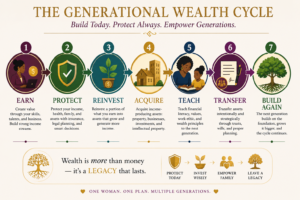
The strongest concept for Her Golden Era is: earn → protect → acquire assets → place appropriate assets into a structure → reinvest → generate income → educate the next generation → transfer control responsibly → repeat. The trust is the legal container; the assets and the reinvestment strategy are what create the wealth.
Kenya, for example, expressly recognizes family trusts in its trust legislation, including provisions allowing the settlor to also be a beneficiary. (Kenya Law) South Africa also has established trust structures and specific tax rules governing them. (South African Revenue Service) That makes this a particularly relevant subject for your African readership—but I’d put a prominent note in the article that the trust structure, tax treatment and asset-transfer rules must be checked in the country where the trust, settlor, beneficiaries and assets are located.
Teach the next generation how to budget, save, invest, negotiate, read contracts, understand interest and debt, protect property and distinguish an asset from a liability.
Where possible, involve children in age-appropriate conversations about money and ownership rather than making finances a forbidden subject.
The Federal Reserve has found that intergenerational wealth transmission occurs not only through inheritances and gifts but through investments in children’s education and opportunities that increase their ability to accumulate wealth themselves.
(Federal Reserve) The greatest inheritance may therefore be a combination of an asset and the knowledge required to keep it.
Finally, generational wealth requires a plan for keeping what you built when you are no longer here to manage it.
Know exactly what you own, whose name is on each asset, where the documents are located, what debts are attached to it and who is legally entitled to receive it.
Create or update your will and investigate trusts, beneficiary designations, succession arrangements, powers of attorney and other estate-planning tools available in your jurisdiction. If you own a company, establish what happens to your shares and business interests if you die or become unable to work.
Do not assume that your family will automatically inherit everything exactly as you intended; inheritance and property laws vary enormously between countries, and women still face legal barriers to owning and administering assets in parts of the world. (World Bank Blogs) The goal is to create a family cycle: earn → protect → reinvest → acquire assets → increase their value or income → teach the next generation → legally transfer the assets → and have the next generation continue building rather than starting from zero. That is how a woman’s financial success can become a family foundation rather than simply a comfortable retirement.