

THE GOLDEN ERA BODY AFTER 45
Why Does Your Body Change So Dramatically After 45—and What Can You Actually Do About It?
There is a particular kind of mourning that nobody talks about.
It happens somewhere around the dressing-room mirror.
You put on the jeans that fit perfectly three years ago. You pull them over your hips. You get them halfway up your thighs. You negotiate with the zipper. You inhale.
Nothing.
You try another pair.
Then another.
Eventually you are standing in your underwear under unforgiving fluorescent lighting, wondering when your body became a country you no longer recognize.
Perhaps your waist has disappeared.
Your breasts have changed.
Your arms feel softer.
Your stomach, which once seemed to understand the basic rules of geometry, has developed its own opinions.
And somehow the internet has decided this is an emergency.
Lose belly fat after 40.
Burn menopause weight fast.
Get your old body back.
Flatten your stomach in 14 days.
The message is relentless.
Your body has changed.
Therefore, something has gone wrong.
But what if that is the wrong story?
What if your body isn’t failing you?
What if it is changing because you are changing?
And what if the real assignment of midlife isn’t getting your twenty-eight-year-old body back—but learning how to inhabit the woman you have become?
The Great Midlife Body Shift
Menopause is not a single afternoon when the ovaries close their office and send everyone home.
It is a transition.
For many women, the years surrounding menopause bring changes in estrogen and other reproductive hormones, sleep, appetite, activity levels, body composition and where fat is stored.
And aging itself matters.
This distinction is important because women have been blaming every additional pound on menopause when researchers increasingly recognize that age, rather than menopause alone, is a major driver of midlife weight gain. A 2024 review found that weight gain occurs across cultural and ethnic groups and that exercise is associated with lower obesity risk in midlife women. (PubMed)
But menopause can change the shape of the problem.
Women can lose lean tissue—particularly muscle—while gaining fat. Research describes increased central and abdominal adiposity alongside reductions in lean body mass during the menopausal transition. (PubMed Central (PMC))
This is one reason the scale can become such a misleading little tyrant.
You can weigh roughly the same and look completely different.
You can lose muscle and gain fat.
Your clothes notice.
Your waist notices.
Your metabolic health notices.
The bathroom scale, meanwhile, is sitting there with the emotional intelligence of a parking meter.
And Then There Is the Belly
Ah, yes.
The belly.
The great midlife plot twist.
Many women notice that fat seems to migrate toward the middle of the body. This isn’t imaginary. Hormonal changes, aging and changes in body composition can contribute to a redistribution toward abdominal fat. (PubMed Central (PMC))
For Black women, the conversation requires additional nuance.
Research following Black and White women through the menopause transition found important differences in body composition and fat distribution. In that particular cohort, Black women entered menopause with more abdominal adipose tissue but did not experience the same increase in abdominal fat seen among the White women studied during the transition. (PubMed)
That finding is fascinating because it reminds us that there is no universal menopause body.
Race, genetics, culture, diet, socioeconomic conditions, physical activity, sleep and environment all intersect.
So when somebody tells you that every woman over 45 should have the same waist measurement, the same diet and the same workout plan, you are allowed to raise one perfectly manicured eyebrow.
Bodies are not standardized furniture.
The Grief Nobody Prepared Us For
Here is the part that deserves more attention.
A woman may know perfectly well that aging is natural and still feel sad about it.
She may love her life and miss her old body.
She may be grateful for her children and still miss the body she had before pregnancy.
She may celebrate being 50 and still stare at an old photograph and think:
Look at me.
There is no contradiction.
Women are allowed to mourn.
The problem begins when mourning becomes self-hatred.
Because there is a very lucrative industry waiting to monetize that sadness.
Creams.
Powders.
Detoxes.
Tea.
Waist trainers.
Fat burners.
Supplements with labels that require a chemistry degree.
And endless photographs of women who appear to have discovered a magical corner of the internet where cellulite was outlawed.
Please.
The goal cannot be to spend the second half of our lives fighting evidence that we have lived.
What We Can Actually Change
Now for the good news.
There is plenty we can do.
And some of it is surprisingly enjoyable.
The first change is philosophical:
Stop making weight the only measure of success.
Your cardiovascular health matters.
Your blood pressure matters.
Your blood sugar matters.
Your muscle strength matters.
Your bones matter.
Your sleep matters.
Your energy matters.
Your ability to climb stairs without negotiating with the universe matters.
Your ability to carry your own suitcase matters.
Your ability to get up from the floor matters.
Your mood matters.
Your joy matters.
A smaller dress size is not a substitute for any of these.
Meet Your New Best Friend: Muscle
If there is one thing I would like every woman approaching 45 to know, it is this:
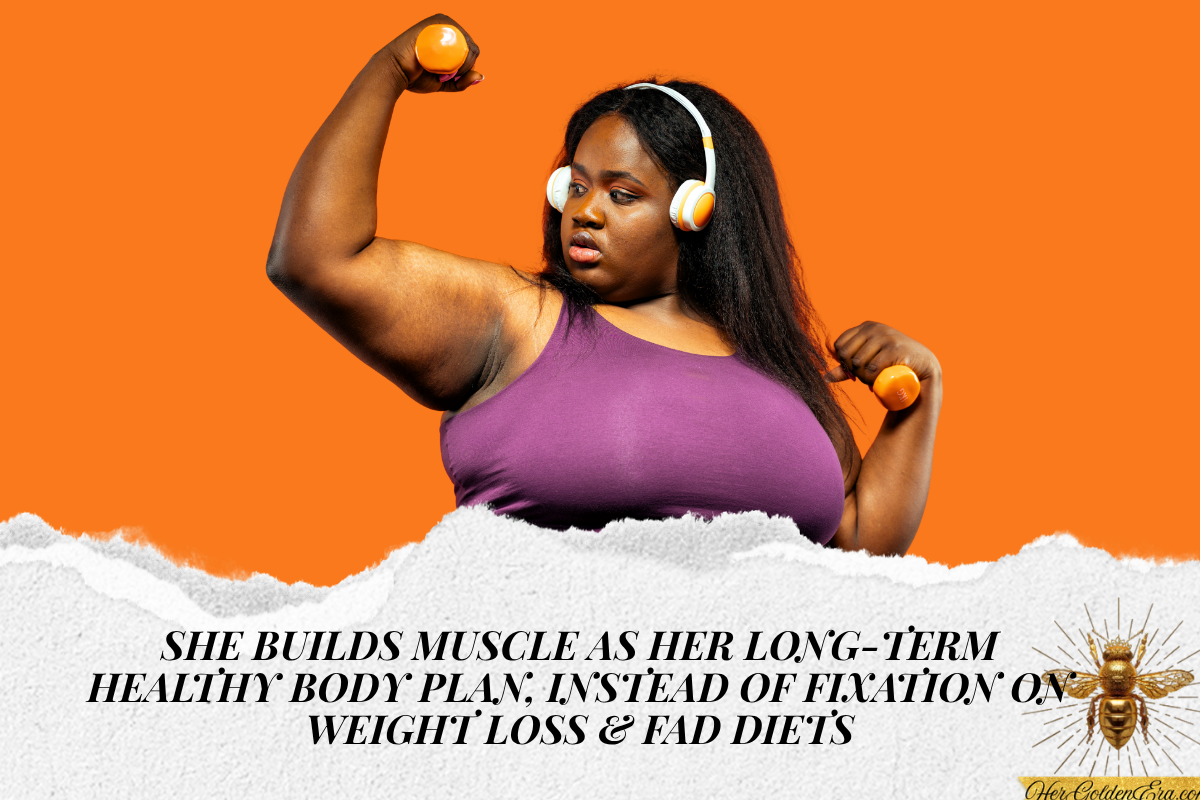
Build muscle.
Not because you need to become a bodybuilder.
Because muscle is one of the most valuable forms of biological currency you possess as you age.
Resistance training improves strength, physical function and body composition in postmenopausal women. A 2026 meta-analysis of 126 studies involving more than 4,000 women found significant improvements in muscular strength and reductions in fat mass associated with resistance training across the female lifespan. (PubMed)
Another systematic review found that resistance training can increase muscle hypertrophy in postmenopausal and older women. (PubMed)
And this does not require a frightening room full of enormous men dropping barbells.
Start with dumbbells.
Resistance bands.
Squats.
Lunges.
Push-ups against a wall.
A properly supervised strength program.
Carry groceries.
Garden.
Dance.
Climb stairs.
Your body doesn’t care whether your workout was aesthetically pleasing.
It cares whether you challenged it.
Walking Is Not “Just Walking”
We have somehow made walking sound boring.
Walking is wonderful.
Walk after dinner.
Walk while talking to your sister.
Walk through the market.
Walk around the neighborhood.
Walk somewhere beautiful.
Walk with music.
Walk without your phone.
Walk for thirty minutes and call it a meeting with yourself.
Current cardiometabolic guidance recommends at least 150 minutes of aerobic activity per week, alongside resistance training two to three times weekly for midlife women, with higher activity levels sometimes appropriate for those pursuing greater weight reduction. (PubMed Central (PMC))
And exercise isn’t only about calories.
A large systematic review of 101 studies involving nearly 5,700 postmenopausal women found that exercise improved muscle mass and reduced fat mass, body-fat percentage, waist circumference and visceral fat. (PubMed)
That is a much more interesting outcome than simply watching a number fall.
Eat Like You Are Building a Woman, Not Punishing One
Midlife is not the moment to survive on coffee and half a grapefruit because an influencer promised you a waistline.
Your body needs nourishment.
Protein becomes particularly interesting because menopause and aging are associated with changes in muscle metabolism and lean tissue. Research suggests that increasing dietary protein may help address some of the mechanisms associated with lean-tissue loss, although individual needs vary. (PubMed Central (PMC))
Think about meals differently.
Eggs.
Fish.
Beans.
Lentils.
Greek yogurt.
Chicken.
Lean meats.
Tofu.
Nuts and seeds.
Vegetables.
Fruit.
Whole grains.
Healthy fats.
And enough protein distributed throughout the day to support muscle maintenance.
You don’t have to become obsessed with counting every gram.
You simply need to stop treating protein as something reserved for bodybuilders.
And About That Glass of Wine…
This is where midlife becomes deeply unfair.
The things we used to get away with begin sending invoices.
Alcohol can add calories, disrupt sleep and interact with menopause symptoms. And poor sleep is not merely an inconvenience.
It can become part of the weight equation.
Research from the SWAN cohort found that sleep problems explained a meaningful portion of the relationship between frequent vasomotor symptoms and subsequent weight gain. (PubMed Central (PMC))
So if menopause has turned you into a woman who wakes at 2:17 a.m. and suddenly remembers something embarrassing you said in 1998, you’re not imagining how exhausting this can be.
Treat sleep as health.
Cool the bedroom.
Manage hot flashes.
Exercise.
Limit late alcohol if it disrupts you.
Address sleep apnea if you have symptoms.
And if night sweats are severe, speak with a clinician.
Hormone therapy is not a weight-loss treatment, but ACOG notes that it may improve sleep when night sweats are disrupting it, and better sleep can support weight control. (ACOG)
What About Hormone Therapy?
This is where women deserve information rather than internet warfare.
Menopausal hormone therapy is not a diet pill.
It does not magically remove belly fat.
ACOG explicitly states that hormone therapy itself does not produce weight loss, although estrogen therapy may influence where fat is stored and improving sleep through symptom control may indirectly help. (ACOG)
A 2026 clinical review similarly found that most hormone-therapy regimens do not appear to cause additional weight gain compared with nonusers, but hormone therapy should not be prescribed simply as a weight-management strategy. (PubMed Central (PMC))
Whether hormone therapy is appropriate depends on the individual woman, her symptoms, medical history and risk profile.
That is a conversation for you and your clinician, not TikTok.
And Then There Is Sea Moss
Now let us talk about one of Africa and the Caribbean’s most interesting ingredients without turning it into another miracle-food fairy tale.
Seaweed is nutritionally interesting.
Species such as Eucheuma spinosum contain minerals and other compounds, and seaweed can be incorporated into a varied diet.
But there is currently not sufficient clinical evidence to claim that sea moss causes menopause weight loss, balances estrogen or treats diabetes or inflammation.
And that distinction matters.
At Her Golden Era, we should be able to love traditional ingredients without pretending that tradition is the same thing as a randomized clinical trial.
There is another reason to pay attention to quality.
Sea-moss products can vary considerably in composition and processing. In January 2026, the FDA published a recall notice involving a commercially sold sea-moss gel because of food-safety and regulatory concerns. (U.S. Food and Drug Administration)
So if a woman chooses to include sea moss in her diet, know what you’re buying.
Look for a clearly identified species.
Know its origin.
Choose reputable processors.
Look for appropriate food-safety controls and testing.
Avoid mysterious blends containing a dozen undisclosed “detox” ingredients.
And be particularly cautious about products making extravagant claims.
For a clean seaweed product, I would personally rather see a simple ingredient label that says what the seaweed actually is than a glamorous capsule containing a proprietary mixture nobody can explain.
The ocean doesn’t need marketing magic.
Supplements Are Supporting Actors
There is an entire supplement industry waiting outside the menopause door.
Some products may be useful when a woman has a genuine deficiency or a specific medical need.
Vitamin D may be appropriate for some women.
Calcium matters for bone health.
Protein supplementation can be useful when dietary protein is difficult to achieve.
Creatine is increasingly being studied in aging and women’s muscle health.
But supplements are not interchangeable with food, resistance training, sleep or medical care.
A 2026 systematic review of nutritional strategies combined with strength training in postmenopausal women found consistent benefits from strength training itself, while evidence for additional supplements remained much less certain. (PubMed)
That is an important finding.
The boring stuff works.
And perhaps that is why the internet keeps trying to make it boring.
The Most Radical Exercise Might Be Acceptance
There is a woman who needs to lose weight.
There is another woman who needs to gain muscle.
There is another who needs to improve her blood pressure.
There is another who needs to sleep.
There is another who is perfectly healthy at her current size and simply needs somebody to stop commenting on her body.
These women may all be the same age.
They may wear the same dress size.
And they may have completely different needs.
This is why the obsession with one ideal menopausal body is so absurd.
Perhaps your stomach is softer.
Perhaps your thighs are wider.
Perhaps your breasts are lower.
Perhaps your face has lines now.
Perhaps your hair is gray.
Perhaps your body looks more like a woman who has given birth, worked, traveled, laughed, cried, survived and lived.
Good.
There is no shame in that body.
Buy Clothes for the Woman You Are
This sounds trivial.
It isn’t.
Stop keeping a closet full of clothes that fit your former body as a form of psychological punishment.
Buy clothes that fit.
Have them altered.
Find the silhouette that makes you feel magnificent.
Wear color.
Wear gold.
Wear linen.
Wear the kaftan.
Wear the jeans.
Wear the dress with the ridiculous sleeves if the ridiculous sleeves make you happy.
The body does not need to shrink before it deserves beautiful clothing.
The clothing needs to meet the woman.
And Please, Have Some Fun
Dance.
Swim.
Garden.
Take Pilates.
Lift weights.
Go hiking.
Play tennis badly.
Ride a bicycle.
Try paddleboarding.
Take a salsa class.
Walk along the beach.
Put music on while you cook.
Have dinner with women who make you laugh.
Go somewhere beautiful.
Travel.
Fall in love with food that makes you feel alive.
There is something psychologically important about replacing the language of punishment with the language of pleasure.
Instead of:
I have to exercise because I’m fat.
Try:
I move because I like being strong.
Instead of:
I can’t eat that.
Try:
I want food that makes me feel good.
Instead of:
I need my old body back.
Try:
I want to make this body the healthiest version of itself.
That is not surrender.
That is maturity.
Your Body Is Not a Before Picture
Perhaps this is the real revolution.
We have spent decades being taught that every photograph of our younger selves is evidence of something we have lost.
I don’t think it is.
That woman is not your competition.
She is your predecessor.
She carried you here.
She had her own beauty.
Her own foolishness.
Her own ambitions.
Her own heartbreaks.
Her own tiny victories.
And she did not know what was coming.
You do.
You have information she didn’t have.
You know what matters.
You know what doesn’t.
You know which people deserve your energy.
You know that life can change overnight.
You know that health is precious.
You know that beauty is temporary—and that joy doesn’t have to be.
So perhaps the goal of menopause isn’t to become the girl you were.
Perhaps it is to become the woman you were too busy surviving to become.
The Golden Era Body Beautiful
There will be days when you love your body.
There will be days when you don’t.
There will be mornings when you put on an outfit and think, Oh, she looks GOOD.
There will be afternoons when you catch your reflection unexpectedly and wonder who moved the mirror.
Both can be true.
You can work toward a healthier waist without hating your stomach.
You can build muscle without declaring war on fat.
You can change your diet without becoming afraid of food.
You can use medicine when medicine is appropriate.
You can enjoy traditional foods and ingredients while still demanding scientific evidence.
You can lose weight if that is medically appropriate for you.
And you can decide that your happiness is not conditional upon losing it.
Because the woman entering her Golden Era has something her younger self did not.
Perspective.
She knows that bodies change. Children grow. Parents age. Careers end and begin again. Marriages come and go. Hair changes color. Faces gather evidence. And somehow, through all of it, she remains.
That is the part we should celebrate.
Not the disappearing waist. Not the number on the scale. Not whether somebody thinks you look younger.
You.
The woman who made it here. The woman who is still curious. Still laughing. Still dressing up. Still learning.
Still dancing. Still building. Still becoming.
And if your body at 52 doesn’t look like your body at 25-Of course it doesn’t.
Neither does your life. Thank God for that.
Because perhaps the greatest gift of the Golden Era is finally understanding that the purpose of growing older was never to remain young.
It was to become fully, gloriously yourself.