

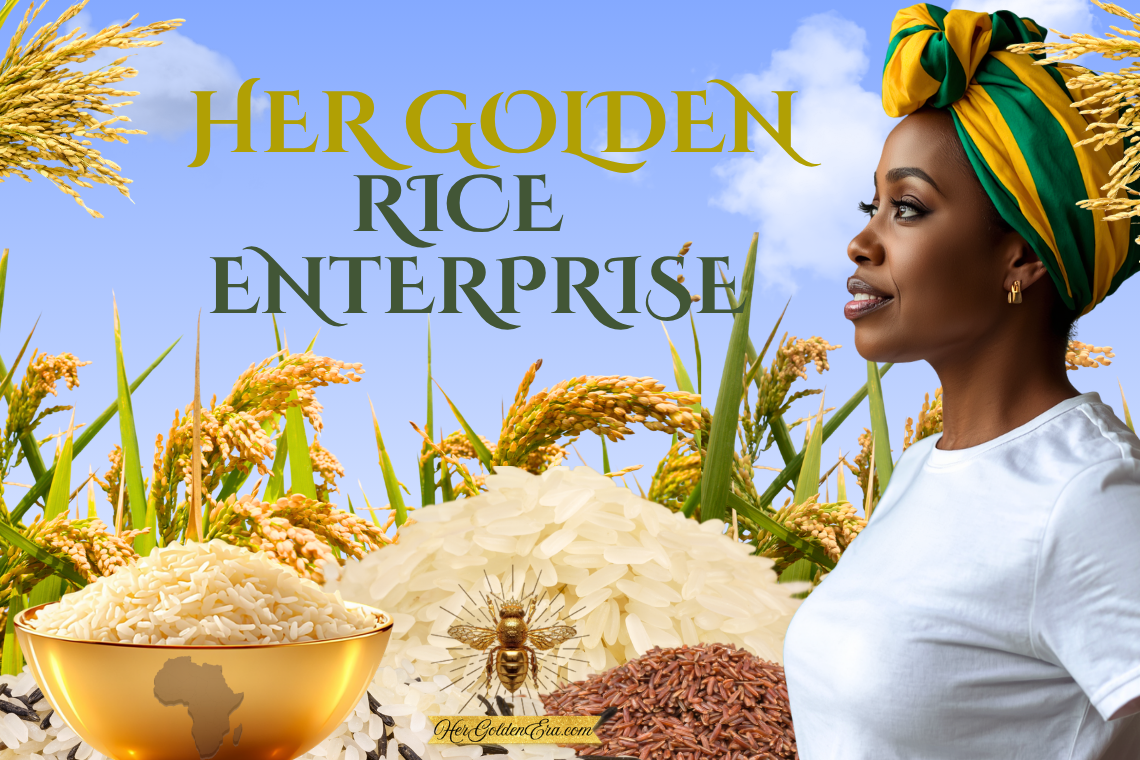
HER GOLDEN RICE ENTERPRISE
From African Paddy Fields to Regional and Global Markets
Rice is no longer simply a staple crop. It is a large global food business, and Africa has an opportunity to capture more of the value between the farmer and the final consumer.
The global rice market was valued at approximately US$316.6 billion in 2025, according to IMARC, while another 2026 market estimate places the market at US$350.1 billion. The precise figure varies by methodology, but the scale is unmistakable: rice is one of the world’s largest food commodities, with Asia accounting for the overwhelming share of global consumption. (IMARC Group)
THE AFRICAN OPPORTUNITY
Africa already grows rice across multiple production zones, including Tanzania, Senegal, Mali, Nigeria, Côte d’Ivoire, Guinea, Ghana, Benin, Burkina Faso, Madagascar, Uganda, Rwanda, Egypt and Mozambique. The opportunity is not simply to grow more rice. It is to process, grade, package and move African rice more efficiently.
Tanzania provides a particularly interesting example. In 2024, Tanzania exported approximately 396.9 million kilograms of rice worth US$200.8 million. Uganda, Kenya and Rwanda were its largest markets, demonstrating that African rice can already move successfully across borders. Tanzania also exported rice to Singapore, Sierra Leone, Djibouti, Togo, Côte d’Ivoire, Senegal, Comoros, the United States and other markets. (World Integrated Trade Solution)
Senegal demonstrates another model. Its rice trade is strongly connected to neighbouring West African markets. In 2024, Senegal supplied approximately 69.5 million kilograms of rice worth US$34.6 million to Mali alone, illustrating how a processing business can be built around regional rather than purely domestic demand. (World Integrated Trade Solution)
Selected African rice exporters — 2024
| Country | Rice exports, 2024 |
|---|---|
| Tanzania | US$200.8M / 396.9M kg |
| Senegal | US$40.2M / 82.8M kg |
| Benin | US$9.5M / 28.9M kg |
| Côte d’Ivoire | US$4.4M / 9.2M kg |
| Kenya | US$3.7M / 6.8M kg |
| Gambia | US$3.3M / 20,693 kg |
| Madagascar | US$1.8M / 2,702 kg |
These figures refer to recorded exports of rice under HS 1006 and show that African countries are already participating in the international rice trade, although at very different scales. (World Integrated Trade Solution)
THE PROCESSING OPPORTUNITY
The interesting business is often between the farm and the supermarket.
A small processor can buy or receive paddy from farmers, clean it, remove the husk, mill and grade the grain, package it under a local brand and sell it to wholesalers, supermarkets, hotels, restaurants and regional distributors.
There is also a lower-impact model that requires less working capital: toll milling.
Instead of purchasing all the paddy, the processor provides the machinery and processing service while farmers, cooperatives or traders retain ownership of the rice. The business earns processing and packaging fees and can gradually introduce its own branded rice.
This model is particularly attractive for a woman entering the sector because she does not necessarily need to begin as a large commodity trader.
Modern small mills are available in the 500–600 kg/hour range, while African agricultural technology programmes have promoted mobile threshing and polishing equipment that can operate with generators or solar power. (Alibaba)
The environmental footprint can also be kept relatively low by locating the mill close to production, reducing unnecessary transport of unprocessed paddy, using efficient electric equipment where reliable power exists, and finding productive uses for rice husk and bran rather than treating them as waste.
THE HIDDEN VALUE IS IN THE BY-PRODUCTS
Rice processing does not end with the white grain.
Rice bran can enter animal-feed and other processing markets. Rice husk can be used as a biomass fuel or in other agricultural and industrial applications. Broken rice can be sold into markets where whole grains are not required.
That means a well-designed small processor can generate several revenue streams from the same crop rather than depending entirely on premium whole-grain rice.
TANZANIA → ZANZIBAR → COMOROS
The regional island opportunity is particularly interesting along the Indian Ocean.
Tanzania already exports rice to neighbouring countries at substantial scale, but its 2024 exports to Comoros were only about 40,335 kg, worth US$34,610. At the same time, Comoros imported approximately 44 million kg from Pakistan and 7.4 million kg from India in 2024. (World Integrated Trade Solution)
That does not prove that a Tanzanian processor can simply replace those imports. It does, however, demonstrate something important: Comoros has a large established rice-import market while Tanzania is geographically close and already exports rice.
The World Bank reported that private operators imported approximately 12,000 tonnes of rice into Comoros between June and November 2024, representing about 40% of annual demand during that period. (World Bank Blogs)
For an entrepreneur, this creates a regional model worth investigating: source paddy from mainland Tanzania, process and package it near the production zone, then build distribution relationships serving Dar es Salaam, Zanzibar and Indian Ocean markets such as Comoros.
The same principle can operate elsewhere in Africa. Senegal can serve West African markets such as Mali, Guinea-Bissau and Gambia, while East African processors can look toward Uganda, Kenya, Rwanda, Burundi, the DRC and island markets.
AND THEN THERE IS ASIA
Asia is not merely the world’s largest rice-producing region. It is also the world’s largest rice-consuming market.
That makes African rice interesting in two very different ways.
The first is commodity trade, where African producers compete on volume, price, quality and reliability.
The second—and potentially more accessible to a smaller processor—is specialty rice.
Tanzania’s 2024 trade data already records nearly 2 million kilograms of rice exported to Singapore, worth approximately US$844,000. (World Integrated Trade Solution)
This suggests that the Asian opportunity does not necessarily begin with trying to compete with India or Thailand on billions of kilograms. A smaller African business could investigate specific varieties, aromatic rice, traceable origin, premium packaging and diaspora or African-food distribution channels in Asian cities.
The business question becomes: Which African rice can command a customer rather than simply compete for a commodity price?
THE INVESTMENT
A woman investor does not have to begin with a large industrial rice factory.
A practical entry model could be a small 500–600 kg/hour milling and grading operation, located close to a rice-producing area and supported by contracted farmers or cooperatives. Current equipment listings show machines in this capacity range, while African agricultural programmes have also identified compact and mobile processing equipment as an appropriate technology for smaller producers. (Alibaba)
Illustrative small-business snapshot
| Startup component | Planning allowance |
|---|---|
| Small rice mill/processing equipment | US$6,000–12,000 |
| Cleaning, weighing & packaging equipment | US$2,000–4,000 |
| Installation, electrical/solar/generator provision | US$3,000–5,000 |
| Small facility, storage & setup | US$3,000–5,000 |
| Initial working capital | US$5,000–10,000 |
| Illustrative startup range | US$19,000–36,000 |
These are planning figures, not supplier quotations. Equipment prices vary substantially by capacity, country, freight, taxes, power configuration and whether drying, grading and polishing are included. Current listings show, for example, a 500–600 kg/hour combined machine around US$5,400–5,850 before the broader project costs are considered. (Alibaba)
A simple ROI scenario
Suppose a small processor invests US$25,000 and reaches an average operating profit of US$1,500 per month after labour, energy, maintenance, packaging and other operating expenses.
That would produce approximately US$18,000 annual operating profit, equivalent to a simple 72% return on the initial investment, before financing costs, taxes and depreciation.
This is a scenario for understanding the economics—not a promised return. The actual result will depend heavily on paddy prices, milling yield, plant utilization, selling price, transport and the processor’s ability to secure consistent supply and customers.
The key is therefore not simply owning a rice machine. The business is the supply chain around the machine.
THE NEXT MOVE
For the African woman or diaspora investor looking at this opportunity today, the first move is not necessarily to buy equipment.
It is to identify a rice-producing district, establish relationships with farmers or cooperatives, determine the varieties available, obtain real paddy and selling prices, identify nearby wholesale and institutional buyers, and test whether the economics work for a small processing operation.
Once the supply and buyer are secured, the machinery becomes a tool rather than the business itself.
THE OPPORTUNITY IN THIS MOMENT
Africa does not need another business simply selling sacks of unprocessed commodities. It needs more businesses capturing the value created after harvest. Rice is already moving across African borders, Tanzania is already exporting hundreds of millions of dollars of rice, Senegal is already supplying neighbouring markets, and Indian Ocean countries continue to import substantial quantities. (World Integrated Trade Solution)
For an African woman or a woman in the diaspora, a small rice-processing company can therefore be built around something very tangible: African farmers, African grain, African processing, regional distribution and eventually selected international markets. The opportunity is not to become the next global rice giant overnight. It is to own one profitable piece of the journey from paddy field to plate.