



HER AFRICAN GOLD MINE
Mali, Ghana, Tanzania and the Question Black Women Should Be Asking About Africa’s Gold
Gold has always been beautiful. The bigger question now is: who gets to own the wealth behind it?
For centuries, gold has been one of Africa’s most enduring symbols of beauty, status and wealth.
Today, it is becoming something else again: a strategic asset sitting at the intersection of technology, finance, national sovereignty and the future of Africa’s economy.
That makes this an important moment for Black women.

Not because gold is a “rare-earth mineral.” It isn’t. And gold is not the lithium or cobalt inside an electric-vehicle battery.
Its importance is more interesting than that. Gold is one of the world’s most established monetary and investment commodities, while simultaneously playing a surprisingly important role in the technological infrastructure of modern life.
It is found in the electronics inside smartphones, computers and other consumer devices because it conducts electricity and resists corrosion. Gold is used in semiconductor applications and high-reliability electronic connections. Aerospace and satellite systems use gold in specialized components and coatings. Automotive electronics, sensors and communications equipment also use it.
And now another technological revolution is adding to that demand.
The World Gold Council reports that electronics is currently the largest industrial application for gold. In the second quarter of 2026, electronics demand reached 68 tonnes, up 4% year-on-year, with AI infrastructure identified as a major growth engine. Gold demand is also being supported by wireless and compound semiconductors, advanced automotive systems, AI data centres, LEO satellites, LiDAR and high-speed optical communications.
So while lithium may power the battery, and rare-earth elements may be essential to permanent magnets, gold is part of the sophisticated electrical and electronic infrastructure surrounding the technology revolution.
And Africa has an extraordinary amount of it.
The question is no longer simply how much gold Africa produces.
The question is:
Who owns the mines?
Who finances them?
Who processes the gold?
Who refines it?
Who trades it?
Who manufactures products from it?
And who captures the wealth?
That question takes us to three countries: Mali, Ghana and Tanzania.
MALI: THE COUNTRY THAT IS REWRITING THE RULES
Mali is one of Africa’s major gold producers, and gold has historically been the country’s dominant export commodity.
The West African nation has one of the world’s most important gold industries, and gold sits at the heart of its export economy.
In 2024, Mali’s mining sector represented approximately 17% of GDP, 18% of government revenues and 83% of exports, according to the World Bank. This is not a niche industry. It is an economic engine. And hidden inside that engine is another story-one about women.
There is a tendency to discuss African women and mining as though women are waiting for permission to enter the industry.
They aren’t. They are already there.
The women nobody sees
Walk into Mali’s artisanal mining communities and the traditional picture of a miner may be a man standing beside a pit. But the reality is considerably more complicated.
Women are there.
They are crushing. Washing. Panning. Transporting. Trading. Cooking. Selling goods. Providing services. And keeping mining communities functioning.’
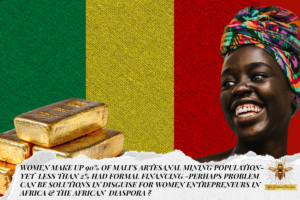
A World Bank assessment found that women represented approximately half of Mali’s artisanal mining workforce in some communities, with women performing as much as 90% of alluvial-gold panning.
Yet much of that labor was poorly paid or unpaid.
In some communities, women who recovered gold were expected to hand it over to husbands who controlled the household assets.
In Gold Mines in Mali, Women are participating in the production of wealth while frequently possessing very little control over it.
And that contradiction is precisely where opportunity begins.
The numbers tell a more uncomfortable story
Cowater International’s 2025 research through the FEMA project provides a remarkably current picture of women in Mali’s artisanal mining communities.
In Kéniéba, only 2% of women surveyed owned mining land, compared with 44% of men.
Only 2% of women had formal financing.
And women in gold trading could earn as much as seven times less than men. Seventy-two percent of women were excluded from decision-making, while only 10.6% held leadership positions. At first glance, these statistics look like evidence of failure. Look again.
This is also evidence of an unserved market.
Where women lack financing, there is an opportunity to create financing.
- Where women lack equipment, there is an opportunity to finance equipment.
- Where women lack land rights, there is an opportunity to support legal ownership and formalization.
- Where women cannot access profitable parts of the value chain, there is an opportunity to build businesses that move them upward.
- The problem is not the absence of women.
The problem is the absence of capital and control.
Imagine the mine differently
What if a woman from the African Diaspora in Atlanta, New York, London or Los Angeles looked at Mali’s gold industry and saw something other than a commodity?
What if she saw a potential partnership?
- A women-owned mining cooperative.
- A responsible gold-financing vehicle.
- A jewelry company sourcing traceable Malian gold.
- A processing facility.
- A women’s equipment fund.
- A jewelry manufacturing enterprise.
- A gold-backed artisan brand.
- A technology company improving traceability.
- A financial-services company providing working capital to women traders.
Suddenly, the question changes from: How much gold is in Mali?
to: How much value can women capture from the gold that is already there?
This is a far more interesting investment question.
From pit to necklace
Gold does not become valuable only when it comes out of the ground. There is an entire value chain after extraction.
- Mining.
- Processing.
- Assaying.
- Refining.
- Trading.
- Design.
- Manufacturing.
- Wholesale.
- Retail.
- Branding.
- Export.
The further a country moves up that chain, the more value it can potentially retain. This is particularly compelling when the final product is jewelry. Gold jewelry carries emotional value that exceeds the raw material.
A wedding bracelet is not merely a quantity of metal. It can represent marriage. Family. Status. Inheritance. Security. Tradition.
And across African cultures, gold jewelry can function as both adornment and a form of portable wealth. That creates an unusually interesting commercial proposition:
A women’s industry built around a product traditionally associated with women, marriage, beauty and wealth. Not exclusively. But powerfully.
The African American opportunity
For African American women, the opportunity is not necessarily to fly into Mali and purchase gold from whoever happens to offer it.
In fact, that would be precisely the wrong approach.
Responsible investment requires due diligence:
- Legal title.
- Traceability.
- Export compliance.
- Anti-money-laundering controls.
- Environmental standards.
- Security assessments.
- Independent assays.
- Transparent accounting.
- And reputable local partners.
Mali’s gold sector has significant informality and security challenges.
The government has been tightening regulation, and in February 2024 it prohibited exports of gold from artisanal and semi-mechanized mines as part of efforts to address informality, illicit financial flows and revenue collection.
For an investor, that sounds like a problem.
For an entrepreneur, it can also describe a market gap.
- Formalization requires services.
- Compliance requires professionals.
- Traceability requires technology.
- Responsible sourcing requires systems.
- Women-owned operations require capital.
Every obstacle creates a potential business around solving it.
Scale is the next frontier
Small artisanal operations cannot simply be expected to transform themselves into international businesses overnight.
- They need equipment.
- Training.
- Geological knowledge.
- Accounting.
- Cooperative structures.
- Access to buyers.
- Better safety.
- Insurance.
- Transportation.
- Storage.
- Digital payments.
- And access to formal credit.
Cowater’s FEMA project offers an intriguing example of what can happen when women organize. In Dialafara, women-led negotiations with village leaders resulted in a 57% increase in women’s mining-land ownership, while community savings groups have helped women pool resources and increase savings.
This suggests something important.
The solution may not be one wealthy investor arriving with a check.
It may be women building institutions together.
- African women on the ground.
- African Diaspora women supplying capital and international networks.
- Jewelry designers creating markets.
- Financial professionals building structures.
- Technology companies creating traceability.
- And consumers demanding ethically sourced African gold.
That is an ecosystem.
Gold with a conscience
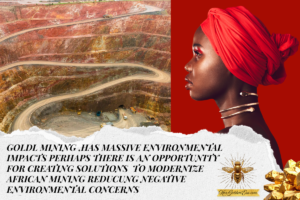
There is another opportunity here for Diaspora women, The future cannot simply be about extracting more.
Mali’s mining communities face environmental, social and governance challenges. Women also face safety concerns, limited land rights and exclusion from decision-making. Therefore, the most interesting investment thesis is not: “Let’s make money from Mali’s gold.”
It is: “Let’s create more value from Mali’s gold while ensuring more of that value remains with the people producing it.”
That distinction matters., Imagine a luxury jewelry brand whose gold can be traced back through a responsible supply chain to women-led mining communities.
The story accompanying every piece could tell consumers not only where the gold came from, but who benefited from its journey.
That is luxury with provenance.
But Mali is now attempting to rewrite the economics of its mining sector.
The country’s 2023 mining code increased the state’s participation in mining projects and expanded the share intended for Malian investors. Under the revised plan, the state has a free carried interest of at least 10% and can acquire an additional 20%, potentially taking state participation to 30%. New projects also face requirements that increase participation by Malian investors.
The philosophy is straightforward:
Mali wants more of Mali’s mineral wealth to remain in Mali.
The politics and economics, however, are complicated.
Foreign mining companies have argued that the revised rules increase costs and uncertainty. Mali’s dispute with Barrick over the Loulo-Gounkoto complex became one of the most dramatic examples of the tension between governments demanding a larger share of mineral wealth and multinational companies protecting their investments. The dispute was eventually resolved, but not before production was disrupted and confidence in the country’s investment environment was shaken.
Mali’s industrial gold production consequently fell sharply in 2025, to approximately 42.2 tonnes from 54.8 tonnes in 2024. Including artisanal production, total gold production was about 48.2 tonnes.
This creates an important observation for potential investors. Mali may offer enormous mineral opportunity.
But opportunity and investment accessibility are not the same thing.
For a Black woman looking at Mali from the diaspora, buying into a major mine is not a simple retail investment proposition. Political risk, regulatory changes, security concerns, capital requirements and the structure of Malian ownership all matter.
The more intriguing opportunity may lie further down the value chain.
THE WOMEN ALREADY WORKING THE GOLD
In Mali’s artisanal and small-scale gold mining sector, women have historically performed crucial economic roles—including processing, trading and other activities surrounding extraction.
Research has documented the different ways women participate in artisanal mining and the gender-specific barriers they face. The problem is not necessarily participation. It is ownership, capital and bargaining power.
Women can be indispensable to the production chain while capturing only a fraction of the wealth generated by it. That d matters enormously. The opportunity for the next generation of African women may therefore not be to replicate the traditional model of women doing the labour while men control the claims, equipment and trading relationships.
It may be to move up the value chain.
- From labourer to licensed operator.
- From processor to processing-company owner.
- From trader to formal aggregator.
- From miner to investor.
- From gold buyer to financier.
- From jewellery consumer to jewellery manufacturer.
- And eventually, from participant to shareholder.

GHANA: WHERE THE GOLD STORY IS MOVING FAST
If Mali represents a country aggressively renegotiating who owns the mineral economy, Ghana represents another fascinating experiment:
What happens when a major gold-producing country tries to bring more of the gold trade under national control?
Enter the Ghana Gold Board, or GoldBod.
Ghana established GoldBod as a central institution for the country’s gold trading and marketing system, with objectives including formalization, traceability, value addition and increasing the national benefit from gold.
The results have been extraordinary.
Ghana’s artisanal and small-scale mining sector produced a record 104 tonnes of gold in 2025, according to GoldBod, surpassing large-scale mining output for the first time. GoldBod said the sector generated nearly US$11 billion in foreign-exchange earnings, compared with approximately US$9 billion from large-scale mining.
And 2026 is on track to remain exceptionally strong.
GoldBod reported purchasing approximately 50–54 tonnes from the artisanal and small-scale sector during the first half of 2026 alone.
But Ghana is not stopping at buying gold.
It wants to capture more of the processing and refining value.
SEPTEMBER 1: GHANA’S GOLD STAYS HOME LONGER
This is the development that should make anyone interested in African commodities pay attention.
Beginning September 1, 2026, Ghana’s GoldBod will require gold doré purchased by self-financing aggregators for export to be refined in Ghana before export approval is granted.
GoldBod’s directive says export applications will only be processed after it confirms that the gold has been refined in Ghana, refining charges have been settled, and assay, regulatory and export requirements have been satisfied.
Why does that matter?
Because doré is not the end product.
If gold leaves a country as semi-refined doré and the final refining happens somewhere else, the country producing the gold is giving away part of the economic activity associated with that transformation.
Refining requires facilities.
Facilities require capital.
Capital creates companies.
Companies create jobs, technical expertise, logistics networks, laboratories, certification systems and financial services.
That means Ghana is attempting to move from:
“We have gold.”
to:
“We have a gold industry.”
And that is a profoundly different proposition.
WHERE COULD A BLACK WOMAN ENTER?
This is where the conversation becomes especially interesting for African American women and the wider African diaspora.
An American woman cannot simply arrive in Ghana and start buying gold from miners independently.
Ghana has tightened the rules around gold trading, and foreigners cannot operate as ordinary participants in the domestic gold-buying market. International participation instead occurs through regulated structures, including approved international offtakers and other investment opportunities within the GoldBod framework.
That sounds restrictive.
It is.
But restrictions can sometimes reveal where the serious opportunities actually are.
GoldBod is actively building a system around licensed participants, international offtakers, refining, traceability, financing and value addition.
For a sophisticated diaspora investor, the opportunity therefore isn’t necessarily:
“How do I buy gold?”
It may be:
“How do I own part of the infrastructure through which Ghana’s gold moves?”
That could include investment or partnerships involving refining infrastructure, technology, logistics, jewellery manufacturing, responsible sourcing, assay services, financial services or other businesses serving the formal gold ecosystem.
There is also an important distinction between investing in Ghana’s gold sector and buying physical Ghanaian gold.
The former can potentially be structured through legitimate investment vehicles, companies, partnerships or publicly traded securities.
The latter is heavily regulated.
And anyone considering an actual Ghana gold transaction should obtain Ghanaian legal, tax and regulatory advice rather than relying on a social-media “gold opportunity.”
There is another reason for caution.
In August 2026, Reuters reported that some Ghanaian gold buyers had experienced delays in receiving GoldBod funding. GoldBod disputed the characterization of this as a funding shortage and said financing was being allocated according to creditworthiness, security and risk assessments.
In other words:
This is a rapidly evolving market.
The opportunity is real.
So are the risks.
GHANA’S 30% GOLD QUESTION
There is another extraordinary development.
Beginning July 1, 2026, Ghana’s government reached an agreement under which GoldBod would purchase 30% of the gold output of large-scale mining companies in Ghana. The gold is purchased in doré form and forms part of Ghana’s broader strategy for building national gold reserves.
The objective is larger than simply selling gold.
Ghana is attempting to use its gold production as part of a national financial strategy.
Gold becomes not merely an export.
It becomes an asset on the country’s balance sheet.
That is a concept worth watching across Africa.
Because if African countries begin treating mineral resources not simply as things to extract and export, but as strategic assets that can support reserves, finance, industrialization and domestic capital formation, the implications are enormous.
AND THEN THERE IS TANZANIA
Tanzania is particularly interesting because the country already has something Ghana is trying to build in a different way:
a substantial gold mining ecosystem alongside a growing conversation about women’s participation.
Tanzania is one of Africa’s important gold producers, with major mining activity concentrated in regions including Geita, Shinyanga and Mara.
And women are already participating.
But, once again, participation is not the same thing as ownership.
Research on Tanzania’s mining sector has repeatedly identified barriers facing women, including access to land, capital, licensing, equipment and decision-making power. Tanzania’s mining laws permit women to own mining rights, but practical barriers can make ownership considerably more difficult.
That is precisely why Tanzania deserves attention.
The country has organizations such as the Tanzania Women Miners Association, while government and development organizations have increasingly focused on women’s access to formalization, safer mining, finance and greater participation across the mineral value chain.
And there are women who are already moving into ownership.
Government-linked reporting in 2026 highlighted women miners and the country’s efforts to increase women’s participation across the mineral value chain, while development programmes have trained hundreds of women miners in regions such as Geita.
So what could a woman do?
She could potentially participate through a licensed mining operation or cooperative, depending on eligibility and the specific licence involved.
She could invest in a Tanzanian mining company.
She could build a service business supplying licensed miners.
She could participate in processing.
She could work in environmental remediation.
She could provide geological, laboratory, financial, legal, technological or logistics services.
Or she could invest in the companies serving the mining ecosystem without ever stepping into a mine.
That last point deserves emphasis.
Mining is an industry.
It is not merely digging.
THE GOLD MINE IS NOT THE ONLY MINE
This may be the most important idea in the entire conversation.
When we say “women in mining,” we tend to imagine women standing at the edge of an open pit with a shovel.
That is the old picture.
The new mining economy is an ecosystem.
There are geological surveys.
Drone mapping.
Satellite monitoring.
Artificial intelligence.
Environmental monitoring.
Water management.
Equipment leasing.
Ore processing.
Laboratories.
Assaying.
Blockchain traceability.
Insurance.
Commodity finance.
Logistics.
Refining.
Jewellery manufacturing.
Export.
Data.
And increasingly, technology.
GoldBod itself has introduced a digital-tokenization initiative designed to convert physical gold into digital tokens for clients around the world.
This is precisely where the modern mineral economy begins to intersect with the technology economy.
WHY GOLD STILL MATTERS TO YOUR PHONE
Consider the device in your hand.
Gold’s electrical conductivity and resistance to corrosion make it useful in tiny but important electronic connections.
Your smartphone contains only a small quantity of gold.
Your laptop contains only a small quantity.
The same is true for many electronic devices.
But multiply that by billions of devices.
Then add servers.
Data centres.
Telecommunications infrastructure.
Automotive electronics.
Medical equipment.
Aerospace systems.
Satellites.
Navigation systems.
Sensors.
High-performance computing.
Artificial intelligence infrastructure.
And the picture changes.
Gold’s role isn’t necessarily about quantity.
It is about performance and reliability.
In high-value electronics, a microscopic amount of a material can be enormously important if that material allows a system to conduct electricity reliably under demanding conditions.
The World Gold Council’s 2026 data is particularly revealing because growth is no longer being driven only by traditional consumer electronics. AI infrastructure, advanced semiconductors, wireless systems, automotive technologies, LEO satellites, LiDAR and optical communications are contributing to industrial demand.
So when Africa exports gold, it is not merely exporting jewellery material.
It is exporting a raw material that ultimately participates in the infrastructure of the digital economy.
THE REAL AFRICAN GOLD QUESTION
This brings us back to Mali.
Ghana.
Tanzania.
Three countries.
Three different approaches.
Mali is demanding a larger national and local share of mining wealth.
Ghana is centralizing parts of the gold trade and pushing aggressively toward domestic refining and value addition.
Tanzania already has a large mining sector while working to increase women’s participation and ownership within it.
None of these systems is perfect.
Mali’s reforms have created significant tension with international miners and raised questions about investment risk. Ghana’s GoldBod system is still evolving and has already encountered liquidity and operational challenges. Tanzania continues to confront the structural barriers that prevent many women from turning participation into ownership.
But together they point toward something much larger.
Africa is beginning to ask a question that resource-rich countries around the world have been asking for decades:
Why should the country that owns the resource capture the smallest part of its value?
And Black women should be asking a parallel question:
Why should the women who live in, come from, invest in and consume products from Africa remain primarily consumers of its mineral wealth?
THE BLACK WOMAN’S GOLDEN OPPORTUNITY
There is no single “Black women’s gold investment.”
There is no magic licence.
There is no risk-free African mining deal.
And responsible investment requires serious due diligence.
But there is an emerging spectrum of possibilities.
At one end: buying gold as an investment.
Then: investing in publicly traded mining companies.
Then: investing in African businesses servicing mining.
Further along: financing equipment, processing, technology or logistics.
Then: partnering with licensed African companies.
Further still: investing in refining, manufacturing or mineral-processing infrastructure.
And at the most sophisticated level:
owning equity in companies positioned somewhere along the mineral value chain.
That is the shift.
From commodity to company.
From extraction to value addition.
From consumer to investor.
From gold jewellery to gold ownership.
AFRICA’S GOLDEN ERA?
For generations, the phrase “African gold” conjured images of colonial extraction.
The gold came out.
The wealth went elsewhere.
The pattern was brutally simple.
But the continent is not standing still.
Mali is renegotiating ownership.
Ghana is building a more centralized gold market and insisting that more refining happen at home.
Tanzania is confronting the barriers that have historically kept women from owning more of the mineral economy.
And across all three countries, the conversation is gradually moving from how much gold can be extracted to how much value can be retained.
That is the conversation Black women need to enter.
Not as tourists.
Not merely as jewellery buyers.
Not as spectators watching another generation of foreign investors discover Africa.
But as entrepreneurs.
Financiers.
Engineers.
Geologists.
Lawyers.
Technology founders.
Commodity traders.
Manufacturers.
Shareholders.
And investors.
Because the gold beneath Africa’s soil belongs to African nations.
But the companies, technologies, financial systems and value chains built around that gold are opportunities that can be created, financed and owned.
The future question is therefore not whether Africa has enough gold.
It clearly does.
The question is whether Africa can build enough African ownership around it.
And whether Black women—on the continent and across the diaspora—will be sitting at the table when that wealth is being created.
Gold has spent thousands of years decorating the world’s women.
Perhaps Africa’s next golden era will be about something more consequential:
women owning the wealth behind the gold.